
NY, New England Blocking Pipes Causes Environmental Destruction

The leftists who run states like New York and Massachusetts are arrogant snobs. And pretty stupid to boot. They pretend (maybe even believe) they’re saving the planet by blocking natural gas pipelines into and through their respective states. Like most faulty leftist thinking, they actually make the problem worse–they are harming the planet–with their policies and actions. How? A guest post by attorney Dan Markind (Flaster Greenberg PC) explains.
Read More “NY, New England Blocking Pipes Causes Environmental Destruction”
 Would you feel better if a driller building a shale well pad near your home was “green certified”? Meaning the company has been reviewed and certified by an independent agency for evidence that company adheres to strict environmental standards as it drills. Researchers at Indiana University’s School of Public and Environmental Affairs set out to answer that question–and they found public opinion of shale drilling would greatly improve if such a “green certification” were in place.
 MARCELLUS/UTICA REGION: Ohio Utica permits go up, Pennsylvania Marcellus permits go down; Hilcorp eyes two new wells in Columbiana County; Is Westchester already experiencing a natural gas shortage?; NY AG refuses to comply with Exxon discovery requests in defiance of judge’s ruling; Encino well pad in Ohio named after deceased college student; OTHER U.S. REGIONS: The world’s biggest shale field is on the brink of an M&A boom; NATIONAL: Look to U.S. for reliable, ‘cleaner’ fossil fuels, says EPA chief; Green New Deal: Money and Jobs (video); The rise of U.S. feedgas demand in 2019; Pompeo says energy abundance can mean national security; CEOs call for investments to grow shale in North America; Court: Directional drilling engineers can be independent contractors; INTERNATIONAL: OPEC Secretary General Barkindo wants to find the secret behind US shale’s success.
 The Ohio Dept. of Natural Resources (ODNR) issued fourth quarter 2018 numbers for Utica shale oil and gas production yesterday, and wow! Both natural gas and oil production rocketed upward. Natgas production was up 32% over the same period last year, to a new all-time high of 663.5 billion cubic feet (Bcf), and oil production hit 5.8 million barrels, up 39% over last year’s 4Q.
 Diversified Gas & Oil has been on a mission to buy as many non-shale (conventional) oil and gas wells as it can in the Appalachian Basin. It owns over millions of acres and tens of thousands of wells–many of them located in Pennsylvania. Last fall the PA Dept. of Environmental Protection (DEP) told Diversified it wants 1,000 of its nonproducing wells plugged in the next five years. Diversified countered it would like to plug 2,000 wells, but over the next 20 years. They ended up compromising.
 West Virginia has the right idea. Their legislature meets for 60 days total at the beginning of each new year, and then they’re pretty much done for the year. Go to Charleston, work hard, then leave and go back to your day job. Part-time legislators. Love it! The 2019 session is now done and dusted. In the closing days of the session, two bills to help the oil and gas industry got passed and now wait for Gov. Jim Justice to sign them. However, one very important bill for the industry did not pass.
 Ever notice how predators like to hunt in packs? First the Chester County, PA District Attorney launched an ethically questionable “investigation” into “crimes” that may have been committed by building the Mariner East pipelines through his county (see
  Two weeks ago MDN told you that New Jersey radicals had succeeded in scuttling a plan to convert an old coal-fired electric plant into using natural gas (see
  Last September MDN told you that a new natgas-fired electric plant planned for the People’s Republic of Rhode Island in Burrillville was on life support, with antis reaching to pull the plug (see
  Cue the dramatic music, cameras pan on the audience (audience members wearing freakish costumes). It’s time for the beginning of the Natural Gas Hunger Games. We have two contestants: New England and the Canadian Maritimes. Only one will survive and have access to barely enough natural gas to sustain life. Which will it be? Re-cue dramatic music with drums…
 Did Williams just float an alternative/competitive pipeline to PennEast? Sure looks that way to us. On Friday Williams announced a binding open season to add 34 miles of looping pipeline next to existing Transco pipeline along with beefing up some of it’s compressor stations, in a bid to increase flows along the Transco from Luzerne County, PA (where PennEast would originate) to Mercer County, NJ (where PennEast would terminate).
 As we keep pointing out, PTT Global Chemical, the company that says they want to build a $6 billion ethane cracker plant complex in Belmont County, OH, keeps hinting that a “final investment decision” (FID) will come soon. Any day now. Just around the corner. They’ve been saying it for nearly two years.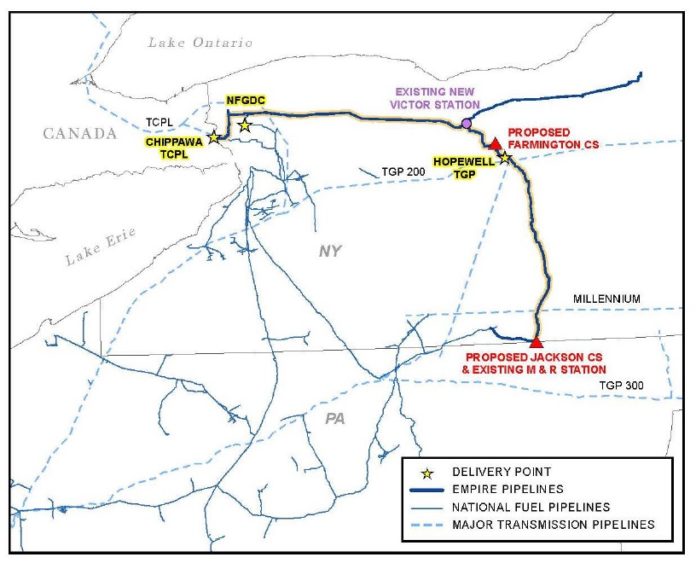
 Anti-fossil fuelers are once again riding their high horse “demanding” that the Municipal Authority of Westmoreland County block any more shale drilling on county-owned property located near Beaver Run Reservoir. Even though CNX’s shale drilling has been going on there since 2011 with zero impacts on the reservoir and its water supply.
 Last Friday MDN reported that Encino Energy CEO Hardy Murchison and COO Ray Walker (formerly of Range Resources) spoke at the Ohio Oil & Gas Association (OOGA) 72nd Annual Meeting in Columbus (see