
Southwestern Energy Wins Major PA Case re Rule of Capture/Trespass
 We believe this is the end of the legal road for the Briggs family’s lawsuit against Southwestern Energy (now part of Expand Energy) in a case that centers on whether hydraulic fracturing constitutes a trespass if it forces gas from a neighbor’s property, even if no fluid enters that neighbor’s specific property layer. In January 2020, the Pennsylvania Supreme Court ruled in favor of Southwestern, retaining the “rule of capture” in the Keystone State (see HUGE NEWS: PA Supreme Court Keeps ‘Rule of Capture’ for Fracking). In 2022, the Briggs family filed an amended complaint, call it “Briggs 2,” along the same lines, alleging that Southwestern’s drilling and fracking on a neighboring property had intruded (“trespassed”) under the property line, draining gas from the Briggs property and injecting PFAS “forever chemicals” under their land (see Briggs v SWN Rule of Capture/Trespass Court Case Resurrected). Read More “Southwestern Energy Wins Major PA Case re Rule of Capture/Trespass”
 On February 2, 2026, Devon Energy and Coterra Energy announced a landmark $58 billion all-stock merger, creating a “Super-Independent” energy producer targeting the AI-driven surge in power demand (see
  In July 2024, EQT Corporation closed on a $5.4 billion deal to buy back the midstream division it had spun off in 2018 (see
  Caturus has reached major milestones in its “wellhead-to-water” strategy, finalizing customer offtake agreements (new customer signups) for its $12.5 billion, 9.5 MTPA Commonwealth LNG project in Louisiana. This commercialization milestone paves the way for imminent project financing and a final investment decision (FID) in the coming weeks. Key international partners, including EQT LNG Trading, Glencore, Mercuria, PETRONAS, and Aramco Trading Americas, have signed long-term Sale and Purchase Agreements.
 A decision issued by the Pennsylvania Commonwealth Court has helped to rein in attempted lawfare (the abuse of our judicial system) by an anti-fossil fuel group in southwestern PA. Protect PT, a group we’ve covered many times in the past, tried to assert “standing” (the right to sue) in a case involving an EQT well pad that needed to be moved by 178 feet from its original location. The local zoning board was happy to give the antis “standing” in their hearings, but when Protect PT didn’t like the board’s decision, they tried to appeal it to a court. The trial court told Protect PT the group didn’t have standing under the very specific requirements of the law.
  The Marcellus/Utica region received a combined 19 new drilling permits last week, Mar. 23 – 29, up 8 from the 11 permits issued two weeks ago. Pennsylvania issued 4 of the permits. Ohio issued no new permits. And, West Virginia issued 15 new permits last week. The drillers who received new permits last week included EQT, Expand Energy, and Range Resources.
  On Tuesday, seven radicalized Big Green groups filed a court challenge to the Federal Energy Regulatory Commission’s (FERC) authorization for Mountain Valley Pipeline, LLC, to construct the MVP Southgate gas pipeline. The petition for review, filed by the Southern Environmental Law Center (SELC), Appalachian Mountain Advocates, and Sierra Club in the United States Court of Appeals for the District of Columbia Circuit (DC Circuit), asks the court to vacate the amended certificate of convenience and public necessity issued by FERC in December 2025.
  Upper Burrell residents (Westmoreland County, PA) recently received notifications from consulting firm Verdanterra regarding upcoming surveying for natural gas lateral wells. These horizontal wells will be drilled from EQT’s Hermes well pad in neighboring Murrysville (also in Westmoreland County), following EQT’s recent acquisition of Olympus Energy. While Township Supervisor Chairman Ross Walker described the process as a standard, “innocuous” procedure conducted by foot without land disturbance, the project highlights the increasing length of well laterals in the Appalachian region.
 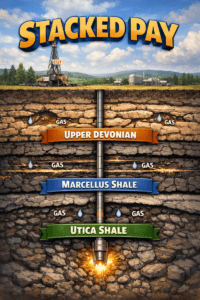 EQT is leveraging its position as the largest natural gas producer in the Marcellus/Utica (second largest in the country) to transition from a “single-target” driller to a “multi-bench” developer. The company aims to drill in more of the M-U’s “stacked pay zones.” What are the zones (layers) that EQT will target in addition to the Marcellus? And where is it experimenting with stacked pay zones right now?
  Epsilon Energy, a relatively small company, used to concentrate most of its effort on developing Marcellus Shale wells. However, over the past few years, the company has expanded into other plays and now owns assets in the Anadarko (Oklahoma), the Permian (Texas), the Powder River Basin (Wyoming), and the Western Canadian Sedimentary Basin (in Alberta, Canada). In the Marcellus, Epsilon does not do its own drilling. It is a joint venture partner with (gives money to) Expand Energy, and Expand does the drilling in the Marcellus. Epsilon issued its latest quarterly update yesterday, discussing what’s on the docket for 2026. And, what’s on the docket is that Expand plans to drill five new wells this year on Epsilon’s leased acreage in northeast Pennsylvania.
  Some more high finance stuff to share—but hang tight, there is a point. EQT Corporation announced the pricing and accepted amounts for the buyback of up to $1.4 billion in eight series of outstanding senior notes (IOUs) maturing between 2027 and 2031. The primary motivation for this action is debt reduction and balance sheet management. EQT is getting financially healthier and stronger by getting rid of debt. That’s the point.
  We just happened across another XTO Energy lawsuit in which leased landowners sued over post-production deductions being taken from their royalty checks. Salvatora v. XTO Energy Inc. is a pivotal Pennsylvania case tackling the messy business of natural gas royalties. Western Pennsylvania landowners from Mercer and Butler counties sued XTO, arguing the company unfairly deducted “post-production costs”—like compression and transport—from their checks. The core debate hinged on “at the wellhead” lease language.