
NRG Receives Final OK to Acquire LS Power’s Gas-Fired Power Plants
 Last May, NRG Energy announced a deal to acquire LS Power’s portfolio of natural-gas power plants in a deal valued at roughly $12 billion, including debt, that will expand NRG’s footprint in Texas and along the East Coast (see NRG Buys 18 Gas-Fired Power Plants, Including 5 in PA, for $12B). The acquisition will add 18 more natural-gas-fired facilities in nine states, including five in Pennsylvania and one in Ohio, doubling NRG’s generation capacity to approximately 25 gigawatts (GW). NRG announced yesterday that it has received antitrust clearance from the U.S. Department of Justice (DOJ), the last hurdle before the deal can close. Read More “NRG Receives Final OK to Acquire LS Power’s Gas-Fired Power Plants”
 Last April, Knighthead Capital Management, Homer City Redevelopment (HCR), and Kiewit Power Constructors Co. announced a plan to convert the former Homer City Generating Station, previously the largest coal-fired power plant in Pennsylvania (Indiana County, 50 miles east of Pittsburgh) into a more than 3,200-acre natural gas-powered data center campus, designed to meet the growing demand for artificial intelligence (AI) and high-performance computing (see
  Last Friday, the Trump administration officials joined several governors from the 13 states that are part of the PJM Interconnect grid to outline a broad plan they say will ensure customers of the grid will not face skyrocketing electric prices due to new AI data centers getting built in the region (see
  As data center operators have sought rapidly deployable power sources for their facilities, some have turned to companies that modify jet engines for commercial power generation. Data center facilities in Texas have recently deployed modified jet engines as generators, each with 48 megawatts (MW) of generating capacity. There’s a whole “graveyard” of retired military aircraft at the U.S. Air Force’s facility on Davis-Monthan Air Force Base in Arizona, called the Boneyard. Could the old/retired jets at the Boneyard be repurposed to power data centers? Quite possibly!
  On Friday, the White House joined with the 13 governors whose states in whole or in part are served by the PJM Interconnection electric grid, the largest grid in the country, to propose a solution that “protects consumers” from soaring electric rates due to the addition of new AI data centers (see
  As MDN reported, on Friday, the Trump administration officials joined several governors from states that are part of the PJM Interconnect grid to outline a broad plan they say will ensure customers of the grid (the country’s largest grid), will not face skyrocketing electric prices due to new AI data centers getting built in the region (see
  Wow, talk about strange bedfellows! On Friday, the White House joined the 13 governors whose states in whole or in part are served by the PJM Interconnection electric grid, the largest grid in the country, to propose a solution that “protects consumers” from soaring electric rates due to the addition of new AI data centers. While some of the ideas discussed were good, others (such as an anti-capitalist price cap) were not. We’ll explain.
  The U.S. Energy Information Administration (EIA) predicts U.S. electricity generation will reach 4,423 billion kilowatthours by 2027, driven by steady annual growth. That’s up 3.7% from 4,260 billion KWH in 2025. While natural gas remains the primary power source, its market share is slipping alongside coal, which is declining 5% annually due to plant retirements. Dispatchable (on-demand) sources of electricity generation (natural gas, coal, and nuclear) accounted for 75% of total generation in 2025, but EIA expects their share to fall to about 72% in 2027. EIA expects the combined share of generation from solar and wind power (unreliable renewables) to rise from about 18% in 2025 to about 21% in 2027. Renewables are still minuscule compared to dispatchable natural gas and coal—which is as it should be if you care anything about energy security.
  At the end of November, Talen Energy, a leading energy producer in the U.S. (owns and operates approximately 13.1 gigawatts (GW) of power infrastructure) completed the acquisition of two gas-fired power plants for $3.8 billion: one located near Wilkes-Barre in northeastern Pennsylvania, and the other in Guernsey County, in eastern Ohio (see
  Last October, the Maryland Public Service Commission (PSC) accepted applications for large-scale power projects, also known as “dispatchable” generation, that can provide energy quickly during periods of peak demand under the state’s Next Generation Act (see
 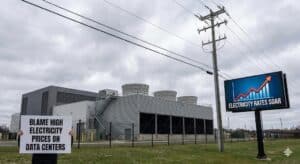 Data center forecasts — beyond existing data centers — made up 45% of the $47.2 billion in capacity costs in PJM’s last three capacity auctions, according to a report by Monitoring Analytics, PJM’s so-called independent market monitor. Data center load accounted for $6.5 billion, or 40%, of the $16.4 billion in costs from the PJM Interconnection’s December capacity auction (the most recent auction). PJM’s market monitor directly and unequivocally blames new data centers for higher electricity prices, instead of putting the blame where it really belongs: On Democrat governors who have restricted new gas-fired power plants.
  Despite claims by anti-fossil fuelers that the Tenaska Westmoreland Generating Station in southwestern PA would spread disease and death if built, it’s been up and running since 2018, producing power and generating revenue for both its builders and the community. Oh, and everyone is in good health. However, the plant has been operating under a state permit since it opened. It needs a federal Title V permit for long-term operation. The state Department of Environmental Protection (DEP) is the agency that issues such a permit and is proposing to do so, which (of course) has antis’ knickers in a twist (see
  Another new (to us) pipeline project in the Southeast with the potential to flow Marcellus/Utica molecules. We recently became aware of Enbridge’s Texas Eastern Line 31 Expansion Project. The project is designed to expand the capacity of the Texas Eastern (TETCO) interstate natural gas system in Madison County, Mississippi. The current proposal (not yet officially filed with FERC) includes approximately 10.2 to 11.5 miles of 36-inch-diameter pipeline looping, a 1.7-mile delivery lateral, and the construction of the new Ridgeland Compressor Station. The project is expected to provide between 125,000 and 160,000 dekatherms per day (Dth/d) of additional natural gas transportation capacity, primarily intended to serve Entergy’s proposed Ridgeland Advanced Power Station (gas-fired power station) in Madison County.