
Electrical Generation | Energy Services | Industrywide Issues | Kinder Morgan | Litigation | Pipelines | South Carolina
SC Landowners Attempt Class Action to Oppose Elba Express Pipe
 A new wrinkle to report in the case of a South Carolina pipeline, the Elba Express Pipeline, and its quest to build an extension to a gas-fired power plant in Colleton County. In June, we told you that Kinder Morgan, the builder, had been forced to sue some 55 (of the 185) landowners along the proposed route to allow simple access to their property for a survey (see Kinder Morgan Forced to Sue SC Landowners for Pipe Survey Access). Now comes word that the reluctant landowners are suing back and asking the court to grant class action status to their lawsuit. Read More “SC Landowners Attempt Class Action to Oppose Elba Express Pipe”
 Diversified Energy and real estate firm Maverick Holdings have secured an option on 100 acres at Letcher County’s Gateway Industrial Park near Jenkins, aiming to use an existing natural gas compressor station to fuel an off-grid, 100-megawatt power plant that could attract data centers or manufacturers. The Appalachian Industrial Development Authority signed an 18-month joint development agreement in March, though some board members were asked to sign NDAs. Local officials remain cautiously optimistic, citing potential tax revenue and infrastructure funding, but stress the project is still in early, unproven stages.
  Despite claims by anti-fossil-fuelers that the Tenaska Westmoreland Generating Station in southwestern PA would spread disease and death if it were built, it’s been up and running since 2018, producing power and generating revenue for both its builders and the community. Oh, and everyone is in good health. However, the plant has been operating under a state permit since it opened. It needs a federal Title V permit for long-term operation. The state Department of Environmental Protection (DEP) issues such a permit. Good news! The DEP recently issued the Title V permit for this power plant.
  In February, FirstEnergy subsidiaries Mon Power and Potomac Edison announced they had selected a 35-acre site in Maidsville (Monongalia County), West Virginia, for a new 1,200-megawatt natural gas power plant (see
  In May, Dominion Energy announced plans to construct a multibillion-dollar, 3-gigwatt (GW) combined-cycle natural gas power plant in Cumberland County to address the state’s rapidly increasing electricity demand, particularly from data centers (see
  In June, members of the South Carolina Public Service Commission (PSC) approved a revised project proposal to build a 1,020-megawatt (MW) gas-fired power plant in the state’s Lowcountry, in Colleton County (see
  Here’s a new gas-fired power plant project not previously on our radar. Beaufort Rosemary, a Virginia-based company, wants to build a 500-megawatt (MW) dual-fuel natural gas and propane power plant on 50 to 80 acres of land in Bethune, South Carolina, in Kershaw County. Officials say the project would bring more than $900 million in economic impact, hundreds of construction jobs, and 15 to 20 permanent jobs once fully operational. After hours of public debate, Kershaw County Council voted 4-3 Tuesday night to approve a 40-year tax incentive deal.
  Northeastern states outside established data center hubs are positioning for major growth that could reshape regional natural gas demand. Surprisingly, blue state Maryland is emerging as a secondary data center hub, supported by large hyperscale projects, new gas-fired generation, and transmission upgrades. Delaware is constrained by coastal regulation, while Massachusetts, Connecticut, and even the Communist state of Rhode Island are seeing proposals (although there is stiff opposition in all of those states). Maine is weighing large-load rules as a mill conversion advances, and New Hampshire and Vermont remain limited.
 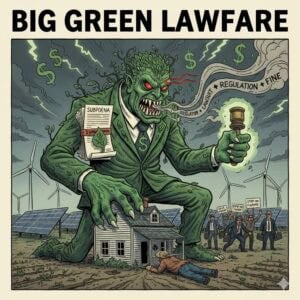 Over the years, we have chronicled the far-left Chesapeake Bay Foundation’s (CBF) lawfare against fracking, gas-fired power plants, and pipelines (
 In April, MDN reported that PowerTransitions, an independent power producer specializing in redeveloping legacy power facilities, had agreed to acquire five New York gas-fired power plants — Batavia, Hillburn, Massena, Shoemaker, and Sterling — totaling 323 megawatts (MW) from Alliance Energy Group affiliates (see
  In February, MDN alerted you to yet another gas-fired power plant project that Williams (the pipeline giant) was adding to its roster. Williams entered the gas-fired power plant space (actually building and operating them) in April 2025 via a subsidiary called Will-Power (see
  Northampton Capital Partners, a middle-market infrastructure asset manager with roughly $1.4 billion under management, has partnered with New Jersey–based Olympus Power to form a joint venture called Winslow Power. Winslow has agreed to acquire three natural gas–fired power plants totaling 752 MW from a Vistra Corp. subsidiary: the 541-MW Casco Bay combined-cycle facility in Veazie, Maine; the 108-MW Beaver Falls dual-fuel turbine in Croghan, NY; and the 103-MW Syracuse dual-fuel turbine in Solvay, NY. Pending regulatory approval, the deal is expected to close later in 2026. And yes, there is a Marcellus/Utica connection in this story.
  Chestnut Run Energy plans to construct a $2 billion natural gas-powered electric power plant in Carroll County, Ohio, capable of powering up to 900,000 homes (see