
Ohio Judge Adds $28M in Fines Against Austin Master Services
 One of the significant stories of 2024 in the Ohio Utica was about Austin Master Services (AMS), a radiological waste management solutions company in Martins Ferry, Ohio, that processes and transports fracking waste for disposal. AMS ran into trouble when it ran out of money. The Martins Ferry facility in Belmont County, where waste is temporarily stored, had vastly exceeded its permitted limit of 600 tons (storing over 10,000 tons), resulting in a permit violation. The Ohio Attorney General’s office filed a lawsuit against the company in March 2024 to compel compliance and require the company to clean up the facility. After the company didn’t perform, the Ohio Department of Natural Resources (ODNR) stepped in to handle the cleanup (see Austin Master Services Ohio Frack Waste Cleanup Complete Today). The AG’s office sued for $6 million to cover the cost of cleanup, and last November, a Belmont County court ruled in favor of the state (see Ohio Judge Rules Against Austin Master Services for $6.2 Million). The judge has just issued a second ruling imposing a $ 10,000-per-day fine for the time the facility was out of compliance. It adds up to another $28+ million. Read More “Ohio Judge Adds $28M in Fines Against Austin Master Services”
 In August, the parents of four children under the age of 18 (from three families) filed a lawsuit on their kids’ behalf against EQT subsidiaries EQT Production Company and EQT XL Midstream Operating, claiming that emissions from a nearby compressor station and nearby shale wells operated by EQT have led to severe health-related problems for the kids (see
  In 2015, a group of landowners in northeastern Pennsylvania who had leased their land for fracking filed a lawsuit against Chesapeake Energy, Anadarko, Statoil (now Equinor), Mitsui E&P, and Access Midstream (later bought by Williams), alleging the companies had improperly deducted post-production costs (e.g., gas gathering and transportation expenses) from royalties owed to the landowners in breach of their respective leases. The lawsuit also alleged collusion and conspiracy to defraud the landowners (antitrust violations). The lawsuit was on hold for many years while other lawsuits played out. In 2024, a federal court in Scranton unpaused the lawsuit, and the judge ruled, tossing out the landowners’ royalty claims (see
  Iroquois Gas Transmission’s Enhancement by Compression (ExC) project would increase horsepower at three compressor stations — two in New York and one in Connecticut — by an extra 125 MMcf/d, to flow more Marcellus/Utica gas into New York City and New England. The two NY compressors are in Dover and Athens. The CT compressor is located in Brookfield. In September, we told you that the Sierra Club paid for a fake study bashing the Connecticut portion of the project (see
  An interesting case in Ohio deals with whether or not natural gas can be taxed, depending on how it’s used. The Ohio Board of Tax Appeals ruled on Tuesday, January 6, that MGQ Terminal, Inc. is exempt from use tax on natural gas purchases used to process asphalt to customer specifications. Although Tax Commissioner Patricia Harris had assessed use tax for the period between 2013 and 2016 based on the determination that the company was engaged in a storage business, the board reversed this decision, finding that the company’s activities qualify as tax-exempt “manufacturing operations.” The board held that MGQ’s use of natural gas to heat, agitate, and blend refinery waste into homogeneous, specification-compliant products constitutes a transformative manufacturing process rather than mere storage.
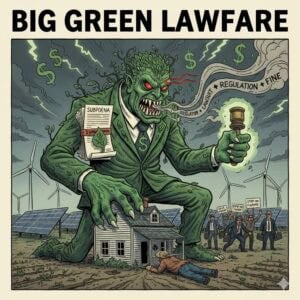
  Big Green grifters from the environmental left have struck out in their attempts to shut down fossil energy and replace it with their own preferred energy sources by appealing to legislators and the general public. So they’re doing the only thing they have left: Launch a blizzard of lawsuits against oil and gas companies, hoping to tie them up for decades (using Democrat judges), or possibly even winning a few cases to further fund their nefarious activities. Bloomberg reports that Big Green is increasing its litigation pace in 2026. Time to shut them down in their efforts.
  In November, Pennsylvania finally passed a budget—four months late. As part of the deal struck between Democrats and Republicans, the Regional Greenhouse Gas Initiative (RGGI) carbon tax scheme was permanently ash-canned (see
  The Ohio Tax Commissioner is facing a lawsuit from Rover Pipeline over an aggressive property tax assessment that inflates the project’s market value. The dispute centers on the state treating $2.2 billion in weather-related construction overruns and an unrealistic “infinite lifespan” assumption as value-adding assets. Critics argue that this approach violates constitutional principles of fair market valuation, under which taxes should reflect what a willing buyer would pay rather than total development costs.
  In April, Knighthead Capital Management, Homer City Redevelopment (HCR), and Kiewit Power Constructors Co. announced a plan to convert the former Homer City Generating Station, previously the largest coal-fired power plant in Pennsylvania (Indiana County, 50 miles east of Pittsburgh) into a more than 3,200-acre natural gas-powered data center campus, designed to meet the growing demand for artificial intelligence (AI) and high-performance computing (see
  In April, Knighthead Capital Management, Homer City Redevelopment (HCR), and Kiewit Power Constructors Co. announced a plan to convert the former Homer City Generating Station, previously the largest coal-fired power plant in Pennsylvania (Indiana County, 50 miles east of Pittsburgh) into a more than 3,200-acre natural gas-powered data center campus, designed to meet the growing demand for artificial intelligence (AI) and high-performance computing (see
  Pipelines in West Virginia (like most other states) pay property taxes. It’s a significant revenue generator for counties. There are many pipelines in Wetzel County, including three NGL pipelines owned and operated by MarkWest (aka MPLX) that connect to the Mobley Gas Plant. In 2022, MarkWest filed a tax return for the pipelines showing a 35% reduction in value due to less-than-forecasted pipeline usage, a concept called “economic obsolescence based on inutility.” The County Assessor for Wetzel County challenged MarkWest’s claim.
  Congressman Troy Balderson (R-OH) and Senator Tom Cotton (R-AR) have introduced a bill that is critical to correcting a long-standing abuse of our justice system. The Curtailing Litigation Excess and Abuse Reform (CLEAR) Act of 2025 will streamline American energy infrastructure projects. The legislation targets “serial litigation” by activist groups, ensuring that once a court rules on a project, opponents cannot repeatedly delay it through additional legal battles. By limiting these indefinite delays while still preserving environmental protections, the bill aims to restore investor certainty, lower energy costs, and support national goals regarding AI competitiveness and grid reliability. The bill balances accelerated construction with legitimate oversight.
  A couple of weeks ago, we told you that a pending lawsuit had stalled the implementation of the All-Electric Buildings Act (passed in 2023), which was supposed to require that any new home or business being built in New York could not (by law) connect to natural gas (see
  This is really rich. Venture Global (VG), now the second-largest LNG (liquefied natural gas) exporter in the U.S., is accusing Shell of waging a “three-year campaign” to damage VG’s LNG business. VG’s Calcasieu Pass (CP) LNG export facility in Louisiana began operations in March 2022. Typically, a new LNG facility will load and ship several (maybe two or three) cargoes to “work out the kinks” and ensure everything is working as advertised. VG, using loopholes in its signed contracts, maintained that it was working out the kinks long after it began shipping. After *hundreds of cargoes* were shipped, CP’s customers were still not receiving their contracted (at lower prices) shipments. Shell, along with several other customers, sued (see
  One of the significant stories of 2024 in the Ohio Utica was about Austin Master Services (AMS), a radiological waste management solutions company in Martins Ferry, Ohio, that processes and transports fracking waste for disposal. AMS ran into trouble when it ran out of money. The Martins Ferry facility in Belmont County, where waste is temporarily stored, had vastly exceeded its permitted limit of 600 tons (storing over 10,000 tons), resulting in a permit violation. The Ohio Attorney General’s office filed a lawsuit against the company in March 2024 to compel compliance and require cleanup of the facility. The Ohio Department of Natural Resources (ODNR) stepped in to handle the cleanup. As of May 2025, cleaning and testing were completed (see
  In May, pipeline giant Williams filed a request with the Federal Energy Regulatory Commission (FERC) to expedite the reissuance of a certificate for the Northeast Supply Enhancement (NESE) project, a $1 billion+ project designed to increase Transco pipeline capacity and flows of Marcellus gas heading into New York City and other northeastern markets (see