
Update on N.C. Pipe Deathmatch: Transco SESE vs. MVP Southgate
 Two pipeline kingpins are engaged in a deathmatch with the Federal Energy Regulatory Commission (FERC) to get their competing pipeline projects approved. One is Williams’ Transco Southeast Supply Enhancement Project (SESE), the other is EQT’s MVP Southgate project. Both projects would be built in the same general area, starting at the same point near Chatham, Virginia, and ending near Eden, North Carolina. Both claim they have customers ready to take their gas. In a July FERC filing, Williams said that its project could easily handle Southgate MVP’s capacity by adding meter tubes and regulation at an existing station (see Williams’ Transco Tries to Muscle Out MVP Southgate in FERC Filing). EQT was not pleased with the attempt to undercut Southgate. However, since that time, MVP Southgate appears to have the regulatory momentum. Read More “Update on N.C. Pipe Deathmatch: Transco SESE vs. MVP Southgate”
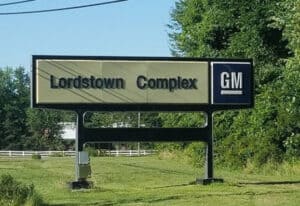 Lordstown is a small village in southern Trumbull County, Ohio (population 3,332). The village has one operational gas-fired power plant, the Lordstown Energy Center, generating 940 megawatts (MW) of electricity. A second gas-fired power plant, the Trumbull Energy Center, is under construction and due to come online in 2026. It will generate 950 MW of electricity. Developers are proposing to build a $3.6 billion, 1.65 million square-foot data center campus in Lordstown on the site of the former GM complex (south of OpenAI’s Stargate AI data center campus). The developers filed a petition with the Ohio Supreme Court against Lordstown, claiming the village is blocking consideration of their proposal in violation of zoning procedures.
 We first told you about a frac sand company called Smart Sand some 13 years ago (see
  Freeport LNG has become something of a punchline for the frequent outages at the facility. Except, it’s no laughing matter. Outages at Freeport have happened so frequently that we’ve lost count. Last Thursday, one of the three LNG trains at the facility was offline again, affecting gas flows to (and from) the facility. According to a Reuters report, the gas restarted flowing to the affected train on Friday. Freeport refused to comment on this latest outage.
  Last week, the Baker Hughes U.S. national rig count gained rigs for the third week in a row. The national count increased by five rigs, rising from 549 to 554. The BH rig count has added rigs in five of the last six weeks. Rigs in the Marcellus/Utica gained a rig! Pennsylvania gained one Marcellus rig, bringing its total to 18. Ohio was the same at 13 rigs. And West Virginia maintained its 7 rigs, which it has operated since May 30 (26 weeks in a row). There were 24 rigs targeting the Marcellus and 14 targeting the Utica, for a combined 38 rigs in the M-U.
  Overwatch Capital and Japanese company Idemitsu Kosan Co., Ltd. have formed a strategic partnership to develop high-density, energy-resilient AI data centers across ten U.S. states. This collaboration involves Idemitsu investing in Overwatch and supplying up to 1 gigawatt of natural gas for on-site power generation to support next-generation AI computers. The initiative leverages Overwatch’s SIDE Platform, which integrates generation, battery storage, and advanced cooling, alongside Idemitsu’s global energy expertise. Initial projects are set to begin in 2026 in Dallas-Fort Worth and Columbus, Ohio, to provide reliable infrastructure for hyperscalers and cloud providers.
 Planette, a long-range weather prediction platform that combines cutting-edge AI with decades of Earth system science, says it can predict long-range weather more accurately than others. Planette’s Winter 2025-26 forecast anticipates a highly volatile season driven by a North Pacific dual ocean temperature “blob” and a weakened polar vortex, deeming the current La Niña too weak to be significant. The outlook predicts above-average temperatures interrupted by multiple, predictable, and “significant” cold snaps, with the AI-driven platform offering 30- to 40-day lead times to warn people of their approach. If you’ve been paying attention to MDN’s posts this week, you know how significant weather is in determining the price of natural gas.
  I see ghosts! Or is that dead people? The U.S. electricity grid faces pressure from surging demand, primarily from data centers, sparking debates over reliability and cost allocation. EPSA (Electric Power Supply Association) CEO Todd Snitchler warns that “ghost projects”—projects announced and planned/funded but never built—are artificially inflating load forecasts. He argues that regulated utilities use these overstated numbers to justify expensive rate-based generation, benefiting shareholders while forcing customers to bear the costs of potential overbuilding. Competitive energy markets are demanding accurate, data-driven planning to maintain affordability and reliability without wasting capital on unnecessary infrastructure. Please, no more ghosts.
 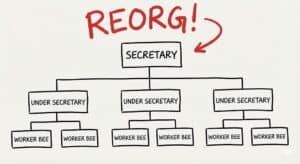 Reorg! The Department of Energy (DOE) unveiled a major reorganization under the Trump administration to prioritize fossil fuels, minerals, and nuclear power while diminishing renewable energy programs. Secretary Chris Wright’s plan rebrands the loan program as “Energy Dominance Financing” and consolidates efficiency and clean energy divisions into a new “Office of Critical Minerals and Energy Innovation.” This restructuring, aimed at restoring “common sense” to energy policy, accompanies billions in project cancellations and staff reductions.
  Bloomberg writes that shale energy’s next revolution should worry the thug dictators of OPEC. American shale drillers currently extract 10% to 15% of the oil locked in the shale layer, leaving the rest underground. However, engineers are actively trying to change this through new techniques and technologies. What if we could double the amount of oil and gas extracted? It would, once again, change the oil and gas industry worldwide. Double the production for the same investment? It’s a no-brainer.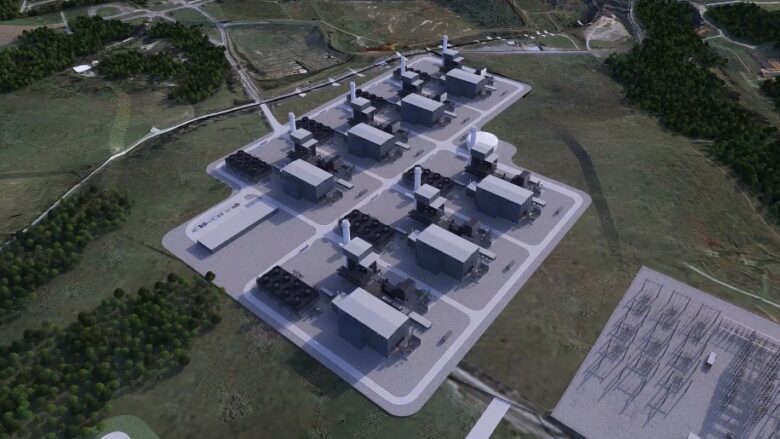
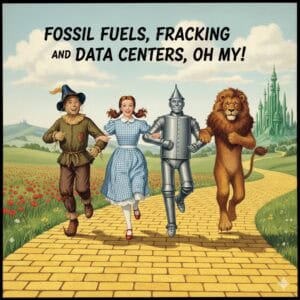 In honor of the new Wizard of Oz movie coming this week: “Lions and tigers and bears, oh my!” The environmental left version of that is, “Fossil fuels, fracking, and data centers, oh never!” Just yesterday, we outlined a trend we see in Pennsylvania (and on the national level): anti-fracking groups morphing into anti-data center groups (see
 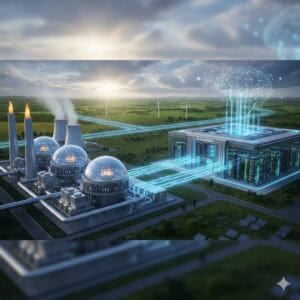 The American Energy + AI Initiative, a collaboration between the Hamm Institute and the American Energy + AI Coalition, held a summit on Monday in Washington, D.C., to address the urgent need for firm power to sustain the rapid growth of Artificial Intelligence (AI) in the U.S. Cabinet officials, including DOE Secretary Chris Wright, and industry leaders, discussed concrete steps to modernize federal tools and accelerate power production. During the summit, a new study was released (full copy below) emphasizing that America’s ability to lead in AI depends on quickly building reliable energy and highlighted the immediate need for more natural gas to meet the massive, unexpected demand from data centers.