
Enstor Closes Deal to Buy Black Bear Transmission Pipelines
 In August, MDN told you that Black Bear Transmission (BBT), the owner of nine regulated short pipeline transmission systems in the Southeastern U.S. totaling approximately 1,700 miles of pipeline, with a throughput capacity of about 2.6 billion cubic feet per day (Bcf/d), was selling itself to Enstor Pipeline Holdings, LLC, for an undisclosed sum (see Black Bear Transmission (Southeast Pipeline Co.) Selling to Enstor). Black Bear’s pipelines interconnect with 16 major long-haul pipelines and storage facilities across seven states, including Alabama, Arkansas, Louisiana, Mississippi, Missouri, Oklahoma, and Tennessee. Last week, the deal was sealed. Yes, there is a connection to the Marcellus/Utica. Read More “Enstor Closes Deal to Buy Black Bear Transmission Pipelines”

 Last week, the Baker Hughes U.S. national rig count gained rigs for the second week in a row. The national count increased by one rig, rising from 548 to 549. The BH rig count has added rigs in four of the last five weeks. Rigs in the Marcellus/Utica remained the same last week at a combined 37, the same number for seven weeks in a row. Pennsylvania remained unchanged at 17 active rigs (seven weeks in a row). Ohio was the same at 13 rigs (eight weeks in a row). And West Virginia maintained its 7 rigs, which it has operated since May 30 (25 weeks in a row). There were 23 rigs targeting the Marcellus and 14 targeting the Utica.
  We continue to win so much, it feels strange. But hey, we can get used to it! Back in April 2021, we reported that the leftist Democrats who run the North Carolina Department of Environmental Quality (NCDEQ) had, for the third time, rejected giving the Mountain Valley Pipeline (MVP) Southgate project a necessary Clean Water Act (CWA) Section 401 water quality certification permit (see
 In April, Knighthead Capital Management, Homer City Redevelopment (HCR), and Kiewit Power Constructors Co. announced a plan to convert the former Homer City Generating Station, previously the largest coal-fired power plant in Pennsylvania (Indiana County, 50 miles east of Pittsburgh) into a more than 3,200-acre natural gas-powered data center campus, designed to meet the growing demand for artificial intelligence (AI) and high-performance computing (see
  One month ago, we reported that Ohio Republican Senators had introduced Senate Bill (SB) 219, the first significant update to Ohio’s oil and gas laws since the Kasich administration more than a decade ago (see
  U.S. retail natural gas prices are rising across all sectors due to higher wholesale costs, particularly the Henry Hub spot price, which is expected to increase by 58% in 2025 compared to 2024. This increase translates unevenly to consumers. Electric power plants and the industrial sector are expected to see the most significant price hikes, forecast at 37% and 21%, respectively, as their costs are more directly tied to fluctuations in wholesale prices. Residential and commercial customers, however, are expected to experience smaller increases of 4% each. This smaller impact is due to utilities adjusting their rates more gradually, and wholesale commodity costs constitute a smaller portion of the final retail bill for these sectors, which also include significant fixed charges for transportation and distribution.
  For seven looooooong years, Pennsylvania Senate Republicans (and MDN, we modestly add) have fought against enrolling the Keystone State in the Regional Greenhouse Gas Initiative (RGGI) carbon tax scheme. RGGI taxes gas- and coal-fired power plants, charging them so much per ton of carbon dioxide emitted. The aim is to eliminate these sources and replace them with unreliable renewable energy sources, such as wind and solar. PA’s former failed Governor, Tom Wolf, tried to force the state to join RGGI via an executive order (see
 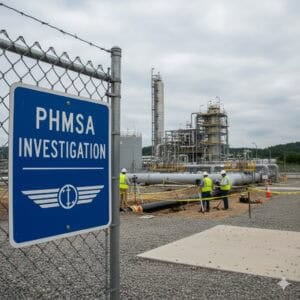 Federal safety officials are investigating leaks of ethane near two small underground storage tanks at the Cove Point LNG export terminal in Maryland and have requested that they be taken out of service immediately, citing potential safety concerns. The cause of the leak appears to be related to the tanks or their piping. However, Cove Point LNG, a facility owned and operated by a Berkshire Hathaway Energy subsidiary, maintains that the 40-gallon tanks are “safe to operate under the current conditions” and that the leaks have never posed an unsafe condition for employees or the community. The Pipeline and Hazardous Materials Safety Administration (PHMSA) issued a proposed safety order in mid-October, and the company has requested an informal consultation to discuss it.
  Despite claims by anti-fossil fuelers that the Tenaska Westmoreland Generating Station in southwestern PA would spread disease and death if it were built, it’s been up and running since 2018, producing power and generating money for both its builders and the community. Oh, and everyone is in good health. However, the plant has been operating under a state permit since it opened. It needs a federal Title V permit for long-term operation. The state Department of Environmental Protection (DEP) is the agency that issues such a permit and is proposing to do so, which (of course) has antis’ knickers in a twist. In particular, antis are complaining that there are no public complaining sessions scheduled.
  Since August, we’ve reported about an ongoing war of words between the City of Marietta officials (mostly Republicans) and the Ohio Department of Natural Resources (ODNR) over a permit for a fifth wastewater injection well located close to the city (see
  In January 2023, New York Gov. Kathy Hochul, a leftist Democrat, floated a plan to ban natural gas hookups in every single new home and business across the “Empire” State (see
  The U.S. Energy Information Administration (EIA) issued its latest monthly Short-Term Energy Outlook (STEO) yesterday. The STEO is the agency’s monthly best estimate of where energy prices and production will head over the next 12 months. In this latest assessment, EIA reversed its months-long trend of lowering its estimates for the Henry Hub spot price for 2025. The agency expects the HH spot price to average $3.50 per million British thermal units (MMBtu) in 2025, $0.10 higher than last month’s forecast. EIA also raised its 2026 forecast by $0.10 to $4.00/MMBtu. Recent soaring HH prices appear to have influenced the official price dartboard at EIA HQ.
 The Pennsylvania House Environmental & Natural Resource Protection Committee will hold a hearing on November 17 for House Bill 1946, sponsored by Rep. Greg Vitali (Democrat from Delaware County), which proposes to significantly increase setback distances for unconventional shale gas wells to “better protect public health and the environment.” The bill mandates a minimum setback of 2,500 feet from homes and 5,000 feet from schools, hospitals, and long-term care facilities, a substantial increase from the current 500 feet. It also raises setbacks for drinking water sources from 1,000 to 2,500 feet and for natural bodies of water from 300 to 750 feet, affecting everything, from lakes and ponds to mud puddles. Vitali knows his bill would be a de facto ban on new shale drilling in 95-97% of the state. That’s his objective.