
Potential FERC Com. Powleson Calls Anti-Fossil Fuelers “Jihadists”

We can’t speak highly enough of Rob Powelson, member of the Pennsylvania Public Utility Commission (PUC) and currently the president of the National Association of Regulatory Utility Commissioners (NARUC). As we recently reported, Powelson is one of three names being rumored as a nominee to the Federal Energy Regulatory Commission (see Names Mentioned for 3rd FERC Post, Incl. PA’s Powelson). It can’t happen soon enough! Yesterday Rob spoke at the Upstream PA conference in State College. He didn’t beat around the bush. In a very frank talk, Rob said equated fossil fuel nutters with Islamic terrorists when he said, “The jihad has begun…At the Federal Energy Regulatory Commission groups actually show up at commissioners’ homes to make sure we don’t get this gas to market. How irresponsible is that?” So true. These anti wackos have more in common with anti-American terrorists than they do with common, decent, ordinary Americans. They are so hyped-up and amped-up on global warming hysteria, they’re willing to use extreme tactics–even violence–to force their will on everyone else. It’s about time we started calling it like it is, and that’s just what Rob did yesterday. He also called Maryland Gov. Larry Hogan (who just announced his support for a permanent frack ban) an ignoramus, in so many words…
Read More “Potential FERC Com. Powleson Calls Anti-Fossil Fuelers “Jihadists””
 TransCanada, one of Canada’s leading midstream/pipeline companies, cooked up a deal last year to pipe natural gas from Canada’s West Coast to the East Coast in order to fend off cheap supplies of Marcellus/Utica gas that will flow into Canada when/if the NEXUS and Rover pipelines get built (see
  A disappointing setback for the much-needed Constitution Pipeline–a $683 million, 124-mile pipeline due to run from Susquehanna County, PA to Schoharie County, NY carrying Marcellus gas. As you may recall, in April 2016, New York’s anti-drilling governor, Andrew Cuomo, decided he would cave to pressure from radical environmentalists and block the building of the federally-approved Constitution Pipeline (see
  A somewhat misguided couple who own land in Harrison County, OH and object to Rover putting a pipeline through their land have decided to break the law. Contractors working for Energy Transfer to clear trees and dig a trench to lay pipeline across their land have been working on their land, on an off, for the past three weeks. Sheila Bittinger and her husband Stanley say they’ve had enough and the couple parked several vehicles across the entrance to their property to prevent any more work on the pipeline. It sounds as if they want to get arrested and that they know this particular bit of “civil disobedience” will result in absolutely nothing. But they’re doing it all the same. If you watch the video (below) you get the impression these are honest, country folks who feel like they’ve gotten a raw deal. We wonder if these landowners have been manipulated by slick lawyers who see a big payday coming from a lawsuit against Rover Pipeline…
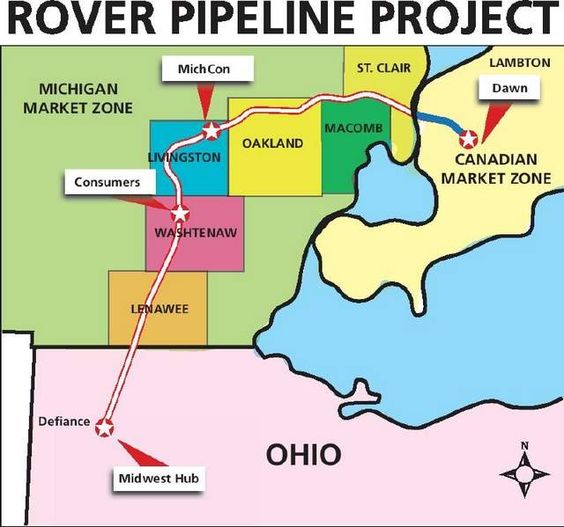
 A group of approximately 250 Ohio landowners, represented by an Ohio eminent domain law firm, is doing its best to stop Energy Transfer’s Rover Pipeline project dead in its tracks. Rover is playing beat the clock to finish tree clearing following a Federal Energy Regulatory Commission (FERC) final approval of the project on Feb. 3 (see

 Today is the day that (some of) Maya’s minions will show up at a meeting of the Delaware River Basin Commission to attempt to bully DRBC staff during the public comments period. As we’ve been reporting (from a well-placed mole on the DRBC email list) Maya has been issuing orders to her minions–people who apparently aren’t bright enough to form their own thoughts about matters like the PennEast Pipeline (see
  Last June, MDN quasi-predicted that natural gas prices may spike during the 2016-2017 winter season in New England, due to a coming shortage of LNG from Tinidad (see
  TransCanada, one of Canada’s leading midstream/pipeline companies, cooked up a deal last year to pipe natural gas from Canada’s West Coast to the East Coast in order to fend off cheap supplies of Marcellus/Utica gas that will flow into Canada when/if the NEXUS and Rover pipelines get built (see
  That was fast. Last Friday MDN reported that New Jersey’s largest utility, Public Service Enterprise Group (PSE&G), is shopping its ownership stake in the $1 billion PennEast Pipeline project (see
  A group of anti-fossil fuel nutters from the Philadelphia suburb of Middletown, PA (Delaware County) spent good money to buy themselves a report from an “independent” consultant that they say proves the Mariner East 2 Pipeline is too dangerous to build through their township. We don’t know how much the Middletown Coalition for Community Safety blew on the study, but we do know that Middletown Township is blowing $45,000 of taxpayer’s hard-earned money for a similar study (see
  The Mountain Valley Pipeline (MVP) is a $3.5 billion, 301-mile pipeline that will run from Wetzel County, WV to the Transco Pipeline in Pittsylvania County, VA. The project, which filed an official application with the Federal Energy Regulatory Commission in October 2015, is being built by EQT, NextEra Energy and several other partners. The project has faced stiff opposition from landowners in West Virginia (see
  Is there still a market need for the NEXUS Pipeline project? That is the $2 billion question. Last December, the Federal Energy Regulatory Commission issued a positive final Environmental Impact Statement (see