Regulation

  • | | | | |

    Monroeville, PA Antis Want 100% Ban on Fracking, Pipelines

    Limiting fracking to an impossibly small 150 acres (out of 12,620 acres) that make up Monroeville–a mere 1% of the acreage–is not enough of a ban for radical antis in the municipality of Monroeville (suburb of Pittsburgh). They want it all banned–every single centimeter. The only problem with that is the Act 13 law, passed in 2012, requires each municipality to allow drilling in at least one zoned area. But hey, disobeying the law isn’t a problem for antis–they do it all the time. They are anarchists by nature. Last October, Monroeville Council passed a temporary ban on oil and gas well drilling everywhere except for those areas marked M-2 industrial zoning–a big change (see Monroeville, PA Hostile to Shale, Bans Drilling in Most Places). Previously, drilling permits were “conditional use” in Monroeville, meaning each permit was evaluated on its own merits, regardless of which zoning district it was located in. By limiting drilling to M-2, Council effectively banned drilling in the municipality. They passed the temporary ban until they could pass a new zoning ordinance that would set the frack ban policy in concrete. In January, Monroeville Council advertised their new zoning ordinance to FURTHER RESTRICT any kind of oil and gas activity–not just drilling, but pipelines, compressor plants, etc.–to a 150-acre parcel located next to the city dump (see Monroeville Pushes Ban on NatGas Activity, Incl. Drilling & Plants). Fantastically, unbelievably, antis in Monroeville aren’t happy with that 150-acre parcel exception–an old dump! They want drilling at the dump banned too…
    Read More “Monroeville, PA Antis Want 100% Ban on Fracking, Pipelines”

  • | | | |

    Harrison County, WV Commissioners Vote to Help Delayed Elec Plant

    Last June, the West Virginia Public Service Commission held a public hearing in Clarksburg, WV on the proposed ESC Harrison County Power Plant project (see Public Hearing Held for Harrison County, WV NatGas Electric Plant). ESC (Energy Solutions Consortium) was founded by father and son team Andrew and Matthew Dorn, based in Buffalo, NY. The Dorns are behind a series of WV natgas-fired electric plants, the first of which will get built in Marshall County (see Progress for 3 WV NatGas Electric Plants; 1 Breaks Ground in 2016). At the public hearing last June, the only person to speak against the project was from the Sierra Club–opposed because the Clubbers claim the plant will contribute to man-made global warming. Whatever. The PSC reported receiving 540 positive comments, and one negative comment. What does that tell you? Last July we reported the project still needs a few more permits (air and water) and was jumping through multiple government hoops to get them (see Harrison County, WV NatGas Electric Plant Close to Final Approval). Here we are, seven months later, and the project is STILL not fully permitted! What in the world is going on in WV? Why is it taking so long? Harrison County commissioners, hoping they can further goose the process and get it dragged across the finish line, will vote tomorrow to issue a resolution giving their full-throated support for the project. Let’s hope their vote of confidence finally does the trick…
    Read More “Harrison County, WV Commissioners Vote to Help Delayed Elec Plant”

  • | | | | | |

    Compromise Allows Drilling to Begin in Pittsburgh Suburb of Plum

    In October 2017, local officials in Plum, PA (Allegheny County) approved a plan by Huntley & Huntley (H&H) to drill a series of Marcellus wells on a single well pad in their municipality (see Plum, PA Gives Huntley & Huntley Green Light for Shale Drilling). Plum’s leaders got blowback from some residents (antis) over the decision to conditionally approve H&H’s request. In Plum, fracking is (or rather was) allowed in any zone if a conditional use is granted. That’s what happened in October–the Plum Council issued a conditional use exception for H&H to drill on 92 acres near Coxcomb Hill Road in Plum. To avoid dealing with more such conditional cases, Plum Council drafted proposed changes to their zoning ordinances (ordinances which haven’t been updated since 1993) that will only allow fracking in rural residential and industrial zones (see Plum, PA Officials Hold Hearing on New Restrictions for Fracking). H&H originally said the changes would be too restrictive. However, they later adopted a “half a loaf is better than no loaf” philosophy, opting to support the new rules. A compromise. In December, Plum Council moved ahead and adopted the new rules, and antis predictably blew a gasket (see Plum, PA Passes Ordinance to Allow Fracking – Antis Livid). How and why did Plum adopt such an ordinance? Especially given so many surrounding towns in Allegheny Township are outright hostile to drilling? Let’s pull the curtain back and probe the thought process Plum used to arrive at a compromise that appears to work for both sides…
    Read More “Compromise Allows Drilling to Begin in Pittsburgh Suburb of Plum”

  • | | | | |

    Marcellus-Fired Electric Plant in Clinton County, PA Gets DEP Approval

    Click for larger version

    Last July MDN brought you news about a new Marcellus-fired electric plant planned for Clinton County, PA (see New Marcellus-Fired Electric Plant Coming in Clinton County, PA). The $800 million Renovo Energy project (in Renovo, PA) will be a 950-megawatt dual fuel (natural gas and ultra-low sulfur diesel) combined cycle electric generating plant located in the Renovo Industrial Park. The official application for the project was filed with the PA Dept. of Environmental Protection (along with an application fee of $29,700) in August 2015. Yeah, it takes a looooong time to get these things approved. However, a key (perhaps THE key) permit needed by the PA DEP was issued over the weekend. The DEP approved Renovo’s application for an air quality permit for the project. An official working with Renovo says recent rumors that plans to build the plant are dead is false. He said construction may start by the end of this year, after a few more kinks are worked out…
    Read More “Marcellus-Fired Electric Plant in Clinton County, PA Gets DEP Approval”

  • | | | | | |

    Sunoco LP Pays PA DEP $12.6M to Resume ME2 Pipeline Construction

    In what can only be considered a government shakedown, Sunoco Logistics Partners has agreed to pay a massive (historically high) $12.6 million fine to the PA Dept. of Environmental Protection (DEP) for “permit violations related to the construction of the Mariner East 2 pipeline project.” The fine, along with a “stringent compliance review” going forward, gives the DEP enough confidence to allow Sunoco to resume construction on the ME2 project, which has been halted since January 3rd (see PA DEP Caves to Big Green Pressure, Stops All Work on ME2 Pipeline). Last Friday Sunoco appealed the DEP’s stop work order to a special court set up to hear appeals of DEP decisions (see Sunoco Appeals DEP’s ME2 Pipe Suspension to Enviro Hearing Board). DEP couldn’t risk having their order overturned–not when there’s a shakedown in progress! With respect to the “deal,” Sunoco said, in so many words, that while they (strongly) disagree with the DEP’s statements in making the deal, Sunoco is willing to pay the fine so they can get back to work and finish the project. A cost of doing business in PA, apparently. Beginning today, thousands of people who had been thrown out of work by the DEP order will resume their jobs. All it took was 12.6 big ones to make it happen…
    Read More “Sunoco LP Pays PA DEP $12.6M to Resume ME2 Pipeline Construction”

  • | | | | | | | | |

    NFG Quarterly Update: Seneca Could Drill More, if Pipeline Gets Built

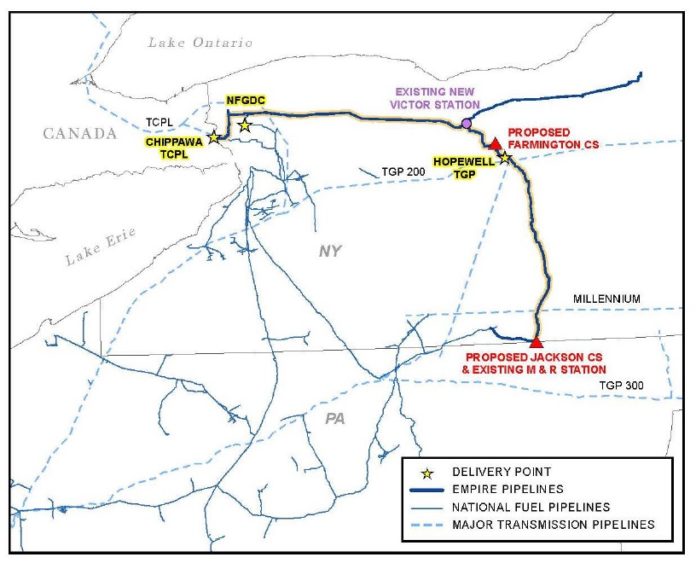
    Last week National Fuel Gas Company (NFG), headquartered in Western New York State which operates drilling subsidiary Seneca Resources and pipeline subsidiary Empire Pipeline, issued its first quarter 2018 (everyone else’s fourth quarter 2017) update. Via Seneca Resources, NFG drills wells in northcentral and northwestern PA. Via Empire Pipeline, they build and maintain hundreds of miles of pipelines. NFG wants to add to their pipeline portfolio by building the Northern Access Pipeline–a $455 million project with 97 miles of new pipeline along a power line corridor from northwestern PA up to Erie County, NY. Northern Access would allow Seneca to drill new wells in an area currently pipeline “constrained.” However, Northern Access construction has been blocked by the corrupt NY Dept. of Environmental Conservation (see Cuomo’s Corrupt NY DEC Blocks NFG Northern Access Pipeline Permit). NFG CEO Ronald Tanski gave an update for the Northern Access project on an analyst call. Tanski indicated the company engaged in a two-pronged strategy: one is a pending court case, NFG sued the DEC; the other strategy involves a request with FERC to overturn the DEC’s decision. No definitive word on when either/both will happen. In the meantime, Seneca Resources must “focus on drilling and completing wells where we have adequate take away capacity or the ability to lock in firm sales.” Which means Seneca could be drilling a lot more were it not for Cuomo blocking the Northern Access pipeline. Seneca continues to operate 2 drilling rigs. Below are portions of the analyst phone call and the complete quarterly update for NFG…
    Read More “NFG Quarterly Update: Seneca Could Drill More, if Pipeline Gets Built”

  • | | | | |

    WV DEP Issues Permit for Mountaineer Gas Pipeline in Eastern WV

    In 2017 Mountaineer Gas launched the Eastern Panhandle Expansion pipeline project–a project to deliver natural gas via local distribution channels to a new industrial facility in Berkeley County, WV, and to provide gas to other local businesses and residents in the Tri-State area. There are three phases to the Eastern Panhandle Expansion project: Phase One runs a 22.5-mile, 10-inch-diameter steel pipeline from Morgan County to Martinsburg; Phase Two includes a loop to Charles Town; and Phase Three will build a four mile segment of pipeline into Martinsburg. The West Virginia Dept. of Environmental Protection held a hearing on Phase One in January, at the Berkeley Springs High School (see Old Hippies Turn Out at WV DEP Hearing to Oppose Mountaineer Pipe). All of the people who spoke at the hearing, some 33 of the 80 people present, spoke against the project. Even though local residents object, on Wednesday the WV DEP issued a permit for the project…
    Read More “WV DEP Issues Permit for Mountaineer Gas Pipeline in Eastern WV”

  • | |

    New Federal Sand Dust Rules Affect NatGas Drillers This Year

    One of the primary ingredients in fracking is sand–a special kind of very fine sand called silica. When silica gets airborne and into a person’s lungs, it’s not good news. Silica behaves like asbestos, with the potential to cause lung cancer. The shale industry is keenly aware of it and takes steps to ensure workers are not exposed. The federal Occupational Safety and Health Administration (OSHA) developed a new rule for respirable silica (tiny tiny sand) that will go into effect for the shale industry in June of this year. We have the details below…
    Read More “New Federal Sand Dust Rules Affect NatGas Drillers This Year”

  • | | | | | |

    FERC Gives Rover Pipe OK to Restart Drilling Under Tuscarawas River

    Looks like asking “Pretty please, with a cherry on top” (along with providing requested information) works! MDN previously told you that on Friday, the Federal Energy Regulatory Commission (FERC) asked Rover Pipeline for more information before FERC would allow the project to restart drilling under the Tuscarawas River (see Rover Again Asks FERC for OK to Restart Tuscarawas Drilling). FERC asked for a review of three different options, including drill in a different place under the river and forget about drilling for a second pipe at all. Rover didn’t like either of those options and lobbied, hard, to get FERC to allow them to restart drilling in the same place where they’ve now lost 200,000 gallons of drilling mud down hole. Rover responded (on Sunday) to FERC’s Friday request, providing the information FERC requested. Rover specifically asked FERC for permission to restart drilling by 3 pm Monday–at the original location. The Monday deadline came and went. However, something in Rover’s appeal must have convinced FERC, because the OK to restart drilling came a day later–on Tuesday. Work has now resumed at the site, much to the consternation of Ohio EPA’s Craig Butler, who continues to oppose the project…
    Read More “FERC Gives Rover Pipe OK to Restart Drilling Under Tuscarawas River”

  • | | |

    PA Senate Passes Meaningless Resolution to “Study” Slow DEP Permits

    This is what passes for “action” in the swamp of Harrisburg. Over the past couple of years the Pennsylvania Dept. of Environmental Protection (DEP) has gotten slower and slower in issuing permits for shale drilling–for simple things, like erosion permits a driller needs to push dirt around to create a well pad. The DEP has a policy of issuing erosion and sedimentation permits 14 days from the date of application. As of last summer it was taking the DEP over 250 days to issue those permits (see More Pushback on PA Senate Plan to Fix Slow DEP Permit Reviews). The drilling industry has been loudly pushing for a change. The DEP says it has fewer people on staff and that’s the reason for the slowdown. The thing is, the number of requests for permits has gone down too–so that particular argument doesn’t hold a lot of water. PA House Republicans have introduced a number of bills to “fix” the DEP, not least of which is a bill introduced that allows certified third parties to assist the DEP in reviewing permit applications (see Bill Introduced to Fix PA DEP’s Extreme Delays Issuing Permits). The PA Senate wants in on the “fix DEP” action too. A Senate Democrat, John Yudichak from Wilkes-Barre, proposed a resolution to study the problem (see PA Senate Ctte Sends “Study Slow DEP” Resolution for Full Vote). A resolution to study something is swamp code for “don’t do a darned thing about it.” Yudichak’s meaningless resolution passed the full Senate yesterday. PA Senators can now all pat themselves on the back, pretending they’ve actually done something to address this critical problem when in fact, they’ve done nothing at all…
    Read More “PA Senate Passes Meaningless Resolution to “Study” Slow DEP Permits”

  • | | |

    PA DEP’s Short-Term Solution to Get More Help – Hire 92 Interns

    Everybody has a “fix” for the chronically slow Pennsylvania Dept. of Environmental Protection (DEP). The DEP has a policy of issuing erosion and sedimentation permits for shale drilling 14 days from the date of application. At last check, it was taking the agency over 250 days to issue those permits. The Marcellus industry has been pressuring the PA legislature for a fix. As we noted in a companion story today, the PA Senate’s “fix” is to study it (see PA Senate Passes Meaningless Resolution to “Study” DEP Slow Permits). The PA House is more proactive, with a series of 5 bills that would, among other things, enlist the help of independent third parties to take up the slack (see PA House Advances “Fix DEP & Other Agencies” Plan with 5 Bills). Even PA Gov. Tom Wolf got in the act, offering his own solution, which involves hiking fees and hiring more people (see PA Gov Wolf Floats Plan to Fix DEP Slow Drilling Permits: Hike Fees). Perhaps the DEP has found a way to fix itself. The DEP recently posted 92 openings for paid internships. Many of the openings are for “Engineering and Scientific Technical Interns” for which the intern will earn $13.23/hour. While some of the openings are in the coal program, or the water resources program, many of positions (we’d say most, judging by a random check) are in the oil and gas program. But wait, the DEP is on a tight budget, right? They don’t have an extra two nickels to rub together. That’s what we always hear. That’s why fees need to go up, right? Somehow the DEP has been able to find money for an intern program. If 92 interns work for a 3-month period earning $13.23 per hour (40 hour weeks), that’s more than $580,000. Maybe the DEP will pull the money from one of the slush funds Republicans wanted to empty as part of balancing the budget? At any rate, here’s the deets on becoming an intern for the PA DEP…
    Read More “PA DEP’s Short-Term Solution to Get More Help – Hire 92 Interns”

  • | | |

    PA DEP Plans to Raise Marcellus Well Permit Fee by 250%

    Pennsylvania Gov. Tom Wolf’s Dept. of Environmental Protection (DEP), the agency charged with overseeing oil and gas drilling in the state, has “blindsided” the shale industry with a proposal to hike the fee required when submitting an application to drill a new shale well. The current fee is $5,000. The proposed new fee is $12,500–or 2.5 times greater (i.e. 250% higher). The DEP Oil and Gas Technical Advisory Board (TAB) is scheduled to meet next week, on Feb. 14, to discuss the permit fee increase. The fee funds the oil and gas program within the DEP. Wells must be visited and inspected throughout their life–decades after they are initially drilled. The permit fee is a one-time, up-front fee. Over the past couple of years the number of new wells getting drilled has decreased (although in 2017 it went back up, see PA Shale Wells Drilled Soars 56% in 2017; Impact Fee Up $5,400/Well). Because there have been fewer wells drilled in recent years, there’s a lot less money in the DEP’s budget for well inspectors. Hence the plan to hike the fee. The industry does not object to a measured increase–but going up 250% is “excessive” and not called for, according to the Marcellus Shale Coalition. In addition to the permit fee hike, the TAB meeting will also hold a discussion on finalizing new GP-5 and GP-5A General Permits to control methane emissions from oil and gas operations. Buckle up, the next TAB meeting looks like it may get heated…
    Read More “PA DEP Plans to Raise Marcellus Well Permit Fee by 250%”

  • | | | | | | | | |

    Sunoco Appeals DEP’s ME2 Pipe Suspension to Enviro Hearing Board

    PA State Sen. Andy Dinniman

    In early January, the Pennsylvania Dept. of Environmental Protection (DEP) issued an order shutting down all construction for the Sunoco Logistics Partners Mariner East 2 (ME2) pipeline project (see PA DEP Caves to Big Green Pressure, Stops All Work on ME2 Pipeline). The DEP claims Sunoco had violated the conditions of the permits that allow it to drill and trench for the project. In particular, the DEP is hot and bothered about drilling mud spills associated with underground horizontal directional drilling (HDD). The DEP said Suonco can restart work when/if certain conditions are met. So far the DEP has not allowed Sunoco to restart work. In the meantime, thousands of workers are in the unemployment line, and have been since Jan. 3rd. Sunoco has just appealed the DEP’s cease and desist order to the PA Environmental Hearing Board–a special court set up to hear appeals of DEP decisions. Sunoco lays out their case in a filing (below) for why the DEP is incorrect in issuing their stop work order…
    Read More “Sunoco Appeals DEP’s ME2 Pipe Suspension to Enviro Hearing Board”

  • | | | | | |

    Rover Again Asks FERC for OK to Restart Tuscarawas Drilling

    On Jan. 24, the Federal Energy Regulatory Commission (FERC) sent a letter to Rover Pipeline stopping drilling at the Tuscarawas River site, which had only restarted in December (see FERC Stops Rover Drilling Near River After 200K Gal Mud Disappears). In a strongly worded letter dated Sunday, Jan. 28, Rover told FERC they are “frustrated by the inaccurate central premise underlying the letter received from” FERC shutting down drilling at that location (see Rover “Frustrated” with FERC Order to Stop Drilling at Tuscarawas). Some 99% of all construction work is now complete for Rover Pipeline. There’s only a little more to do to finish things up, including installation of a second Rover Pipeline (next to the first) underneath the Tuscarawas River. Rover has “lost” 200,000 gallons of drilling mud down the hole in drilling for the second pipe. However, the “lost” mud has not come back to the surface. Mud disappearing–and staying down the hole–when drilling for pipelines is not uncommon. Yet FERC will not lift the stop work order. On Friday, FERC sent a letter to Rover saying Rover must provide information on three different scenarios before work can resume: (1) how Rover plans to complete drilling at the current location without losing any more mud, (2) change locations and run the second pipe under another part of the Tuscarawas River, or (3) forget about drilling and installing a second pipe altogether, and stick with just a single pipe already in place now. FERC’s letter brought a swift response. On Sunday, Rover provided a mountain of evidence to say the current plan of drilling under the river at the existing location is the right plan. Rover went one step further, asking FERC to allow them to begin drilling again by yesterday (Monday) afternoon at 3pm. To the best of our knowledge, that did not happen…
    Read More “Rover Again Asks FERC for OK to Restart Tuscarawas Drilling”

  • | | | | |

    NJ Continues to Hassle PennEast Pipe with Refusals & Rejections

    The State of New Jersey and its elected leaders (Governor and Attorney General) continue their quest to hassle and block the PennEast Pipeline from entering a small portion of their state. Why? To answer that question you’d have to enter their brains to understand all of the political calculations that go on–a very scary proposition. NJ Attorney General Gurbir Grewal (far-left Democrat) on Friday rejected PennEast’s request to use state-owned land for small part of the pipeline’s route. Also last week, the NJ Dept. of Environmental Protection (an executive branch agency, reports to NJ’s newly elected LibDem Gov. Phil Murphy) told PennEast the DEP is closing the books on PennEast’s water crossing permit application for lack of information. PennEast says the DEP’s action was not a surprise and that they will refile the application with the additional information sought. It all just points to a very hostile (to private business) government that has seized power in The Garden State. Don’t worry, PennEast isn’t letting NJ’s hostility stop them. This pipeline will still get built…
    Read More “NJ Continues to Hassle PennEast Pipe with Refusals & Rejections”

  • | | |

    Trump Tax Cut has Unintended Consequences for Pipeline Projects

    President Trump’s marvelous tax cut has had some unintended (negative) consequences for pipeline companies. Trade groups and some states are pressuring the Federal Energy Regulatory Commission (FERC) to force pipeline companies to cut the rates they charge customers in light of the Trump tax cut. The corporate tax rate is going from 35% (highest of any modern/Western country) down to 21%. Which will encourage all sorts of investment in the good old US of A. When pipelines file rate cases for how much they will charge customers to flow gas (or oil or whatever else) through the pipeline, part of the calculation for what FERC allows them to charge is based on profitability. Since those companies will now be a whole lot more profitable (tax payments going down), the customers using those pipelines want the rates recalculated to reflect the savings. In other words, they want part of the tax savings too. But wait just a rootin’-tootin’ minute! (says the pipeline companies). The pipelines have duly signed contracts in place. You can’t just rework a single portion of those contracts with the sweep of a pen. What about other components in the contract that are used in calculating prices? In some (many?) cases pipeline companies have borne increased costs that are not passed along to customers. If the customers (mainly utility companies) want FERC to adjust the rates, they may not like how those rates get adjusted considering all the other factors that could/should be changed. Maybe they’ll go up instead of down! A battle is brewing between utilities and the pipelines that feed them, all because of Trump’s tax cut…
    Read More “Trump Tax Cut has Unintended Consequences for Pipeline Projects”