
Ohio Gov Kasich About to Lose Power to Stop Drilling on State Land
 Thumbing their collective noses at Ohio RINO Gov. John Kasich, in May Republican legislators in the House added a “little-noticed provision” in the state budget deal that will give the legislature, and not the governor, the power to select members of the Ohio Oil and Gas Commission (see Ohio Legislators Push to Allow Fracking in State Parks, Forests). That small change would have huge consequences. How? the Oil and Gas Commission is charged with approving potential drillers on state land. Five years ago, Kasich flip-flopped on the issue and since then has not allowed shale drilling in state-owned forests and state-owned parks–by refusing to add any new members to the Commission, which is his state constitutional duty. It is a de facto moratorium from the governor that prevents fracking on state-owned land. Enough is enough. Republicans intend to change it this year, so they added the change to the state budget bill. Kasich vetoed the measure, and the House, last week, voted to override the veto. The only thing left now is for the Senate to adopt the budget and when that happens, the fat lady will be singing–an aria for Utica Shale drilling…
Read More “Ohio Gov Kasich About to Lose Power to Stop Drilling on State Land”
 Once again, the radicals behind the Pennsylvania-based Community Environmental Legal Defense Fund (CELDF), operating in Ohio, have suffered a humiliating defeat. This time in liberal Athens, Ohio. For three years running, the CELDF and their local useful idiots have been pedaling a so-called Community Bill of Rights ballot measure–which is nothing more than an anti-fracking law. No, there is no drilling in or under Athens, but such a law would send a loud and clear signal that Athens is closed for business when it comes to the oil and gas industry–an industry that pumps millions into the local economy (even without drilling in the area). For the third year running the CELDF drones filed a petition to include the “Bill of Rights” measure on the November ballot–and for the third year in a row, the County Board of Elections voted NOT to allow it–unanimously…
 In April MDN told you that the Virginia Dept. of Environmental Quality (DEQ) had succumbed to political pressure from the MANY lib Dems in the state that oppose benign pipeline projects, like the Atlantic Coast Pipeline (ACP) and Mountain Valley Pipeline (MVP), and changed their minds about the process they will use in issuing water quality certifications under Section 401 of the federal Clean Water Act (see
 Phase I of the 711-mile Rover Pipeline project that will run from PA, WV and eastern OH through OH into Michigan and eventually into Canada is supposed to be completed by July 2017, while Phase II is supposed to be done by November 2017. Will Phase I be done by the end of this month? We sure wouldn’t want to take that bet, but we suppose there’s still a slim chance. While building the $3.7 billion pipeline project, Energy Transfer (or more correctly its contractors) hit some snags, including spilling 2 million gallons of non-toxic drilling mud near the Tuscarawas River (see
  Franklin Kury was a young lawyer and PA House of Representatives member back in the late 60s/early 70s. He was, at that time, the author of Pennsylvania’s so-called Environment Rights Amendment (Article I, Section 27 of the PA Constitution). For 40 years the ERA didn’t have much of an impact–but then activist, liberal, leftist judges got ahold of it and (ab)used it to screw with the Marcellus Shale industry in the state. Things “all changed” on June 20 when the PA Supreme Court (ab)used the ERA to tell the Dept. of Conservation and Natural Resources (DCNR) it can’t use money raised from shale drilling to help fund itself–a bass ackwards view of things if ever we’ve heard of one (see
 The federal Environmental Protection Agency (EPA) wisely move to begin the process of rolling back Obama-era regulations on methane, designed to regulate the oil and gas industry, last month (see
  Although we understand self-interest and wanting to protect one’s profit margin, we continue to be distressed that some of the biggest chemical companies in the world (meaning in the U.S.) are still actively trying to block approvals for more LNG export facilities. Why? They want the natural gas they buy (in very large quantities) to be as cheap as possible. In April, Big Chemical–companies like Dow Corning, BASF, Eastman Chemical and others–via their trade association Industrial Energy Consumers of America (IECA) launched an effort to try and persuade Energy Secretary Rick Perry and the Trump Administration to create barriers to exports of natural gas, ’cause you know, it’s “America First” now baby, and we want that gas all to ourselves (see
  Last December Spectra Energy pushed the pause button on their Access Northeast Pipeline project, a roughly $3 billion project in New England to connect four existing pipeline systems (with enhancements): Texas Eastern, Algonquin Gas Transmission, Iroquois and Maritimes & Northeast (see
  Earlier this month MDN reported that extreme partisan Sen. Chuck Schumer had recommended to the White House that Richard Glick, a current a Senate staffer (i.e. swamp dweller) and former lobbyist for the wind industry, should succeed Democrat Colette Honorable as the second Democrat commissioner on the Federal Energy Regulatory Commission (see
  Some good news for Utica (and Marcellus) drillers: The Ohio Dept. of Natural Resources (ODNR) has just approved permits for two new frack wastewater injection wells in Trumbull County, OH. Which doesn’t make the local anti-fracking nutters with FrackFree America happy. One of them calls the approvals “immoral.” She’s calling on the company building the wells, Highland Field Resources, to “abandon its plans.” (chuckle) The wells will be built in the town of Brookfield. ODNR has attached a myriad of conditions and required testing before the wells can go live. Here’s the immoral details…
 Yesterday Energy Transfer Partners, the builder of the Rover Pipeline, once again asked the Federal Energy Regulatory Commission (FERC) if they could pretty-please-with-a-cherry-on-top resume horizontal directional drilling (HDD) in a couple of key locations in Ohio, so they can finish phase one of the pipeline somewhere close to on-time. Rover is a $3.7 billion, 711-mile Marcellus/Utica natural gas pipeline that will run from PA, WV and eastern OH through OH into Michigan and eventually into Canada. It is a critical piece of sorely needed infrastructure for the Marcellus/Utica industry. As soon as ET received approval for the project in February, they began building it. But they hit a few snags along the way, including an “inadvertent return” (i.e. leak) of 2 million gallons of drilling mud in a swamp next to the Tuscarawas River (Stark County, OH). Following that leak and other leaks, FERC told Rover to stop any new underground drilling not already under way (see
  In October 2016, Dominion announced a new pipeline project called Eastern Market Access Project (see
 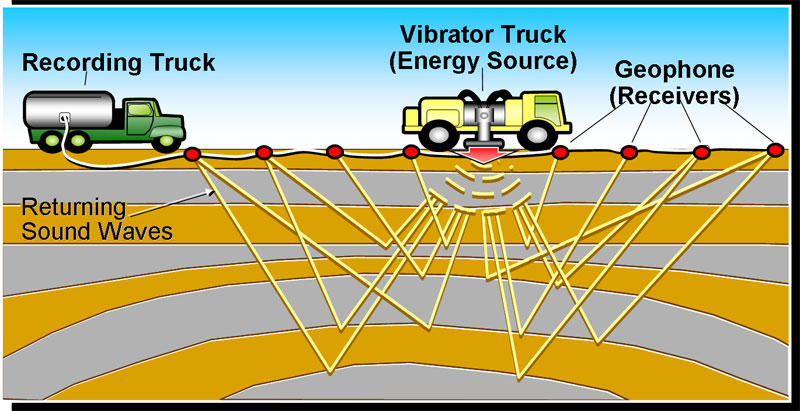 One of the first steps before a company decides to drill for shale gas (or oil), is to conduct a seismic survey–bouncing sound waves through the rock layers a mile or more down–to “see” what the geology looks like. It helps drillers target locations with the best possibility of success, which is a good thing for everyone (no unnecessary “misses” when drilling a well). One of objectives of the original Act 13 law passed in PA in 2012 was to provide uniform zoning ordinances for the oil and gas industry, so drillers don’t have to work with a crazy quilt patchwork of zoning requirements in every new town in which they drill. That failed when seven selfish towns filed a lawsuit that ultimately went to the PA Supreme Court, where the towns won the right to pass their own zoning regulations for oil and gas drilling (see