
New Frack Wastewater Well on the Way in Allegheny County, PA
 The Federal Environmental Protection Agency (EPA), which is the agency in charge of approving oil and gas wastewater injection wells, will hold a hearing next Wednesday in Plum, PA (Allegheny County, near Pittsburgh) on whether or not to approve an application and plan from Penneco Environmental Solutions (division of Penneco Oil Co.) to convert a plugged gas well into a brine (wastewater) injection well. Typically when a hearing like this is held, it’s an indicator that the EPA will approve the project. However, just because the EPA approves it doesn’t mean it’s a done deal. After an EPA approval, the application then goes to the PA State Dept. of Environmental Protection where it goes through another round of reviews–and likely more public hearings. The stuff getting disposed of, which we generically call wastewater, is technically called brine, because of it’s salty/mineral-ly composition. Brine is naturally occurring water from the depths that comes out of oil and gas wells for years after they are drilled. Because of the high concentration of minerals in the water, it either must go through a rigorous recycling process, or get disposed of via an injection well. OH has more than a hundred such wells. WV has a few dozen. PA has less than a dozen, due to the geology needed. Every new injection well in PA is a big deal, including this one…
Read More “New Frack Wastewater Well on the Way in Allegheny County, PA”
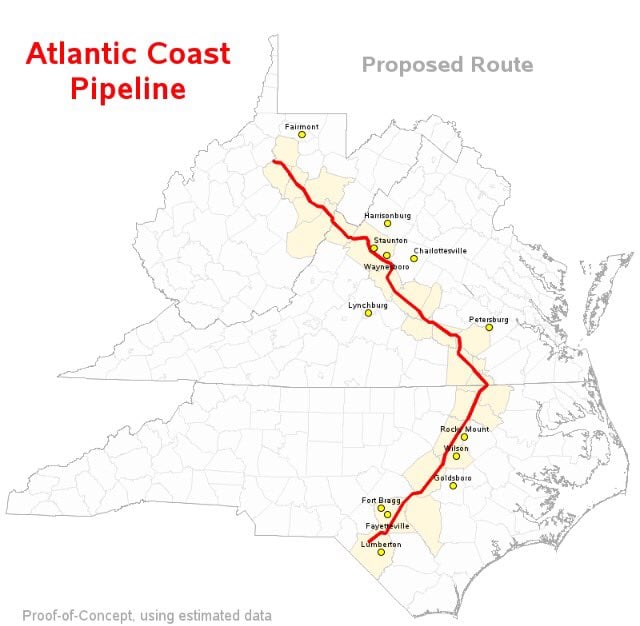 This past week, the North Carolina Dept. of Environmental Quality (DEQ) held two public hearings on Dominion’s proposed $5 billion, 594-mile natural gas pipeline that will stretch from West Virginia through Virginia and into North Carolina. One hearing was in Fayetteville, the other in Rocky Mount. Both had more people opposed to the project than for it, although the Fayetteville hearing saw a strong showing of people in favor of the project. The Fayetteville public hearing was held Tuesday, and Rocky Mount on Thursday. Here’s the coverage we could find of the two hearings…
 Anti fossil fuelers believe they have a new angle in their years-long war to prevent Sunoco Logistics Partners from building the Mariner East 2 twin pipelines across the state: drilling mud spills. When a pipeline company installs a new pipeline, the vast majority of pipe is laid in trenches. However, there are places (creeks, rivers, wetlands, roadways) where you can’t just dig a trench to lay the pipe. In those cases, you drill underground horizontally, something called horizontal directional drilling (HDD). When you drill through rock, you need drilling mud to cool the drill bit as it chews away. Drilling mud is typically bentonite, a non-toxic clay substance used to manufacture things like toothpaste, cosmetics and kitty litter. The only threat from bentonite is that it can smother aquatic life if enough is spilled. Or it can foul a water aquifer–making the water in your well cloudy for a period of time, until it settles. Such an instance recently happened in Chester County, when Sunoco’s drilling for ME2 fouled an aquifer, causing well water for some 15 homes to become temporarily unusable (see
  For the past two years running, the Delaware River Basin Commission, a cooperative organization with five members–Pennsylvania, New York, New Jersey, Delaware and the U.S. Army Corps of Engineers–has received more than half a million dollars per year from PA as its dues to support the anti-drilling organization. The problem is, PA pays its full share, but states like NY and NJ consistently short-change the DRBC. PA Gov. Tom Wolf is a big DRBC fan. Wolf supports the DRBC’s ongoing ban of drilling in the Delaware River Basin–which unfairly denies landowners in Wayne and Pike counties (PA) from benefiting from Marcellus Shale drilling–Wolf’s own constituents. However, the DRBC’s gravy train from PA is now over. Gov. Wolf recently allowed the PA budget to pass, without his signature. Part of the budget bill whacks PA’s contribution to the DRBC to just $217,000 this year–less than half of what is has been getting. The effort to whack the DRBC came from PA representatives in northeastern PA, tired of the ongoing drilling ban. Looks like layoffs are coming to the DRBC. They don’t do a heck of a lot, so why not? Time to toss the bureaucrats out on their rear-ends…
 In March of this year, Williams filed a full, official application for the Northeast Supply Enhancement project (see
  [begin political rant] Massachusetts Gov. Charlie Baker is a RINO–Republican in Name Only–and not all that different from another RINO who was once governor of the Bay State: Mitt Romney. We personally find RINOs disgusting. Why don’t they just switch parties and be done with it? Join the Democrats, or if the lib Dems are too far to the left, join the Establishment Party, which is really what they all belong to anyway, regardless of the D or R after their name. [end political rant] Gov. Baker has (surprise!) caved to pressure from radical, insane environmentalists in his state who want to stop a compressor station from getting built in Weymouth, MA. The compressor is part of Spectra Energy’s (now Enbridge) federally-approved Atlantic Bridge project (see
  In May 2015, Rover purchased a house in Carroll County, OH, located near where the pipeline, and a compressor station for that pipeline, is due to run. Rover bought the house to use for offices for several Rover affiliate companies. After buying it, Rover determined the house was “ill-suited for its intended purpose” and decided to demolish it. Problem was/is, that house was under consideration to be added to the National Register of Historic Places. The house was not yet on the list of Historic Places, but was on a list of properties under consideration. Their action in demolishing the house landed Rover in hot water with the Federal Energy Regulatory Commission (see
 Yesterday the Federal Energy Regulatory Commission (FERC) sent a letter to Energy Transfer regarding the Rover Pipeline project. You may recall that Rover hit some bumps along the way in its aggressive schedule to get part of the pipeline up and running by the end of this month, and the rest operational by the end of November. In Ohio, Rover experienced a series of mishaps, the most serious of which spilled 2 million gallons of non-toxic drilling mud in a swamp near the Tuscarawas River back in April (see
  Isn’t it interesting how a small-but-mouthy group of anti-fossil fuelers can drive a media narrative? Just two days ago MDN told you about a meeting of 100 (likely far less) anti-fossil fuel protesters in Dexter Township, Michigan, who rallied to protest the impending construction of the Rover Pipeline in that area (see
  West Goshen Township, in Philadelphia suburb of Chester County, has failed yet again to stop Sunoco Logistics’ Mariner East 2 NGL pipeline in its community. Last March MDN told you about the desperate last stand taken by liberal anti-pipeliners in West Goshen (see
  Last March MDN told you about the desperate last stand taken by liberal anti-pipeliners in West Goshen Township, in the Philadelphia suburb of Chester County (see
  The lack of a quorum (enough voting members) for the Federal Energy Regulatory Commission (FERC) is has gone beyond amusing and angering–it’s now critical. Early in the new Trump presidency we noted the curious behavior of liberal Democrats, who are also virulent anti-drillers, in their hammering of Trump over lack of nominating people to FERC (see
  Sounding eerily like a Borg drone from Star Trek (“YOU WILL COMPLY, RESISTANCE IS FUTILE”), the Ohio EPA (OEPA) has asked Ohio’s Attorney General, Mike DeWine, to force Rover to pay the Ohio EPA $914,000 in so-called fines it has unilaterally levied (with no apparent authority to do so) to punish Rover for a series of accidents while constructing the pipeline. Rover has not agreed to the fines and is challenging the OEPA’s authority to levy them. So the OEPA is asking DeWine to use the full weight and force of his office to force Rover to comply. Rover has had the pedal to the metal since receiving a go-ahead from the Federal Energy Regulatory Commission (FERC) in March to begin construction to build a 711-mile natural gas pipeline from PA, WV and eastern OH through OH into Michigan and eventually into Canada (see
  Huntley & Huntley has plans to drill shale wells in Upper Burrell Township (Westmoreland County), PA. As MDN reported in June, a landowner in Upper Burrell filed an appeal against Upper Burrell’s zoning ordinance that allows drilling in rural, agricultural districts (see