
FERC Grants VG Request to Delay Official Start of Plaquemines LNG
 Venture Global is building a new LNG export facility in Plaquemines Parish, Louisiana, approximately 20 miles south of New Orleans. When fully complete, Plaquemines LNG’s nominal capacity will be 2.6 Bcf/d (3.2 Bcf/d peak). The first portion of the new plant came online in December when it officially shipped its first cargo to Germany. Venture Global said that it would (as it did with the Calcasieu Pass facility it previously built) pretend that Plaquemines LNG is not “commercially ready” while shipping all sorts of LNG cargoes around the world. The practice allows the company to cream the market and make more money for the first couple of years (see Plaquemines LNG Coming Online, Will Hose Customers for 2 Years). But that’s not enough for Venture Global! In September, the company asked the Federal Energy Regulatory Commission (FERC) to extend the deadline for declaring the facility commercially ready by another 15 months, from September 30, 2026, to December 31, 2027 (see VG Wants an Extra 15 Months for Commissioning Plaquemines LNG). FERC fell for the ruse and agreed. Read More “FERC Grants VG Request to Delay Official Start of Plaquemines LNG”
 The U.S. Army Corps of Engineers has proposed new permitting processes in West Virginia and Ohio that would allow certain fossil fuel projects to be built through wetlands and streams without a public comment opportunity. The proposals would allow mines, natural gas pipelines, hydropower dams, and other energy infrastructure projects in WV and OH to proceed using two simplified permits: “letters of permission” and “regional general permits.” For these projects, water pollution impacts must be limited to 2 acres or less for a letter of permission and 1 acre or less for a regional general permit. This action has the potential to speed up new natural gas pipeline projects in the Marcellus/Utica region.
  How many articles have we written about the connection between Pennsylvania’s ill-advised quest to become a member of the Regional Greenhouse Gas Initiative (RGGI) and the high cost of electricity? Dozens of articles, for sure. Former PA Governor Tom Wolf attempted to force the state to join the RGGI carbon tax scheme unilaterally. Republicans in the Senate sued to block it, as the legislature is the proper branch of government with the power to tax, not the executive. Wolf’s successor, Josh Shapiro, appealed a Commonwealth Court decision in favor of the Republicans to the PA Supreme Court, where the case now sits, waiting for a decision (after the election).
  On September 29, some 105 Democrat state legislators from 10 states across the PJM Interconnection region released a joint letter urging PJM to take immediate action to accelerate the deployment of unreliable renewable energy projects—to favor unreliable renewables over fossil fuels. The letter, organized by the partisan left-wing National Caucus of Environmental Legislators (NCEL), highlights urgent concerns about grid reliability, rising energy costs, and recent federal actions against renewable energy. A group of Pennsylvania Republican legislators responded with their own letter asking PJM to disregard the lunatic letter from NCEL.
 Two separate reports released last week from the New York Independent System Operator (NYISO), the entity in charge of the state’s electric grid, warn of coming blackouts in New York City without “several thousand megawatts of new dispatchable generation within the next ten years” added to the grid. Starting next summer, NYISO anticipates its reliability margins in NYC will be “dangerously thin,” making the grid more vulnerable to failures. This is not the first time NYISO has warned the state it’s on a razor’s edge and heading for blackouts. Yet NY’s Democrat politicians ignore the warnings and insist on pushing unreliable renewables.
  Nations at a meeting of the UN’s International Maritime Organization voted to delay by one year a decision on a global tax on carbon emissions from shipping. The U.S. campaigned against the measure, with President Donald Trump and other officials arguing it was an “untenable global carbon tax” that would harm the U.S. economy. The delay, a major win for Trump, was backed by 57 countries, including the U.S., Saudi Arabia, Iran, and Russia, while European nations and the UK, which had supported the regulations, were on the losing side of the vote.
  Earlier this week, a seven-member, all-Democrat group of Pennsylvania House of Representatives members announced a six-bill legislative package aimed at regulating the “responsible development” of artificial intelligence (AI) data centers in the state. “Responsible development” is code for “no development” of new AI data centers. The proposed onerous legislation focuses on environmental and community impacts related to the centers’ water and energy use, emergency preparedness, community standards, and transparency. Don’t be fooled. This is an attempt to throttle new data centers to prevent more natural gas from being used to power them.
 Ohio Republican Senators have introduced Senate Bill (SB) 219, the first significant update to Ohio’s oil and gas laws since the Kasich administration more than a decade ago. SB 219, introduced by Sen. Al Landis, aims to reform Ohio’s orphaned oil and gas well program. The bill proposes establishing the Oil and Gas Resolution and Remediation Fund, funded by filing fees and penalties, to protect orphan well funds from being raided by the state legislature (as often happens now). The bill also streamlines notification procedures for abandoned wells, requiring only publication in a newspaper or on the ODNR website. Additionally, the bill accelerates drilling by eliminating the Ohio Department of Natural Resources’ (ODNR) discretion to deny expedited project reviews and by making road-use agreements with local governments voluntary and capped at three years.
  Ohio Democrat House members have introduced a bill to solve a problem that doesn’t exist. House Bill (HB) 399 would ban fracking under Lake Erie (which has NEVER been proposed or even thought of), and ban fracking under state-owned parks, which is now happening. With respect to drilling under (not on) state-owned parks, when it happens, nobody knows it’s happening (see
  Pennsylvania state Rep. Greg Vitali, a radical Democrat and the majority chairman of the state House Environmental & Natural Resource Protection Committee, introduced legislation (H.B. 1946) this week that would increase the current setback distances for unconventional oil and gas wells in Pennsylvania from 500 feet to 2,500 feet, effectively banning all new shale drilling in the state. Period. End of sentence. And Vitali (and the other radicals who have signed on to the bill) know it. The bill doesn’t stand a chance in the Republican-controlled Senate, but that’s not the point. The point is (a) fundraising, and (b) there is no other reason, except fundraising.
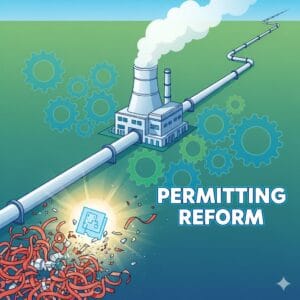 We’re not big fans of the American Petroleum Institute (API), which tends to do the bidding of the Big Oil companies that fund it. Big Oil’s aims are sometimes at odds with those of smaller, independent oil and gas producers—the innovators who discovered shale drilling. Yet there are state chapters of the API that do a good job. One of them is the Pennsylvania API chapter. The executive director of PA API, Stephanie Catarino Wissman, recently published an excellent article in Broad+Liberty that calls for fast-tracking the effort to pass federal permit reform so Pennsylvania can get back to building.
  Unintended (but entirely predictable) consequences are now happening in New York State. In January 2023, New York Gov. Kathy Hochul, a leftist Democrat, floated a plan to ban natural gas hookups in every single new home and business across the “Empire” State (see
  In August, the Federal Energy Regulatory Commission (FERC) reissued a certificate for the Northeast Supply Enhancement (NESE) project, a billion-dollar-plus project designed to increase Transco pipeline capacity and flows of Marcellus gas heading into New York City and other northeastern markets by an extra 400 MMcf/d (see