
80% of PA, OH, VA Voters Support More Pipelines & Power Lines
 The National Association of Manufacturers (NAM) recently commissioned a survey of residents in Pennsylvania, Ohio and Virginia–so-called “battleground” states that can swing either Democrat or Republican come election-time. The survey found that an average of 80% of the respondents support energy infrastructure spending, by both government and private companies. Which is remarkable. When was the last time you heard of 80% of the American electorate agreeing on anything? This survey takes the wind out of the sails of the “keep it in the ground” movement of fossil fuel haters, like those opposing pipeline projects like NEXUS, Rover, PennEast, Atlantic Coast, Atlantic Sunrise, Mountain Valley, et cetera et cetera. Here’s the results of the NAM survey…
Read More “80% of PA, OH, VA Voters Support More Pipelines & Power Lines”
 Gulfport Energy reports they have just snagged another 12,600 net undeveloped Utica acres located dry gas window of northern Monroe County, Ohio for $87 million. When you run the math, that works out to be $6,905 per acre–far less than the recent $10,000/acre prices we’ve seen. Half of the acreage is “held by production,” meaning wells have either been drilled or are already producing. Analysts figure the land, which is located next to land already leased by Gulfport, will yield something like 105 new wells for the company. Gulfport is head over heels in love with the Utica and plans, as we noted in November, to run an average of six drilling rigs in the Utica in 2017 (see
  The worldwide Baker Hughes rig count was up by 5 in November, from 920 in October to 925 in November. That reverses a brief slide back in October when rigs worldwide slide back by 14. However, the rig count in the U.S. went up for the fifth month in a row. The average U.S. rig count for November was 580, up 36 from the 544 counted in October. That’s a two month increase of 71! The Marcellus/Utica rig count was up for the fourth month running. In November the M/U rig count went up by 4 (second month in a row it’s gone up 4) with 2 additions in PA (now 27 rigs) and 2 in OH (now 16 rigs). WV stayed even running with an average of 10 rigs…
 On Monday MDN reported that the future site for an ethane cracker in Belmont County, OH is now cleared and ready for construction to begin (see
  All seven members of the Bowling Green City Council (Wood County) unwisely voted to reject an offer from Spectra Energy’s NEXUS Pipeline to lease 4 acres of city-owned land for the pipeline. Why unwise? Because the project is close to receiving its final federal approval, which will give it the right to use eminent domain to use the land anyway (see
  PDC Energy, a driller in the Wattenberg Field in Colorado and the Utica in Ohio, paused their Utica drilling program in 2015 (see
  The future site of a $5 billion petrochemical complex, including an ethane cracker, in Belmont County, OH is now cleared and essentially ready to begin building on. It has taken nearly a year, but the old R.E. Burger power plant that used to sit along the Ohio River is now just a memory. Belmont County officials say they expect PTT Global Chemical, the company that will build and operate the cracker, will make a final (positive) investment decision by the end of March–in just a few months’ time. Although the project began after Shell’s cracker project in Beaver County, PA, the PTT Global project in Belmont County has almost caught up with the Shell cracker project with respect to site readiness and building the actual buildings that will house the mighty cracker…
 As MDN predicted, yesterday the Federal Energy Regulatory Commission (FERC) approved the NEXUS Pipeline project (see
  FERC (the Federal Energy Regulatory Commission) is not happy with Energy Transfer and their Rover Pipeline. There are two major pipeline projects planned for Ohio: NEXUS and Rover. NEXUS got some FERC love today (see today’s lead story). Rover, on the other hand, is getting the cold shoulder from FERC, from a self-inflicted wound. Let us explain. As a reminder, Rover (an Energy Transfer project) is a $3.7 billion, 711-mile Marcellus/Utica natural gas pipeline that will run from PA, WV and eastern OH through OH into Michigan and eventually into Canada. The short version of what happened is that in May 2015 Rover purchased a house in Carroll County, OH, located near where the pipeline, and a compressor station for that pipeline, is due to run. Rover bought the house to use for offices for several Rover affiliate companies. After buying it, they determined it was “ill-suited for its intended purpose” and decided to demolish the house. Problem was/is, that house was under consideration to be added to the National Register of Historic Places. The house was not yet on the list of Historic Places, but was on a list of properties under consideration. Rover should have reported their decision to demolish the house to FERC but didn’t, which has Rover in hot water with FERC and the Advisory Council on Historic Preservation. Will Rover’s action kill the project? No. Will it slow down Rover and end up costing the company boatloads of money? Most likely, although Rover disputes that interpretation of events…
 For several years MDN has tracked and reported on a lawsuit brought against the Muskingum Watershed Conservancy District (MWCD) by an anti-drilling couple in Guernsey County, OH–Leatra Harper and her husband Steven Janstro (backed by the odious Food & Water Watch). At last check in April 2014, the couple had won the right to continue on with the lawsuit (see
  Pipelines have been, and continue to be, a big deal throughout the Marcellus and Utica region. Landowners who are approached about placing a pipeline through their property should (1) never sign the standard contract presented, and (2) never sign anything without first running it by a lawyer. Beyond that, what else should landowners think about/do when negotiating a pipeline easement? Clif Little from the Ohio State University Extension gives us some helpful tips…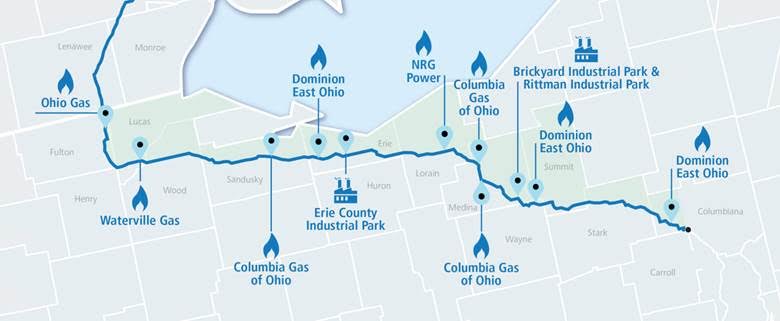

 The city of Green in Summit County, OH has put NEXUS Pipeline on notice that if surveyors show up to survey in the city and if those surveyors don’t have permission from the landowner, or a judge’s order, those surveyors will be arrested and charged with trespassing. Apparently Green hasn’t gotten the memo that pipelines are the safest form of transportation on earth–period. NEXUS, as well as other pipeline projects, face a classic Catch-22 situation. In order to get the Federal Energy Regulatory Commission to grant a certificate to build the pipeline, the pipeline company must first conduct initial surveys to plan the route. With a certificate from FERC in hand, the pipeline then has the power of eminent domain to use on recalcitrant landowners to build the pipeline across their land. The open question is whether or not the pipelines can use eminent domain to conduct the survey ahead of a full FERC certificate. That’s the Catch-22. Surveying doesn’t do a single thing to a property, other than a few guys and gals running around for a short time looking through a transit and taking measurements. It’s a shame that landowners, in some cases, won’t even allow that. So Green has put NEXUS and the world on notice that the city and its residents don’t want to participate in the riches that come from shale. Fine. Let them eat dirt…
 In June, Massachusetts-based Clean Energy Future broke ground on their $800 million, 940-megawatt Utica gas-fired electric plant in Lordstown (Trumbull County), OH (see