
In FERC’s Game of Musical Chairs, NEXUS Pipeline Left Standing
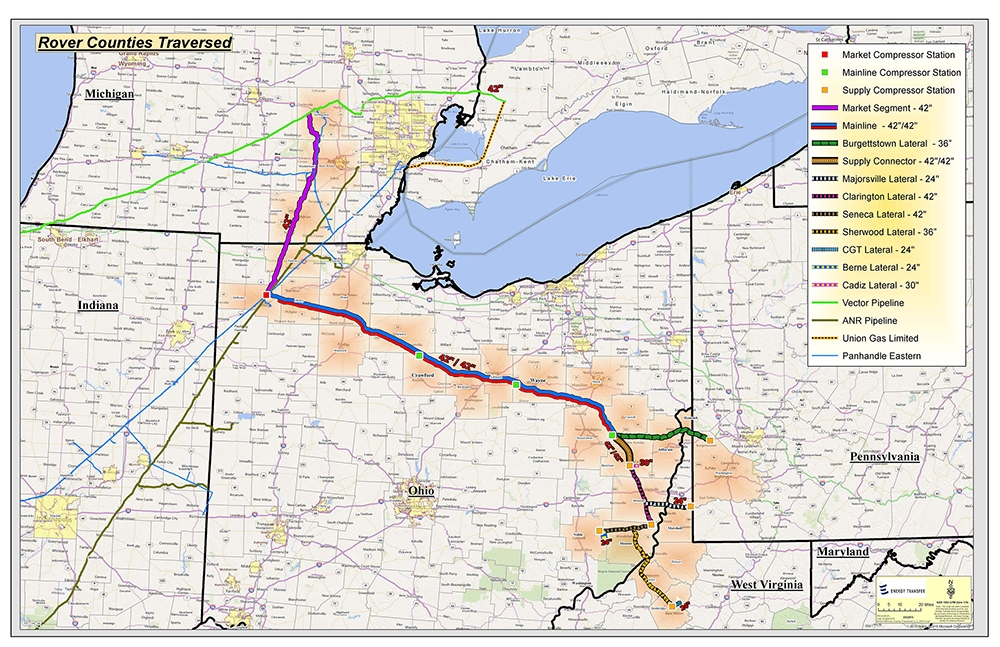
 When reporting on the flurry of Federal Energy Regulatory Commission (FERC) approvals from last Friday, before Commissioner Norman Bay resigned in a huff over losing the chairmanship of the agency (and leaving the Commission with only two Commissioners, not enough to vote on more projects), we noticed there was one major Marcellus/Utica pipeline project that didn’t receive a final approval: the NEXUS Pipeline project. NEXUS is a $2 billion, 255-mile interstate pipeline that will run from Ohio through Michigan and eventually to the Dawn Hub in Ontario, Canada. It is a critically needed pipeline to move Utica and Marcellus Shale gas from an over-saturated market in the northeast to markets in the Midwest and Canada. It is a joint venture between DTE Energy and Spectra Energy. In December FERC issued a positive final Environmental Impact Statement (see FERC Approves NEXUS Pipeline, Project on Track for 2017). The only thing left is for FERC to issue a certificate of public convenience and necessity, to begin construction. That didn’t happen on Friday, which means the project is now delayed until at least one more FERC Commissioner is nominated and approved by the U.S. Senate so the Commission regains a voting quorum. In a sense, FERC could only rush through so many projects at the last minute, and in a game of musical chairs, the music stopped and NEXUS was left standing–without a chair. Is lack of a FERC decision last week an indicator that the project is in trouble? What happens now?…
Read More “In FERC’s Game of Musical Chairs, NEXUS Pipeline Left Standing”
 In December the Bureau of Land Management proceeded with an online auction for BLM-controlled land in Ohio’s Wayne National Forest (see
  A few weeks ago MDN highlighted a developing issue in Ohio that potentially impacts Utica/Marcellus shale in the region (see
  Kinder Morgan has proposed the UTOPIA (Utica To Ontario Pipeline Access) pipeline, a 12-inch ethane pipeline that will run ~240 miles across the state of Ohio where it will connect with another pipeline and (eventually) flow ethane all the way to a cracker plant in Canada. That is, if they can get some holdout landowners to allow them onto their land (see
  In December 2013 MDN first reported a new $250 million pipeline on the way in the Utica Shale from Marathon Petroleum Corporation, the largest refiner in the Utica Shale region (see
  MDN reported in September that American Electric Power is selling four electric generating plants to a newly formed joint venture of Blackstone and ArcLight Capital Partners (see
  World Oil calls itself “the premier trade publication for the international upstream industry.” Perhaps it is–who are we to say otherwise? The folks at World Oil have done us all a favor. They surveyed the upstream (i.e. drilling) oil and gas industry to find out what drillers are planning for 2017. Overall, they find drillers plan to drill 18,552 wells in North America this year–a big 26.8% jump from last year. In releasing a summary of the results, Wold Oil outlines region by region in the U.S. what they predict will happen this year, based on survey results. The northeast section caught our eye. World Oil predicts Pennsylvania will see a 29% increase in new well drilling this year (total of 774 new wells drilled). Ohio will see an increase of 19.1% in new well drilling (380 new wells). And West Virginia will see a big 21.9% increase (245 new wells). Here’s the full summary from World Oil…
 “Johnny could only sing one note / And the note he sang was this…” Ohio Gov. John “severance tax” Kasich is Johnny One Note when it comes to his desire to tax the Utica Shale industry and transfer their hard-earned money away to other people who didn’t earn it. Kasich announced he would obstinately include a nosebleed-high Utica Shale severance tax (6.5%) in his biennium budget–again. Kasich has been pining for an increase in Ohio’s severance tax for years (
 Pennsylvania hired research firm IHSMarkit to study the Marcellus and Utica and how many ethane cracker plants the region can comfortably support. Denise Brinley, a special assistant to the Secretary of the state Department of Community and Economic Development, offered a preview of that report at this week’s Hart Energy Marcellus Utica Midstream conference in Pittsburgh. Although the report is due to be published “in the next few weeks,” Brinley spilled the beans on what it concludes: The PA Marcellus can support another two cracker plants, and the Utica can support two crackers. That’s another four cracker plants, theoretically, that our region can support, in addition to Shell’s ethane cracker. However, the study will also show we need more infrastructure (i.e. pipelines) in order to support such projects. Here’s a glimpse into some very exciting news…
 A Cleveland, OH-based natural gas utility company, Gas Natural Inc., has sold itself to investment firm First Reserve Energy. Gas Natural sells 21 billion cubic feet (Bcf) of natural gas to roughly 68,600 customers through regulated utilities operating in Montana, Ohio, Maine and North Carolina. Gas Natural’s other operations include an intrastate pipeline, natural gas production and natural gas marketing. First Reserve Energy is an investment firm focused solely on investing in (and buying) energy companies. Shareholders for Gas Natural voted at the end of December to approve the buyout/merger…
 A professor from an Ohio college had the temerity to publish a guest column in the liberal Cleveland Plain Dealer taking federal regulators to task over the years-long wait time it takes to get a new LNG (liquefied natural gas) facility approved. Prof. Robert Chase, Emeritus Professor in the Department of Petroleum Engineering and Geology at Marietta College, says more natural gas needs to reach the world market, via LNG, and if it doesn’t, the lack of LNG exports will put Ohioans out of work. The good prof says the incoming Trump Administration and Congress needs to take “prompt action” to “speed up the licensing process for companies seeking permits to export liquefied natural gas.” Here, here! We fully agree…
 MDN has reported on the Ohio Dormant Minerals Act (DMA) for years. In a nutshell, there are two DMAs in Ohio–one passed in 1989 that went into effect in 1992, and another in 2006 which added certain additional procedural requirements to the 1989 version. The DMA in its various versions provides for mineral rights that had previously been separated from surface rights to transfer back to the surface owner under certain conditions. The problem, for drillers and for landowners in Ohio, is in knowing which set of DMA rules to use (1989 or 2006) in determining who owns the mineral rights. A number of DMA cases went before the Ohio Supreme Court. In September the Ohio Supreme Court ruled in three cases, saying all of the other cases come under those three (see
  For the past couple of years Gulfport Energy has made major investments in the local communities where it operates in Appalachia (see