
New Law Blocks Anti-Drilling Ballot Measures in Ohio
 Enough is enough. As MDN reported last June, anti-drilling zealots in Youngstown, OH filed a petition to place a frack ban resolution on the November ballot–for the 6th time (see Brain Dead: Youngstown Antis File Petition for 6th Frack Ban Vote). The petition held up, there were just enough signatures. And once again in November, as the five times that preceded it, Youngstown voters rejected the misnamed, so-called Community Bill of Rights ballot measure–yet another humiliating defeat for the PA-based Community Environmental Legal Defense Fund (CELDF) which is behind the measure (see Youngstown, OH Frack Ban Ballot Measure Defeated for 6th Time). The measure was voted down by an 11-point margin (i.e. landslide against it). The radicals of the CELDF are behind most, if not all, such measures throughout Ohio and Pennsylvania (see our CELDF stories here). Like the six times before, recalcitrant antis say they will try yet again, and keep trying. Except in Ohio they now won’t get that chance. Ohio legislators are heard the pleas of local municipalities that are spending big money (in legal fees) dealing with these patently illegal ballot measures. So the legislature passed House Bill (HB) 463 in December (full copy below)–a measure that says you can’t add a ballot measure (like home rule for oil and gas regulation) that expressly contradicts state law. Gov. John Kasich signed the bill on Jan. 4–meaning no more Youngstown ballot “Community Bill of Rights” measures on the ballot…
Read More “New Law Blocks Anti-Drilling Ballot Measures in Ohio”
 On Dec. 31, 2011, the Youngstown, OH area experienced a 4.0 earthquake that was later determined to be caused by a wastewater injection well (see
  In April 2015 the Obama administration’s U.S. Fish and Wildlife Service (USFWS) did a disservice to not only the drilling industry, but the wind industry, farmers and the construction industry. USFWS listed the northern long-eared bat as “threatened” under the Endangered Species Act (see
  As we reported in December, Ohio legislators sent Gov. John “foreigner hunter” Kasich a bill at the end of the year with provisions that clear up language regarding tax exemptions for the oil and gas industry (see
 In August, the Federal Energy Regulatory Commission (FERC) issued a favorable environmental assessment (EA) for three Spectra Energy projects: Access South, Adair Southwest and Lebanon Express (see
  The legal beagles at global law firm Norton Rose Fulbright continue to do us all a huge favor. Researchers at the law firm issue a quarterly legislative action update looking at bills and laws previously voted on, and new bills/laws introduced, affecting the oil and gas industry in Pennsylvania, Ohio and West Virginia. The “Quarterly legislative action update: Marcellus and Utica shale region” for 4Q16 (full copy below) begins with a quick listing by state for existing or new laws introduced, with descriptions for each bill/law. This is, in one place, pretty much everything you need to know about what new laws (i.e. regulations) are coming down the pike that will affect the Marcellus and Utica Shale drilling industry…
 Based on a recent uptick in new permits issued in PA, OH and WV, a writer for the Daily Caller says “a wave of new fracking is about to hit Appalachia.” We agree! Recent trends all point to an increase in drilling–which is good for landowners, jobs, taxes and the environment (more gas lowers CO2 emissions, if you believe in man-made global warming). Here’s a startling statistic: Fracking is estimated to have generated 4.6 million new jobs and $3.5 trillion in new wealth–in just three years (see today’s companion story). Surf’s up! Here’s the evidence that a new “wave” of fracking is on the way in our neighborhood…
 The GoMarcellusShale Forum where landowners and others interested in shale drilling hang out and swap messages back and forth was recently updated to become
  As we previously noted, last week the Bureau of Land Management (BLM) proceeded with an online auction for BLM-controlled land in Ohio’s Wayne National Forest (see
 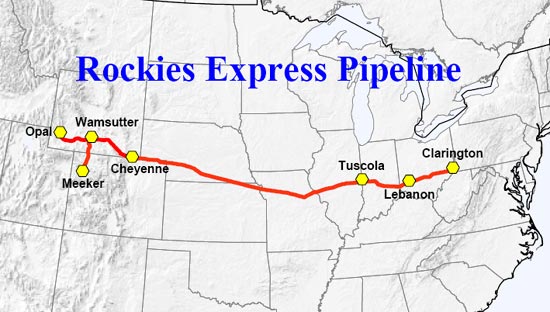 The Rockies Express Pipeline (REX), originally built from Colorado and Wyoming to Monroe County, OH to bring natural gas from west to east, last year reversed the flow for a large and important section of the pipeline. On August 1, 2015 the section of REX from Monroe County, OH to Mexico, MO reversed the flow and began to carry 1.8 billion cubic feet per day (Bcf/d) of Utica and Marcellus Shale gas to the Midwest, including to the greater Chicago area. REX has been hard at work on plans to expand capacity even more by beefing up compressor stations along portions of the pipeline. REX filed a plan with FERC to add another 800 million cubic feet per day (MMcf/d) of capacity along the same portion of the reversed pipeline. In late November, the Federal Energy Regulatory Commission (FERC) gave REX the go-ahead to start additional compressors added at three locations along the route (see
  Headquartered in Houston, Texas, Exterran Corporation (with 5,400 employees) specializes in natural gas compression production equipment and processing facilities. They design, build and operate compressor stations and natural gas processing plants. In 2012 MDN reported on a contract Exterran won to build three natural gas processing plants in West Virginia (see
  The Ohio Dept. of Natural Resources (ODNR) has just issued production numbers for the third quarter of 2016. Compared with third quarter 2015, production numbers in 3Q16 continued to be a mixed bag, as was the case in 2Q16 (see
  It’s happened, just as we predicted. Paid, out-of-state protesters have arrived in Ohio, as they did in North Dakota, with the intent to block plans to begin fracking on land in Wayne National Forest. The Bureau of Land Management will conduct an auction tomorrow for 1,600 acres of land in WNF (see