
OH Court Sides with Mariner East 2 Pipe in Eminent Domain Case
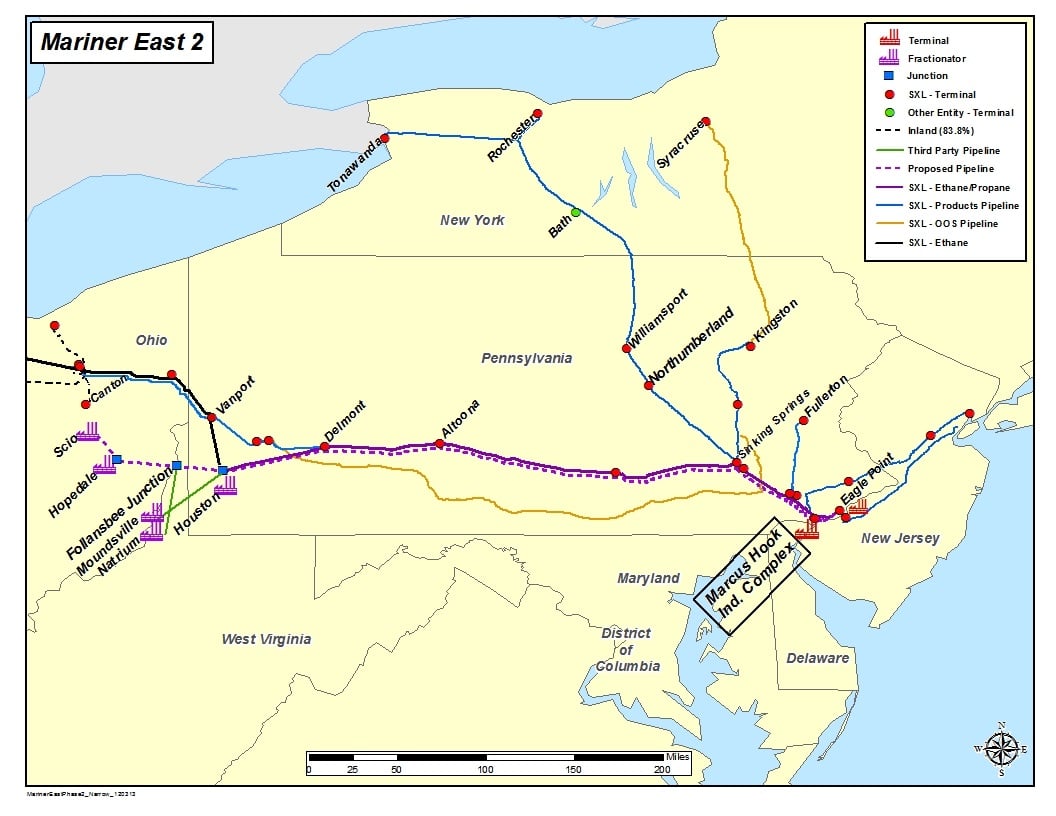
An Ohio landowner whose land Sunoco Logistics Partners wants to traverse with the Mariner East 2 pipeline tried a novel legal argument. The landowner’s attorneys argued in the Ohio Seventh District Court of Appeals that pure propane and pure butane–both of which would be transported through the pipeline from eastern Ohio all the way to the Marcus Hook refinery near Philadelphia–are not “petroleum.” At least, not petroleum for the purposes of the permit which grants Sunoco the right to use eminent domain to build the pipeline to transport petroleum products. The Court of Appeals justices rejected that argument and said, in essence, that propane and butane fit under the definition of petroleum as that word has been used for generations…
Read More “OH Court Sides with Mariner East 2 Pipe in Eminent Domain Case”

 Tim Greene is owner of Land & Mineral Management of Appalachia and a former West Virginia Department of Environmental Protection inspector. He knows a thing or two about leasing and drilling in the Mountain State. As part of a recent article, Greene was asked about the many leases signed five years ago that are coming up for renewal (or release). Greene said five years ago landowners in WV and OH were getting signing bonuses of $5,000 per acre and more, with royalties going as high as 20%. As those leases come up for renewal, Greene cautions landowners that they won’t see anywhere near those terms if they sign again. What will they see?…
 In February MDN brought you exclusive news that Shell had begun approaching landowners in Beaver County to get them to sign easements for two ethane pipelines to feed the mighty cracker plant they plan to build in the county (see
  The 2017 Northeast Oil & Gas Awards has received a boatload of nominations for the upcoming awards ceremony in Pittsburgh next March. LOTS of nominations. The folks at the Oil & Gas Awards will be contacting each nominee to see if they want to participate this year. Below is the entire list of nominees. Note: there is still time to nominate your company! The deadline is Dec. 14th. Below we have a list of everyone nominated so far, and the list of categories for which your company can be nominated…
 Marathon Petroleum, which purchased midstream company MarkWest Energy last year, continues to grow and expand–because of the Utica Shale. Marathon operates a refinery in Canton, OH that processes crude oil. Question: Did you know that 25% of the crude oil being processed at the Marathon refinery comes from the Utica Shale? No, we didn’t know that either! Marathon has made some big bets on the Utica. In fact, over the past two years, they’ve bet more than $1 billion on the Utica…
 In September the Ohio Supreme Court finally ruled on a series of cases involving the state’s Dormant Mineral Act, or DMA (see
  At last year’s Utica Summit III event held in Stark, OH, Tom Gellrich of consulting firm TopLine Analytics, a company that “closely follows ethane markets,” said he thinks the first ethane cracker to get built will be the Shell cracker plant in Beaver County, PA. He was right. Shell announced their official decision to move forward earlier this year. At that same event Gellrich said he thinks the Marcellus/Utica region will see three, possibly four, ethane crackers built (see
 Kinder Morgan’s UTOPIA (Utica To Ontario Pipeline Access) pipeline is a 12-inch ethane pipeline that will run ~240 miles and will only be built in Ohio–therefore the Federal Energy Regulatory Commission (FERC) won’t be involved in permitting the project. In September we noted that Kinder Morgan is still facing opposition from some Ohio landowners (see
  Gas Natural Inc., a local distribution company (LDC), or “gas utility” company has operations in four different states, including Ohio. Gas Natural also owns pipelines and processing facilities. Gas Natural has just sold itself to energy investment firm First Reserve for $139 million…
 The Baker Hughes rig count, watched closely by those in the industry (the benchmark used across the world) has been trending up in the U.S. since July. BH released their venerable count for September on Friday and once again the counts have gone up–very good news indeed. BH is reporting an average of 509 active rigs in the U.S., up 28 from August. MDN performs its own rig count for the Marcellus/Utica, using BH’s numbers for Pennsylvania, Ohio and West Virginia. The Marcellus/Utica rig count was up for the second month running. In September the M/U rig count jumped up by 7. The biggest gainer was Pennsylvania, up by 5. West Virginia was up by 2, and Ohio stayed even…
 Oilfield services company Mammoth Energy Services, headquartered in Oklahoma City, OK, operates in both the Utica Shale and Permian Basin. Mammoth offers services like “completion and production services, natural sand proppant services, contract land and directional drilling services and remote accommodation services.” Mammoth is a baby company, formed in 2014, but already booking $243 million in revenue for the 12 months ended June 30th. Mammoth announced yesterday an initial public offering (IPO) of stock, which will trade under the ticker TUSK (keeping with the theme of a woolly mammoth–clever). The company plans to raise between $128-$169 million (call it $150M) by offering 7.75 million shares. What is noteworthy is that this is one of the very few new IPOs to be offered this year in the o&g sector…
 At last week’s Shale Insight conference, MDN editor Jim Willis had the opportunity to listen to three top legislators, one each from PA, WV and OH. We reported on their panel discussion, titled “Pennsylvania, Ohio and West Virginia Legislative Leaders: The Future of the Industry” (see