
EIA: Utica Shale Turned Out to be a NatGas (Instead of Oil) Play
 When Aubrey McClendon first trumpeted his find in the Ohio Utica Shale, he famously said the Utica Shale could be worth $500 billion, and the “biggest thing economically to hit Ohio, since maybe the plow.” Not quite as famous, but on the same day at the same event, McClendon also said the Utica “is likely most analogous, but economically superior to, the Eagle Ford Shale in South Texas.” That one turned heads and got tongues flapping. McClendon made those remarks five years ago this month at the Ohio Governor’s 21st Century Energy & Economic Summit in Columbus, OH. The reason Aubrey was so excited was because of the oil potential in the Utica. But fate is a funny thing. As it turns out, it is natural gas that’s turned out to be the big story in the Utica. Last Friday the U.S. Energy Information Administration (EIA) published an article that chronicles the development of the Utica and illustrates, with charts and graphs, how the Utica has turned out to be a gas rather than an oil play–at least so far…
Read More “EIA: Utica Shale Turned Out to be a NatGas (Instead of Oil) Play”
 Ohio’s Ninth District Court of Appeals has upheld the right of NEXUS Gas Transmission to enter onto private land in order to conduct surveys for a potential pipeline route. Ohio’s Sixth District Court previously made a similar ruing in favor of NEXUS. Top energy law firm Bricker & Eckler argued for NEXUS in both cases and turns in the following report:
 The Ohio Business Roundtable (BRT) is a partnership of the CEOs of leading Ohio companies that collectively account for more than $1 trillion in annual revenues, $1 trillion in market value and $2.6 trillion in assets. BRT’s members employ 2.6 million men and women, invest hundreds of millions of dollars annually in combined charitable contributions and research and development, and generate billions of dollars in sales for small and medium-sized businesses that are part of the supply chain. When the BRT in Ohio talks, people had better listen. Here’s the latest in what the BRT has to say: The state (i.e. Gov. Kasich) needs “a comprehensive reworking of the state’s energy policies in order to accelerate shale gas development.” No more tiptoeing around. Build those pipelines and build them NOW. That’s the upshot of a new report from the BRT titled, “Improving Ohio Energy Competitiveness” (full copy below). The report is backed up by detailed research from powerhouse consulting company McKinsey and Co. (their research is also embedded below). The BRT’s report points out the importance of the state’s natural gas-fired electric generating plants and says without more pipelines, new power plants won’t get built. The two issues are joined at the hip–vitally important for Ohio’s shale drillers, midstream companies, electric generators and yes Ohio’s electric ratepayers as well. LISTEN UP: Here’s what the BRT had to say…
 American Electric Power is selling four electric generating plants to a newly formed joint venture of Blackstone and ArcLight Capital Partners. Three of the plants are natural gas-fired–two of them in Ohio and one in Indiana. One of the plants is coal-fired, located in Ohio. Total sale price for all four: $2.17 billion. While the announcement doesn’t say, we expect at least the gas-fired plants in Ohio, and perhaps the one in Indiana, are fed in part by Utica/Marcellus natural gas. Which is why the story caught our eye. The plants are already up and running–this is simply a transfer of ownership and (we presume) management of the plants. The larger story is just how important these types of plants are in the Marcellus/Utica ecosystem–because they use a huge amount of gas. Here’s the details of the deal…
 Anti-fossil fuel zealots in Athens, Meigs and Portage counties in Ohio are spitting and sputtering after the Ohio Supreme Court on Tuesday once again shut down their childish frack ban ballot measures–ruling that Secretary of State Jon Husted and the election boards of those counties did not violate the law in tossing out the ballot measures. The radical Pennsylvania-based Community Environmental Legal Defense Fund (CELDF) is particularly torqued off. It’s not the first time the Supremes have slapped them down. Their frack ban ballot measures were also tossed last year by the Supremes (see
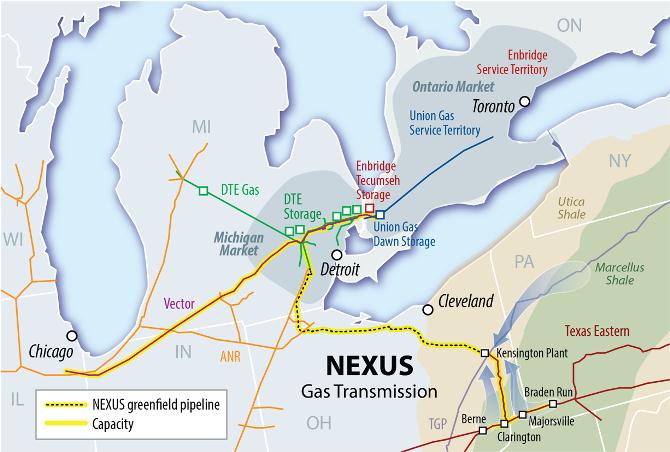
  Spectra Energy’s NEXUS Pipeline, a $2 billion, 255-mile interstate pipeline that will run from Ohio through Michigan and eventually to the Dawn Hub in Ontario, Canada, continues to build support and a good head of steam. In July the Federal Energy Regulatory Commission (FERC) issued a favorable draft Environmental Impact Statement for the project, a sure sign that FERC intends to approve it (see
  Duke Energy Ohio, an LDC or “local distribution company” serves some half a million customers with natural gas in Ohio. The company has a ~12 mile pipeline to flow gas it needs to move from one point to another in Hamilton County, the southwest corner of the state. The Duke pipeline has been around and in service since the 1950s. Duke needs to replace that pipe or some of the half million Duke customers won’t get natural gas any more. Because anything to do with “fracking” or “pipelines” has been so thoroughly bastardized by the media and anti-drilling whack jobs, there was, of course, opposition to Duke’s plan. So Duke “listened” and has scaled back their plans. Instead of building a 30-inch gas pipeline running at 600 psi (pounds per square inch), the revised plan calls for a 20-inch pipeline running at 400 psi. Duke has proposed two potential routes (see the map below). Here’s the lowdown on Duke’s scaled-back, tiny pipeline project in Hamilton County called the Central Corridor Pipeline Extension Project…
 Dominion launched a $4 billion, 25-year Pipeline Infrastructure Replacement (PIR) program in mid-2008. The program involves replacing over 5,500 miles of Dominion’s 22,000-mile pipeline system. Most of the pipeline to be replaced was installed in the first half of the 1900s. Some of the pipeline (much?) is being done in Ohio. The pipelines Dominion wants to replace in Ohio are regulated by the Public Utilities Commission of Ohio (PUCO). If Dominion wants to do anything with or for the pipelines in Ohio, they first need PUCO permission. Dominion has sought, and now received, PUCO permission to expand the program in Ohio. Dominion currently spends $160 million per year on the program in Ohio. PUCO gave them permission to up that amount to $170 million next year and $200 in 2018. Why is that important? Because Dominion gets to “recover” the costs (i.e. charge the costs) to utility customers. Dominion customers in Ohio can expect to see a rate increase…
 David Hill is a geologist and a driller located in Ohio (David R. Hill Inc.). At a recent Coffee and Commerce meeting sponsored by the Cambridge Area Chamber of Commerce, Hill offered his insights into when oil drilling may return to Guernsey County and eastern Ohio. As MDN recently reported, much of the focus on drilling in the Utica has lately turned to dry gas, or methane only (see
  Yesterday MDN reported the story that Dominion Transmission has decided to lock out union members from working at their jobs in Dominion installations over a contract dispute (see
  Virulent anti-fossil fuel nutters who are opposed to Spectra Energy’s $2 billion, 255-mile NEXUS interstate pipeline that will run from Ohio through Michigan and eventually to the Dawn Hub in Ontario, Canada, have stayed up late at night reading through all of the comments sent to the Federal Energy Regulatory Commission (FERC). The habit of antis is to generate a blizzard of negative comments to FERC on any given project, sometimes using the names of their children (see
  This story is almost too good to be true. Researchers from Ohio State University have been analyzing the genomes of microorganisms (i.e. bacteria) that live in Utica Shale wells. (Who would think to do something like that?) The researchers “have found evidence of sustainable ecosystems taking hold there–populated in part by a never-before-seen genus of bacteria they have dubbed ‘Frackibacter.'” Translation: There’s little communities of microscopic critters that live in those shale wells, including a brand new critter that lives only in fracked Utica Shale wells. The hypothesis is that fracking itself created this new mutated life form. The researchers are calling it Frackibacter (we think it’s pronounced frack-uh-back-tor). We have a better name: Frackenstein! Yes ladies and gentlemen, step right up to witness this fracking freak of nature–a bacteria created from fracking itself. Who knew fracking didn’t destroy life, but actually creates it?! Below is an article about the discovery, along with a copy of the peer reviewed paper published in the journal Nature Microbiology announcing the discovery of this new fracked life form…
 This is an update to a story MDN ran last week observing that Utica drillers have slowed (or stopped) their wet gas drilling work and instead have shifted to drilling Utica wells, in Ohio, in the dry gas areas (see