
Energy Services | Energy Transfer Partners | Industrywide Issues | Ohio | Pipelines | Statewide OH | Supply Chain
ET Rover Buys Largest-Ever Order of Cat® Gas Compression Engines
 In September MDN told you that the 711-mile ET Rover Pipeline, costing an estimated $3.7 billion to build, had awarded a contract to an Ohio company to build 39 compressor stations (see Rover Pipeline Awards OH Company $34M to build 39 Compressor Stns). The announcement makes a quick mention that “Rover Pipeline purchased a combination of Caterpillar natural gas engines and Ariel compressors.” We now have the details on the Cat engines being purchased, which according to Cat is “the company’s largest ever single-project order”…
Read More “ET Rover Buys Largest-Ever Order of Cat® Gas Compression Engines”
 In March of this year, Syracuse University Professor Dr. Donald Siegel published the results of an extensive research study that found fracking of Marcellus Shale wells in Pennsylvania does not cause methane in water wells (see
  Countless times MDN has told you that in rare cases, injecting fracking wastewater into a deep, underground Class II injection well (for disposal) can cause earthquakes–if the injection well is located over a fault. When you inject fluids under high pressure into rock formations with a fault it can act like a lubricant, allowing the rocks to slip and slide–causing a low-level earthquake. It’s happened in Ohio. It’s happened (a lot) in Oklahoma. It’s happened in Texas. And in other states too. Thirteen oil and gas states joined together with the Interstate Oil and Gas Compact Commission (IOGCC) and Ground Water Protection Council (GWPC) to form the StatesFirst Initiative, a working group to pool their knowledge and try and figure out how, and under what conditions, injection wells cause earthquakes. Co-heading the initiative is Ohio’s Chief for the Division of Oil & Gas Resources Management (Ohio Dept. of Natural Resources), Rick Simmers. Rick and the working group have just released a 150-page Primer (copy below) to help regulatory agencies evaluate and develop good policies to mitigate and prevent earthquakes from injection wells…
 Last week MDN told you that Ohio’s RINO legislators continue to work on raising the Utica Shale severance tax in the state “behind closed doors” (see
  Last Thursday the Ohio Oil and Gas Commission issued its first order addressing the issue of forced pooling. The Commission upheld a forced pooling order against Ohio landowner Gary Teeter Trust (Ronald Roudeush is the trustee of the trust) by reaffirming that Ohio’s pooling and unitization provisions work to protect landowners–even those landowners like Roudeush who prefer not to be part of a drilling unit–by fairly compensating them. Rex Energy has leased land around the Teeter Trust (in Carroll County, OH) and sought to include 71 acres of the Teeter Trust property in a drilling unit, which Roudeush objected to and appealed. We have a copy of the decision below along with a further explanation of the case from the legal beagles at the Vorys law firm (the firm representing Rex Energy in the case)…
 Good news for the citizens of Ohio. The U.S. Environmental Protection Agency (EPA) recently released a report on Ohio’s Class II Underground Injection Control (UIC) program–that is, wastewater injection wells–and found that the Ohio Department of Natural Resources’ (ODNR) regulatory program is of “good quality” and continues to provide strong protections for Ohio’s underground sources of drinking water (USDW). The federal EPA just gave Ohio a big, fat, sloppy kiss right on the mouth along with a big two thumbs up that the state is doing it right when it comes to wastewater injection wells…
 ET Rover is a 711-mile Marcellus/Utica natural gas pipeline that will serve mostly U.S. customers and will cost $3.7 billion to build and run from PA, WV and eastern OH through OH into Michigan and eventually into Canada (see
  Once again Ohio Republicans are starting to lose their cool and are considering a dalliance with a high Utica Shale severance tax proposed by RINO Gov. John Kasich (who’s running for president, but then nobody knows since he’s at 0% in the polls). Perhaps state Republicans think by giving Kasich what he wants in a high severance tax it will enhance his presidential prospects with conservatives? (NOT!) Whatever the reason, Ohio’s left-leaning PBS outlet at Kent State is reporting legislators are meeting “behind closed doors” with members of the oil and gas industry to beg and plead for an increase in the severance tax…
 Just a few weeks ago Dominion announced they will hand out $1 million in grants for housing, food and health care in the regions in which they operate (see
  For several years a thorny legal issue in Ohio has been bubbling in the background–the Dormant Minerals Right Act (DMA). In a nutshell, there are two DMAs in Ohio–one passed in 1989 that went into effect in 1992, and another in 2006 which added certain additional procedural requirements to the 1989 version. The DMA in its various versions provides for mineral rights that had previously been separated from surface rights to transfer to the surface owner under certain conditions. The problem for both drillers and for landowners in Ohio, is in knowing which set of DMA rules to use (1989 or 2006) in determining who owns the mineral rights. It’s a big problem when drillers are spending sometimes up to $15,000 per acre in lease bonuses, to say nothing of where to send the royalty check. Some drillers are holding back on leasing because of this issue. There are now 12 (!) different cases before the Ohio Supreme Court dealing with the DMA and decisions may come soon for many of them. We get a good overview and update on DMA litigation from the legal beagles at the Bricker & Eckler law firm…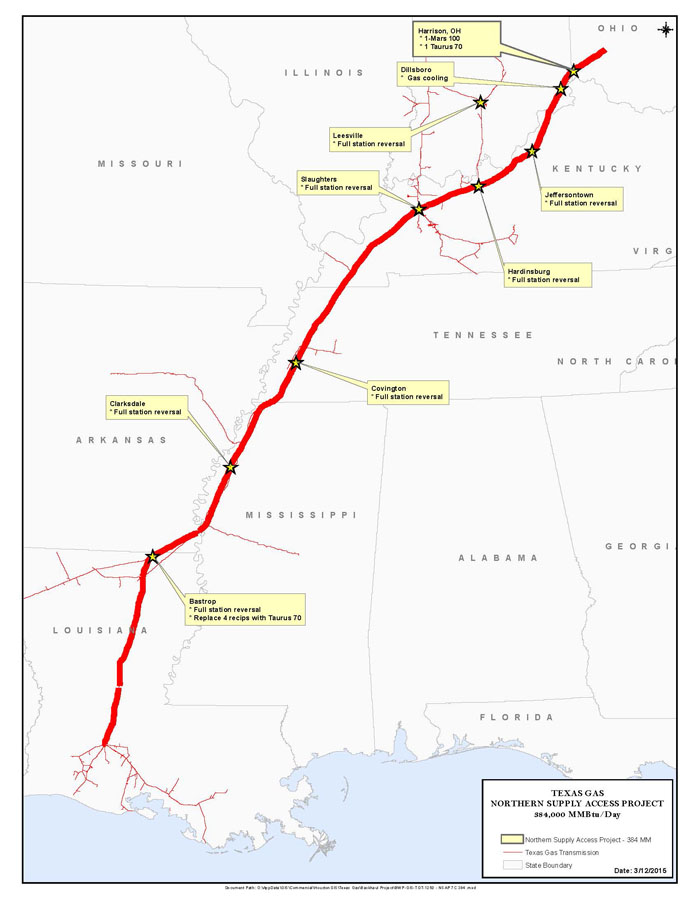
 Midstream giant Williams and drilling giant Chesapeake Energy are cuddling a little bit closer in the Ohio Utica Shale. Williams announced today they have signed an agreement with Chesapeake to run gathering pipelines in a new area of the dry gas Utica for Chesapeake in return for signing a contract that binds Chessy to using Williams until 2035. Williams was already gathering natural gas for Chessy on 140,000 acres of Utica Shale land in Ohio. This agreement extends the time on that 140,000 acres by adding another 20 years, and adds another 50,000 acres to the mix…
 Two sister companies based in Ohio–Valley Electrical Consolidated Inc. and Evets Oil & Gas Construction Services–will be merged together under parent company VEC, Inc. starting January 1, 2016. VEC/Evets has done construction and steel fabrication work for many Utica/Marcellus companies in Ohio and neighboring states. According to VEC’s president and owner, Rex Ferry, the realignment and merging of the two into one will allow them to better serve customers. Along with the merger of the two companies comes a few promotions, including a promotion for an MDN subscriber…
 The Ohio Utica Shale has just passed a major milestone on its way into the history books. There are now more than 1,000 producing Utica Shale wells in Ohio, with nearly another 1,000 permitted (with half of those already drilled). Although the pace of drilling has slowed, the Utica is turning out to be a worthy rival to the Marcellus. It’s not there yet! But keep a close eye on the Utica. The Utica may one day surpass the Marcellus in production, given the incredible volumes of gas that come from Utica wells…
 Last October MDN told you about an exciting project from Boardwalk Pipeline Partners’ Texas Gas Transmission pipeline that will reverse the flow from the Louisiana Gulf Coast all the way to Ohio (see
  Compressor stations in Ohio, needed to flow natural gas through numerous new pipelines being built, require a permit from the Ohio Environmental Protection Agency (EPA) in order to get built. The Ohio EPA considers each application independently, a laborious and long process. In an effort to streamline that process, the Ohio EPA is accepting comments during a “pre-comment” period from now until September 18 on a plan to issue general permits for compressor stations. A general permit is, essentially, a cookie cutter approach. If midstream companies agree to the provisions in the general permit, they will use certain types of equipment and certain standards, allowing the permit process to speed along much faster. Once the pre-comment (in essence, give us your feedback) period is over, the EPA will issue draft “final” general permits for full public comment, which will run for 30 days…