
Mountaineer Pipeline Under Potomac Latest Focus of Anti Movement
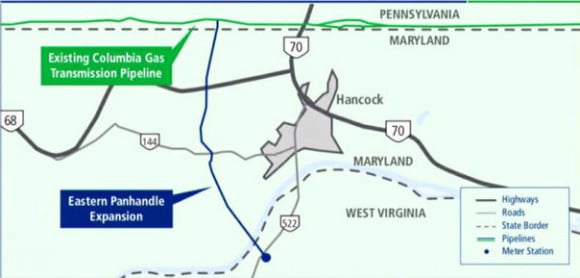
In April, MDN brought you the news that Columbia Pipeline (now owned by TransCanada) has filed an application with the Federal Energy Regulatory Commission (FERC) to build a 3.5 mile, 8-inch pipeline that will carry natural gas from Pennsylvania to connect the Mountaineer Gas system in the Eastern Panhandle of West Virginia with the Columbia Gas Pipeline in Pennsylvania (see New 3.5 Mile Pipeline Project to Drill Under the Potomac River). The purpose of the Eastern Panhandle Expansion project is to deliver natural gas via local distribution channels (local utility Mountaineer Gas) to a new industrial facility in Berkeley County, WV, scheduled to open in Fall 2017, and to provide gas to other local businesses and residents in the Tri-State area. Most of the proposed pipeline crosses through a tiny sliver of Washington County, Maryland. The main “issue” with the project is that the pipeline will be drilled underneath the Potomac River, which serves as the border between WV and MD. That has radical anti-fossil fuelers in an uproar. As we pointed out in July, the project is in a fight for its life (see WV Fight Over Simple Expansion of Local Gas Delivery Pipeline). Lack of natural gas is strangling expansion in Jefferson County, WV. But that makes no difference to antis in Maryland who are kicking up a fuss and planning to stage a kayak protest in the Potomac. Below is an update on anti efforts to stop the project, and pro efforts to get it approved and built…
Read More “Mountaineer Pipeline Under Potomac Latest Focus of Anti Movement”
 For those of us who have long supported the Williams Atlantic Sunrise Pipeline project, it seems like it has taken FOREVER for the Pennsylvania Dept. of Environmental Protection (DEP) to issue final water and air permits for the pipeline. Atlantic Sunrise is a $3 billion, 198-mile natural gas pipeline project, most of which will get built in northeast Pennsylvania. In an attempt to get the DEP moving, Williams co-hosted an event a few weeks ago in Wyoming County to pressure the DEP into granting final permits (see
 Chesapeake Energy reported second quarter 2017 results last week. As is typical, the company hosted a conference call with analysts to discuss those results. However, Chesapeake CEO Doug “the ax” Lawler had some rather exciting news about the Marcellus to report–late breaking news. In recent weeks Chesapeake has brought online an experimental well drilled in Wyoming County, PA (northeastern part of the state) with an initial production of 61 million cubic feet equivalent per day (MMcfe/d). This is a MONSTER Marcellus well! The most productive onshore shale well we know of is EQT’s Utica well in Greene County, PA, with a 72.9 MMcfe/d IP rate, drilled in July 2015 (see
  On July 25th, a Pennsylvania state environmental judge issued an order blocking all underground horizontal directional drilling (HDD) work being done across the state to install the Mariner East 2 (ME2) pipeline (see
  We’ve noticed a meme, largely started by an Associated Press article endlessly repeated and published in dozens of news outlets across Pennsylvania, that the recent budget deal (with a severance tax) passed by the traitorous Republican-controlled PA Senate “jams a shale tax and industry permits into unhappy package” that now sits before a House that essentially has no choice but to adopt it. Here’s the establishment “received wisdom” in a nutshell: Drillers don’t get what they want (a severance tax), but they do get what environmentalist wackos don’t want (streamlined approvals for permits). And guess what? “That’s politics.” And if you don’t like it, on either side of the equation, you’re an unrealistic dope who doesn’t know anything about politics. We manifestly reject that assertion. Here’s why this deal is one sided–a severance tax only deal. Big Green groups with endless pockets to fund litigation factories are already talking about how if this budget is passed with what they want (a high severance tax) but also with what they don’t want (streamlined approvals for permits), no problem. They’ll just sue to remove the streamlined permits part, leaving drillers with the high severance tax. That’s how “fairness” works for Democrats and antis. Get part of what you want, then litigate the rest–force it on people who don’t want it. That’s the strategy laid out in the AP article claiming both sides are unhappy, implying it’s a good deal because both sides are getting something they want and something they don’t want. The clear signal being sent by environmentalists is that they’ll litigate their way to happiness. Meanwhile the Marcellus industry will get the shaft, which is why the House MUST reject this budget as written…
 It’s not often these days we get to announce a new driller in the Marcellus/Utica. Today is one of those days. Actually, this company has been around since early 2015, but we’re only now becoming aware of them. Pin Oak Energy Partners, headquartered in Akron, OH, is an exploration and production company engaged in both conventional and unconventional oil and natural gas wells and the operation of associated assets (like pipelines). Pin Oak currently operates 363 wells producing nearly 5.7 MMcfe/d (32% liquids) across more than 32,000 acres in the Marcellus/Utica region. The company is also involved in midstream, field services and operations through its affiliate companies. Pin Oak is on an aggressive acquisition binge of shale AND midstream assets, as well as leasing new acreage. Who is Pin Oak? According to CEO Chris Halvorson, Pin Oak is comprised of folks who were formerly with AB Resources. You may recall that AB Resources built a position in the southwestern “core” of the Marcellus and sold out to Chevron several years ago. Pin Oak is “what’s next” for for the former AB folks. Their target: the Appalachian basin. In July, Pin Oak bought 9,300 acres of leases and 8 Utica wells from EQT in Guernsey, Muskingum, and Columbiana counties (Ohio). Earlier this week Pin Oak announced they’ve purchased another 7,700 acres of leases and 10 Utica wells from an undisclosed seller in Trumbull, Tuscarawas and Mahoning counties (in Ohio) and Mercer, Crawford and Venango counties (in Pennsylvania). Below are two recent announcements. Pin Oak can be summed up in one word: aggressive. Keep a close eye on this company in the coming months and years…
 Just when you thought we’d heard the last of “Dimock” and “fracking poisons water” nonsense, the storyline as pushed by mainstream fake news has come roaring back to life–thanks to the Trump Administration. Dimock, Pennsylvania was made famous in Josh Fox’s faux documentary Gasland, which aired on HBO a bizillion times. It was Fox’s 15 minutes of fame. He lied about fracking, painting it as an evil practice that polluted water wells around Dimock. His lies were later exposed by a real documentary called
  What’s this? The Pennsylvania State Senate, which is controlled by the Republican Party, has added insult to injury. We’ve already told you about Republican traitors in the Senate who sold out their House counterparts by voting for a disastrous severance tax to raise money to give away to teachers’ unions (see
 We suspect Pennsylvania Gov. Tom Wolf (a Democrat) may be smoking some of the state’s medical marijuana–sampling the goods, just to be sure it’s safe, ya know. During an interview with a PA public radio station yesterday, commenting on the horrible budget bill passed by traitorous Senate Republicans, Wolf said, “I believe that the House will support the Marcellus Shale tax as well.” Notice the Freudian slip? Wolf WANTS to target the Marcellus industry. He called it a “Marcellus Shale tax” as opposed to a severance tax. The Dems are attempting to conflate a “Marcellus Shale tax” with things like a “cigarette tax.” Nasty, vile stuff–but if people want it, tax ’em to hell and back. RINOs in the Senate fell for the severance tax trap sprung by Wolf and the Dems. We predict the House will NOT pass the Marcellus tax, Mr. Wolf. We don’t smoke weed–so we have a clear head about these things…
 Shell officials held the fourth (so far) public meeting in Beaver, PA to talk with local residents about the mammoth, $6 billion ethane cracker plant the company is building in their midst. For the most part, the event was uneventful. More than 150 people came out to hear what the petrochemical giant had to say. A table at the event held polyethylene pellets–the stuff that will be manufactured by the plant. Also on the table were a variety of products made from those pellets, including bottles, food packaging and more. One local resident opposed to the plant told a reporter she had to restrain her potty mouth because Shell officials would not answer her questions from the floor–in front of the crowd. Shell (and others in the o&g industry) have wised up. They post representatives at tables who are happy to answer private questions privately, but they don’t throw open the floor to antis who want to bleat and blat in front of an audience. We think it’s a wise precaution. The woman could get her questions answered, and express her unhappiness–but she wanted to do it in front of a crowd and in front of cameras and microphones. No thanks. Organize your own meeting if you want to do that…
 Good news if you’re a welder, or interested in a welding career, and you live in southwestern Pennsylvania. Shell needs you. Shell is in the process of building a massive, $6 billion ethane cracker plant in Beaver County, PA (northwest of Pittsburgh). Cracker plants have lots of pipes that need to be welded as the plant goes up. While these jobs are not long-term, as in “the rest of you career,” they’re long enough, likely lasting several years. Steamfitters Local 449 is right now recruiting new apprentices, offering a free 17-week apprentice training program. Local 449 is holding an open house this Saturday…
 In March, MDN told you about a small group of radical protesters who established a protest “camp” on a private farm along the path of the Williams $3 billion, 198-mile Atlantic Sunrise Pipeline in Lancaster County, PA (see
  There’s an app for that! Williams is launching an app (for smartphones) latter this month to connect Williams contractors with local businesses–to ensure as much of the work (and supplies) as possible is sourced from local businesses for the Atlantic Sunrise Pipeline project. This is a great sign that Williams believes they are about to receive final permits from the foot-dragging Pennsylvania Dept. of Environmental Protection (DEP) to begin work. In August, Williams will launch WillShop Local, a digital application designed to connect local businesses with contractors and construction crews working in the project area. The app is not for local businesses but for the contractors and workers working on the pipeline to locate local suppliers. So how do you, as a local business, get listed on the app? Glad you asked! Just
  Yesterday the American Petroleum Institute (API) released a new study showing that the natural gas and oil industry supported 10.3 million U.S. jobs and added $1.3 trillion to the nation’s economy in 2015. The study, “Impacts of the Natural Gas and Oil Industry on the US Economy in 2015” (full copy below) found that jobs supported by the o&g industry increased by half a million since 2011, and showed that all 50 states, whether producing or non-producing, continued to benefit from the o&g industry. The study was conducted by PricewaterhouseCoopers (PwC) and commissioned by API. Yes, it’s an industry-funded study. But hey, if we don’t do the research and toot our own horn, you can be sure anti-fossil fuelers won’t do it for us! This is solid, no-nonsense (and real) economic research. We thought it would be interesting to look at the impact of the o&g industry in Pennsylvania, Ohio and West Virginia–the only three states producing Marcellus and Utica Shale gas and oil. Yes, each of those states still has a thriving conventional o&g industry as well and conventional numbers are part of the study–but let’s be honest. The unconventional (shale) sector dwarfs production of the conventional sector. When you look at o&g’s impact in our region, you find that it created 322,600 jobs in PA, 262,800 jobs in OH, and 70,900 jobs in WV. Value added (economic impact) for each state was: $44.4 billion in PA, $37.9 billion in OH, and $8 billion in WV. Add them all together and you get roughly 656,000 jobs and $90 billion of economic contribution in 2015. From one industry–oil and gas. WE LOVE FOSSIL FUELS!…