Bradford County | Energy Companies | Expand Energy | JKLM Energy | Ohio | Pennsylvania | Range Resources Corp | Tioga County (PA) | Washington County | Weekly Permits | West Virginia
7 New Shale Well Permits Issued for PA-OH-WV Oct 6 – 12
 For the week of October 6 – 12, the number of permits issued to drill new wells in the Marcellus/Utica dropped significantly from the previous week. There were only seven new permits issued across the three M-U states last week, down from 32 issued two weeks ago. The bottom fell out of the new permits issued. In fact, only one state, Pennsylvania, issued new permits last week. Both Ohio and West Virginia issued no new permits. Last week marked the third consecutive week with no new permits issued in WV. Is someone asleep at the switch in the Mountain State? Read More “7 New Shale Well Permits Issued for PA-OH-WV Oct 6 – 12”
 Pennsylvania is aggressively positioning itself as a leader in the AI data center race with an ambitious $92 billion, state-level initiative (see
  Earlier this week, a seven-member, all-Democrat group of Pennsylvania House of Representatives members announced a six-bill legislative package aimed at regulating the “responsible development” of artificial intelligence (AI) data centers in the state. “Responsible development” is code for “no development” of new AI data centers. The proposed onerous legislation focuses on environmental and community impacts related to the centers’ water and energy use, emergency preparedness, community standards, and transparency. Don’t be fooled. This is an attempt to throttle new data centers to prevent more natural gas from being used to power them.
  Pennsylvania state Rep. Greg Vitali, a radical Democrat and the majority chairman of the state House Environmental & Natural Resource Protection Committee, introduced legislation (H.B. 1946) this week that would increase the current setback distances for unconventional oil and gas wells in Pennsylvania from 500 feet to 2,500 feet, effectively banning all new shale drilling in the state. Period. End of sentence. And Vitali (and the other radicals who have signed on to the bill) know it. The bill doesn’t stand a chance in the Republican-controlled Senate, but that’s not the point. The point is (a) fundraising, and (b) there is no other reason, except fundraising.
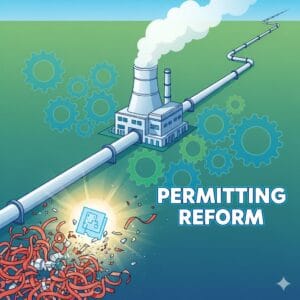 We’re not big fans of the American Petroleum Institute (API), which tends to do the bidding of the Big Oil companies that fund it. Big Oil’s aims are sometimes at odds with those of smaller, independent oil and gas producers—the innovators who discovered shale drilling. Yet there are state chapters of the API that do a good job. One of them is the Pennsylvania API chapter. The executive director of PA API, Stephanie Catarino Wissman, recently published an excellent article in Broad+Liberty that calls for fast-tracking the effort to pass federal permit reform so Pennsylvania can get back to building.
  In August, the Federal Energy Regulatory Commission (FERC) reissued a certificate for the Northeast Supply Enhancement (NESE) project, a billion-dollar-plus project designed to increase Transco pipeline capacity and flows of Marcellus gas heading into New York City and other northeastern markets by an extra 400 MMcf/d (see
  On August 17, Eureka Resources’ Williamsport Second Street facility (one of the three wastewater treatment plants previously operated by Eureka) leaked some of its stored untreated frack wastewater, which ended up in the nearby Susquehanna River via a storm drain (see
 After gaining rigs for four weeks in a row, the Baker Hughes U.S. national rig count stayed even two weeks ago, neither gaining nor (more importantly) losing any rigs (see
  Infinity Natural Resources (INR), headquartered in Morgantown, WV, focuses 100% on the Marcellus/Utica. The company went public earlier this year with a $265 million ($20/share) initial public offering, giving INR a $1.18 billion market capitalization (see
  Fox Tank Company is one of the leading oil storage tank manufacturers in Texas, serving the growing oil field production needs of the Eagle Ford Shale, Permian Basin, and Bakken Shale areas. Chip Rogers, president of Fox Tank, traveled to Coshocton, OH, for an equipment auction at the former Crozier Welding in March. He liked what he saw and decided to stay. Fox is interested in servicing the Marcellus/Utica region. The company leased the former Crozier Welding site in June after being welcomed “with open arms” by local officials.
 Governor Josh Shapiro’s Streamlining Permits for Economic Expansion and Development (SPEED) program, launched in August 2024, aimed to expedite Pennsylvania’s permitting process (see