Williams CEO Alan Armstrong, whom corporate raiders like Keith “Mini-Me” Meister tried to oust (unsuccessfully), recently made a visit to Pennsylvania. As part of that visit, he sat down for an interview in Harrisburg with the Central Penn Business Journal. During the interview, Armstrong talked about shale gas, PA regulation, and the $3 billion Atlantic Sunrise Pipeline project. Here’s a portion of the interview… Read More “Williams CEO Alan Armstrong Goes On the Record in PA”
Fire departments, schools, parks and townships are some of the 44 Pennsylvania organizations in 11 counties that will receive $326,800 in funding *this spring* from Williams–through its bi-annual community grant program. Grants up to $10,000 per organization are being awarded by Williams in communities where the proposed Atlantic Sunrise pipeline project will be constructed and operated. This is the fifth round of grants for areas that will host or be affected by the Atlantic Sunrise Pipeline. All together (including this latest round of $326,800), Williams has now given away $1.79 million to communities on behalf of Atlantic Sunrise. Now that’s something worth celebrating! Is your organization eligible? Grant applications are available at www.williams.com/atlanticsunrise. Here’s a list of the organizations that will get grant money this spring… Read More “Atlantic Sunrise Pipeline Spreads $326,800 of Love in 11 PA Counties”
Whenever a big, important project like the Shell ethane cracker, reported to be a $6 billion investment, goes forward, a whole lotta people were involved before the decision was made. However, if there is one universal truth in business it is this: There is always a champion at the center of any important project. The one person who’s responsibility it is to propel that project forward. The person who, we like to say, has their “butt in a sling.” It is on their shoulders to ensure the projects success. When you dig down into the story of the multi-billion dollar Shell cracker plant now being built in Beaver County, PA, you will find that one person. His name is Brent Vernon. He worked for more than five years to lure Shell to the Keystone State. Vernon was senior project manager for energy for the state when he began working, full time, on the Shell project in 2011. Since then he was promoted, first to deputy director and eventually director of the Governor’s Action Team, a role he continues. Vernon is key–one of the linchpins without whom the Shell deal would not have happened… Read More “The Person Most Responsible for Luring Shell Cracker Plant to PA”
More fake “research” is on the way courtesy of the anti-drilling Southwest Pennsylvania Environmental Health Project. The Project is launching a so-called public health registry. Log in to the website and if you live within five miles of a drilling site, you can report your latest headache in an attempt to link it to (and smear) shale development. Yep, just blame everything on drilling. Got allergies? Blame drilling. Headache? Blame drilling. Earache? Blame drilling. Er, a “performance issues?” Blame drilling. (Maybe they’ll give you some free Viagra.) That’s the purpose of this latest sham initiative by the same group that has brought us such glittering examples of “research” as “The List of the Harmed”… Read More “Fake Science: SWPA Enviro Health Registry for Those Near Fracking”
Talk about a waste of taxpayer time and money. The so-called leaders of Newtown Township in Bucks County (Philadelphia orbit) took time out to compose, debate, and pass a resolution opposing the PennEast Pipeline. Even though the pipeline isn’t coming anywhere near Newtown Township. What the vote reveals is that Newtown is led by far-left anti-fossil fuelers with nothing better to do than get on their soapbox and prance around discussing issues that don’t affect the residents of the town. Typical leftist politicians that believe they know better than you what’s best for you–even if it doesn’t even affect you… Read More “PA Town Votes to Oppose PennEast Pipe; Not Even Coming Close”
Truly maddening. A Pennsylvania farming family has had to put up with Chesapeake Energy’s lame justifications for not paying them a dime in royalties over the past two years, even though Chesapeake continues to extract gas from their property. Chesapeake claims that since 2015, their costs to extract/sell gas from Russ Forba’s land exceeded any revenue generated–by $112,000. Chesapeake promised Forba that the company would not try to recoup those “costs” from future royalties. The company just broke its promise. On Monday, Forba received a statement from Chesapeake revising the price of the gas sold (down), and revising the post-production costs claimed (up) for the month of April 2015. Chesapeake then deducted the extra $5,700 “loss” from current royalty payments to cover the difference–something they PROMISED would never happen. This is why PA landowners are incensed and calling for legislation. We don’t blame them… Read More “Chesapeake Deducts from Current Royalty Check for Old Loss in PA”
Penn State University professor Terry Engelder, the geologist who first discovered the potential of the Marcellus (and called “the Father of the Marcellus Shale”) is retiring from Penn State in June. The Marcellus Shale boom, while starting with a single Range Resources well in 2004, is largely due to the insights of Engelder. In 2007 he did some “back of the envelope” calculations that showed (first) there is roughly 50 trillion cubic feet (Tcf) of recoverable natural gas in the Marcellus. He later revised that number, to 489 Tcf. It was Engelder’s calculations that caught the interest and confidence of drillers who then decided to give the Marcellus a try. The rest is history–and we have Dr. Engelder to thank. Penn State News does a good job in providing a tribute to celebrate the contributions of Engelder to the university’s geosciences department. What will Engelder miss the most when he retires? Finding new shale layers? Figuring out new techniques to extract oil and gas? Maybe a better way of predicting earthquakes? Nope. He’ll miss the people–students and the professors/staff at “one of the finest geosciences departments in the world.” Here’s a proper sendoff for a key figure, a giant in the canon of the Marcellus story… Read More ““Father of Marcellus Shale” Terry Engelder Retiring from Penn State”
Broadband seismometer used for surface seismic monitoring
We hesitated to use the headline that we did, given the way virulent anti-drillers bastardize the issue of fracking and earthquakes. But we used it to make a point. Quick history: The headline-grabbing “fracking causes swarms of earthquakes” in places like Oklahoma is about frack wastewater that is injected in special saltwater injection wells, deep below the surface. There are, literally, hundreds of thousands of such wells across the country. Unfortunately, when such a well is located directly over or very close to an underground fault (large crack), the fluid getting injected acts like grease, allowing rock layers to slip and slide–in some cases causing low level earthquakes–typically earthquakes under 2.0 on the Richter scale (can’t be felt on the surface). Is fracking itself ever the cause? Statistically, no. But it has been documented to happen in a handful of cases–under 10 times in the entire world, out of millions of fracked wells. And again, it only happened because of fracking directly over an underground fault. However, any time you explode charges underground, which is what fracking is, if you have equipment sensitive enough, you can detect it. Is that an “earthquake”? We’d say no. Perhaps it is considered an “earthquake” according to a technical definition, but those extremely low vibrations are brief–typically 30-60 seconds–and they never cause any kind of harm on the surface. In fact, the vibrations can’t be felt at the surface. So our headline referring to “tiny earthquakes” is somewhat tongue-in-cheek, a way to tweak antis. Researchers at the National Energy Technology Laboratory (NETL) have discovered that those vibrations from fracking–what they call “low frequency tremors”–can be measured and used to figure out how to get more production out of Marcellus Shale wells in PA and WV… Read More “NETL Researchers Find Tiny Earthquakes Help Marcellus Production”
Would it surprise you to learn that Pennsylvania and Ohio had the largest increase in natural gas production in 2016–larger than any other natgas-producing states? If you read MDN regularly, perhaps not. Old news. However, it may surprise you to learn that from 2012 to 2016, 85% of the growth in our country’s enormous natural gas output came from the Marcellus/Utica. Yeah, 85%. That’s huge. More old news: Pennsylvania passed Louisiana back in 2013 to become the second highest-producing natgas state in the country. More new news: Last year, in 2016, Ohio passed West Virginia to become the seventh highest producing natgas state in the country. Here’s some more facts about PA & OH from our favorite government agency, the U.S. Energy Information Administration… Read More “OH & PA NatGas Production Increased More Than Other States in ’16”
As previously reported, liberal Pennsylvania House of Representatives Democrat Pam Synder has now introduced a bill (HB 1283, copy below) to “clear up” what the state Public Utility Commission (PUC) is a loophole in the Act 13 law that may allow some drillers to avoid paying impact fees (i.e. drilling taxes) on some Marcellus Shale wells (see PA Lib Dem Introducing Bill to “Fix” Strippers Once and for All). In 2012 Pennsylvania passed the Act 13 law that includes a fee on wells targeting shale layers, including the Marcellus. Snyder Brothers, headquartered in Kittanning, PA, drills mostly conventional (vertical only) wells in southwestern PA. In 2011-2012 they drilled 45 vertical-only wells, targeting the Marcellus–all of the wells fracked. Initially those wells produced more than 90 Mcf/day, but by December of the year they were drilled, they produced less than 90 Mcf/day. The way the 2012 Act 13 law is written, if a well produces less than 90 Mcf/day during “any” month it is considered a stripper well and exempt from paying the impact fee. The state’s Public Utility Commission (PUC) assessed the fee anyway because for 11 months the wells produced more than 90 Mcf/day. Snyder Bros. sued and after an appeal of the case, won their case in March, exempting those wells from paying impact fees (see PA Court Says Snyder Bros Wells are Strippers, No Impact Fees Due). That sent the state Public Utility Commission (PUC) into a tizzy. The PUC and the PA Democrat Party is using the court case to try and accomplish two things they haven’t been able to accomplish heretofore: (1) claim this is a prime example of why a nosebleed high severance tax is needed, in this year’s budget, and (2) fundamentally change the intent of the Act 13 law by passing a “clarification” as introduced by Snyder’s HB 1283 bill. Below we explore this issue in depth and tell you why the Snyder case win is NOT a way for drillers to avoid paying impact fees. In fact, the court’s decision makes it clear that drillers cannot simply reduce production for one month and then claim it’s a stripper well under the 90 Mcf/day definition. Snyder’s bill is an overreaction and does not clear up anything. Instead, it changes everything… Read More “New PA Bill an Overreaction to Court Ruling on Strippers”
The Pennsylvania Dept. of Environmental Protection has just fined driller Seneca Resources $325,000 for a series of violations that occurred between 2013 and 2015. It seems in moving dirt around when building drill pads, Seneca caused erosion to occur. They also spilled ~100 barrels of crude oil in one location, and ~500 barrels of wastewater at another location. The violations happened in Forest, McKean, and Elk Counties. Here’s the notice issued by the PA DEP… Read More “Seneca Resources Fined $375K by PA DEP for “Multiple Violations””
A group of radical (we’d call them criminal) environmentalists–some of the same ones who broke the law in North Dakota while “protesting” the Dakota Access Pipeline (DAPL)–are now trying to replicate the DAPL “protest” (i.e. illegal action) against Sunoco Logistics’ Mariner East 2 pipeline in Pennsylvania. The radical group Earth First! recently issued a “call to action”–their version of ringing the dinner bell for hungry dogs to come running from all other the country (even from other countries). The “call to action” invites hippies and hippie wannabes (those who can put down their bongs for five minutes) to come to Huntingdon County, PA–to Camp White Pine–to stretch wires and ropes from tree to tree and sit, suspended, to prevent crews from clearing trees in the path of the pipeline. According to Mob Rule Now! (aka Democracy Now!), the nutters have now “launched ongoing 24-hour tree-sits” to stop Mariner East 2… Read More “Anti-Govt Radicals Begin 24/7 Tree Sit in PA to Block ME2 Pipe”
Nesbitt Memorial Hospital – click for larger version
If you’re a landowner and want to dissuade a pipeline, like, say, the Atlantic Sunrise Pipeline, from crossing your property–what can you do? It helps if your property belongs to one of the local dynasties (i.e. BIG money) and if you can hire high-priced lawyers and issue a blizzard of press releases via Business Wire at $500 a pop. Apparently that’s what it takes to convince a pipeline company to change its course. At least, that’s the lesson we take away from Geraldine Nesbitt, landowner of The Nesbitt Parcel in Dallas Township (Luzerne County, near Wilkes-Barre), PA. Nesbitt has been 100% against the Atlantic Sunrise project since learning its proposed route would cross her big-monied estate. Nesbitt’s heir, Abram Nesbitt, once built a hospital in Kingston, PA that reminds of Downton Abbey (see the picture). Atlantic Sunrise is a $3 billion, 198-mile pipeline project running through 10 Pennsylvania counties to connect Marcellus Shale natural gas from northeastern PA with the Williams’ Transco pipeline in southern Lancaster County. In February the Federal Energy Regulatory Commission (FERC) gave its final seal of approval for the project (see Atlantic Sunrise Pipeline Gets Final Approval by FERC). After FERC’s approval, Ms. Nesbitt’s lawyers began an aggressive publicity campaign to try and convince FERC to stop the project. Last week Williams (builder of Atlantic Sunrise) filed a request with FERC to adopt an alternative route around the Nesbitt estate–and all of a sudden Ms. Nesbitt “has never been opposed to natural gas pipelines.” What disgusting hypocrisy. If Joe Farmer wants the pipeline rerouted around his prized hay field–good luck with that. But if an old-line establishment family with BIG MONEY like the Nesbitts wants a reroute, they get it. We don’t like it… Read More “PR Campaign Gets Atlantic Sunrise Pipe to Change Course in PA”
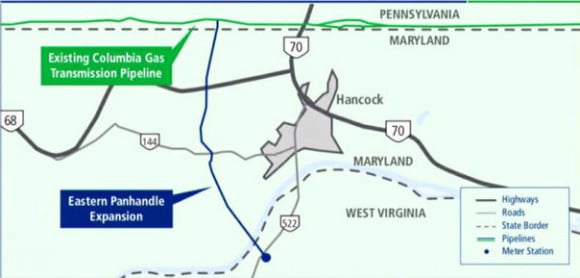
Columbia Pipeline, now owned by TransCanada, recently (in March) filed an application with the Federal Energy Regulatory Commission (FERC) to build a 3.5 mile, 8-inch pipeline that will carry natural gas from Pennsylvania to connect the Mountaineer Gas system in West Virginia with the Columbia Gas Pipeline in Pennsylvania. The purpose of the Eastern Panhandle Expansion project is to deliver natural gas via local distribution channels to a new industrial facility in Berkeley County, WV (scheduled to open in Fall 2017), and to provide gas to other local businesses and residents in the Tri-State area. Most of the pipeline crosses through a tiny sliver of Washington County, Maryland. The main issue with the project is that the pipeline will be drilled underneath the Potomac River, which serves as the border between WV and MD. That has antis in an uproar. The good news is that FERC has agreed to prepare an environmental assessment (EA) for the project. That is, this is now a real project with a high degree of likelihood it will get built… Read More “New 3.5 Mile Pipeline Project to Drill Under the Potomac River”
For the past couple of years MDN has covered the issue of low and no royalties for landowners in Pennsylvania and other states because of the low commodity price for natural gas–and because drillers are deducting post-production expenses. The problem, from the landowner’s perspective, is that gas is still getting pumped–and they aren’t getting anything in royalties. Who would sign up for that?! The problem, from the driller’s perspective, is that they’ve spent big bucks to drill the well and even if they have to sell the gas at a loss, at least they’re getting some revenue through the door–hoping to hang on until prices go higher again. It is a conundrum. Last month the Pennsylvania Chapter of the National Association of Royalty Owners (NARO) held their annual meeting and convention in State College, PA. A number of interesting bits of information came out of that meeting. One interesting tidbit: A Houston lawyer told attendees that he is now using the strategy of telling drillers if they keep sending royalty statements with no checks (i.e. statements showing the driller is not making a profit)–they have 30 days to terminate their lease with those landowners. Some leases (not all) state that if a well quits producing profitable quantities of gas, the lease is officially ended. While in some respects the lawyer’s innovative interpretation of o&g contracts may be an empty threat, the strategy does appear to be getting results. Another tidbit: There is a concern that drillers may try to deduct losses today from profits in the future–from a landowner’s royalty check. What can landowners do to guard against it?… Read More “Lawyer to PA Drillers: No Royalties? Time to Terminate the Lease”
Last December the Pennsylvania Dept. of Environmental Protection (DEP) said it would go on a “listening tour” in early 2017, to focus on so-called environmental justice (see PA DEP to Conduct ‘Listening Tour’ for ‘Environmental Justice’). The DEP finally set up a schedule for its listening tour, which began in March in Greene County (see PA DEP Conducting “Listening Tour” for “Environmental Justice”). Our take: “environmental justice” means asking poor people if they’ve been abused by the oil and gas industry in any way–and if they have a beef, the DEP will “do” something about it. The first session in the tour was interesting for several reasons. For one, just a handful of people turned out–a maximum of 30 in the crowd. For another, the po’ folk didn’t bother coming. It seems only radical activists bothered to turn up, claiming to represent the abused, repeating the same tired, old lies they always repeat. Another stop along the tour was held last week in Williamsport, PA. The pattern repeats. If anything, there were fewer people in the crowd–about 20 according to the local newspaper. Next to nobody turns up for these things. Why is the DEP wasting its time, and PA taxpayers’ money?… Read More “PA Enviro Justice Listening Tour Continues to Draw Almost No One”


 Fire departments, schools, parks and townships are some of the 44 Pennsylvania organizations in 11 counties that will receive $326,800 in funding *this spring* from Williams–through its bi-annual community grant program. Grants up to $10,000 per organization are being awarded by Williams in communities where the proposed Atlantic Sunrise pipeline project will be constructed and operated. This is the fifth round of grants for areas that will host or be affected by the Atlantic Sunrise Pipeline. All together (including this latest round of $326,800), Williams has now given away $1.79 million to communities on behalf of Atlantic Sunrise. Now that’s something worth celebrating! Is your organization eligible? Grant applications are available at
  Whenever a big, important project like the Shell ethane cracker, reported to be a $6 billion investment, goes forward, a whole lotta people were involved before the decision was made. However, if there is one universal truth in business it is this: There is always a champion at the center of any important project. The one person who’s responsibility it is to propel that project forward. The person who, we like to say, has their “butt in a sling.” It is on their shoulders to ensure the projects success. When you dig down into the story of the multi-billion dollar Shell cracker plant now being built in Beaver County, PA, you will find that one person. His name is Brent Vernon. He worked for more than five years to lure Shell to the Keystone State. Vernon was senior project manager for energy for the state when he began working, full time, on the Shell project in 2011. Since then he was promoted, first to deputy director and eventually director of the Governor’s Action Team, a role he continues. Vernon is key–one of the linchpins without whom the Shell deal would not have happened…
 More fake “research” is on the way courtesy of the anti-drilling Southwest Pennsylvania Environmental Health Project. The Project is launching a so-called public health registry. Log in to the website and if you live within five miles of a drilling site, you can report your latest headache in an attempt to link it to (and smear) shale development. Yep, just blame everything on drilling. Got allergies? Blame drilling. Headache? Blame drilling. Earache? Blame drilling. Er, a “performance issues?” Blame drilling. (Maybe they’ll give you some free Viagra.) That’s the purpose of this latest sham initiative by the same group that has brought us such glittering examples of “research” as “The List of the Harmed”…
 Talk about a waste of taxpayer time and money. The so-called leaders of Newtown Township in Bucks County (Philadelphia orbit) took time out to compose, debate, and pass a resolution opposing the PennEast Pipeline. Even though the pipeline isn’t coming anywhere near Newtown Township. What the vote reveals is that Newtown is led by far-left anti-fossil fuelers with nothing better to do than get on their soapbox and prance around discussing issues that don’t affect the residents of the town. Typical leftist politicians that believe they know better than you what’s best for you–even if it doesn’t even affect you…
 Truly maddening. A Pennsylvania farming family has had to put up with Chesapeake Energy’s lame justifications for not paying them a dime in royalties over the past two years, even though Chesapeake continues to extract gas from their property. Chesapeake claims that since 2015, their costs to extract/sell gas from Russ Forba’s land exceeded any revenue generated–by $112,000. Chesapeake promised Forba that the company would not try to recoup those “costs” from future royalties. The company just broke its promise. On Monday, Forba received a statement from Chesapeake revising the price of the gas sold (down), and revising the post-production costs claimed (up) for the month of April 2015. Chesapeake then deducted the extra $5,700 “loss” from current royalty payments to cover the difference–something they PROMISED would never happen. This is why PA landowners are incensed and calling for legislation. We don’t blame them…
 Penn State University professor Terry Engelder, the geologist who first discovered the potential of the Marcellus (and called “the Father of the Marcellus Shale”) is retiring from Penn State in June. The Marcellus Shale boom, while starting with a single Range Resources well in 2004, is largely due to the insights of Engelder. In 2007 he did some “back of the envelope” calculations that showed (first) there is roughly 50 trillion cubic feet (Tcf) of recoverable natural gas in the Marcellus. He later revised that number, to 489 Tcf. It was Engelder’s calculations that caught the interest and confidence of drillers who then decided to give the Marcellus a try. The rest is history–and we have Dr. Engelder to thank. Penn State News does a good job in providing a tribute to celebrate the contributions of Engelder to the university’s geosciences department. What will Engelder miss the most when he retires? Finding new shale layers? Figuring out new techniques to extract oil and gas? Maybe a better way of predicting earthquakes? Nope. He’ll miss the people–students and the professors/staff at “one of the finest geosciences departments in the world.” Here’s a proper sendoff for a key figure, a giant in the canon of the Marcellus story…
 As previously reported, liberal Pennsylvania House of Representatives Democrat Pam Synder has now introduced a bill (HB 1283, copy below) to “clear up” what the state Public Utility Commission (PUC) is a loophole in the Act 13 law that may allow some drillers to avoid paying impact fees (i.e. drilling taxes) on some Marcellus Shale wells (see
  The Pennsylvania Dept. of Environmental Protection has just fined driller Seneca Resources $325,000 for a series of violations that occurred between 2013 and 2015. It seems in moving dirt around when building drill pads, Seneca caused erosion to occur. They also spilled ~100 barrels of crude oil in one location, and ~500 barrels of wastewater at another location. The violations happened in Forest, McKean, and Elk Counties. Here’s the notice issued by the PA DEP…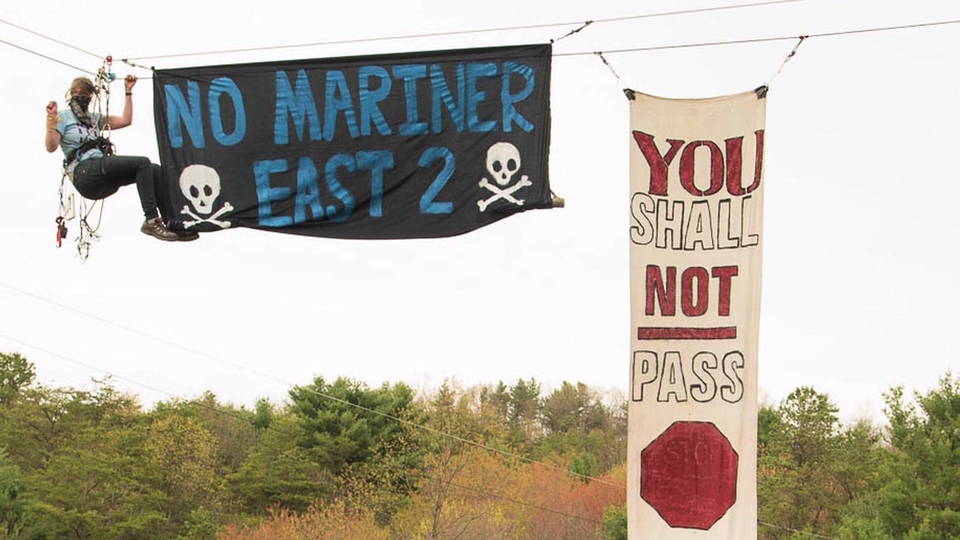

 For the past couple of years MDN has covered the issue of low and no royalties for landowners in Pennsylvania and other states because of the low commodity price for natural gas–and because drillers are deducting post-production expenses. The problem, from the landowner’s perspective, is that gas is still getting pumped–and they aren’t getting anything in royalties. Who would sign up for that?! The problem, from the driller’s perspective, is that they’ve spent big bucks to drill the well and even if they have to sell the gas at a loss, at least they’re getting some revenue through the door–hoping to hang on until prices go higher again. It is a conundrum. Last month the Pennsylvania Chapter of the National Association of Royalty Owners (NARO) held their annual meeting and convention in State College, PA. A number of interesting bits of information came out of that meeting. One interesting tidbit: A Houston lawyer told attendees that he is now using the strategy of telling drillers if they keep sending royalty statements with no checks (i.e. statements showing the driller is not making a profit)–they have 30 days to terminate their lease with those landowners. Some leases (not all) state that if a well quits producing profitable quantities of gas, the lease is officially ended. While in some respects the lawyer’s innovative interpretation of o&g contracts may be an empty threat, the strategy does appear to be getting results. Another tidbit: There is a concern that drillers may try to deduct losses today from profits in the future–from a landowner’s royalty check. What can landowners do to guard against it?…
 Last December the Pennsylvania Dept. of Environmental Protection (DEP) said it would go on a “listening tour” in early 2017, to focus on so-called environmental justice (see