
CORNballs Accuse FERC of Illegally Approving NEXUS Pipeline in OH
 The CORNballs of Ohio continue to try and shut down the $2 billion, 255-mile NEXUS interstate natural gas pipeline that will run from Ohio through Michigan and eventually to the Dawn Hub in Ontario, Canada. CORN stands for Coalition to Reroute NEXUS. CORNballs is what we affectionately call the group–as a way of pointing out their nutty true purpose–to try and shut the NEXUS project down. Period. Their aim has nothing to do with “rerouting” and everything to do with shutting it down. In May 2017, the CORNballs revealed their true colors when they filed a lawsuit in federal court in Akron, OH (see CORNballs Strike Again, File Lawsuit to Stop NEXUS Pipeline). Last week, lawyers for the CORNballs were back in court with a filing that claims the Federal Energy Regulatory Commission (FERC) acted illegally during the approval process. Good luck with proving that in court. NEXUS filed a motion to dismiss this frivolous case, based on the fact the federal court in Akron doesn’t have jurisdiction. The Natural Gas Act of 1938 gives “exclusive review” of FERC-related cases to the federal court of appeals in Washington, D.C. There goes another CORNball…
Read More “CORNballs Accuse FERC of Illegally Approving NEXUS Pipeline in OH”
 The “most serious remaining legal challenge” to Sunoco Logistics’ Mariner East 2 Pipeline project is a challenge by the odious Big Green group, the Clean Air Council, based in Philadelphia. CAC claims in a court case in Common Pleas Court in Philly that ME2 violates the federal and state constitutions. The case takes up constitutional claims that have “not yet been addressed in other litigation.” It dawned on us when reading an account of the case and who says what about whether or not Sunoco has the right to use eminent domain and whether or not ME2 is a public utility, is why does the CAC even care? Why are they the ones bringing the lawsuit? After all, pipelines don’t pollute the air! Well, technically that’s not 100% true–pipeline compressor stations do emit some air pollution, depending on how they are powered (diesel engines). But at the end of the day, pipelines pollute the air far less than other forms of transportation, like trucks and trains. How does CAC even have “standing” to bring such a lawsuit? Of course the fact that CAC is litigating is a tip-off that there is Big Green money behind the effort–and CAC is just a tool being used in a wider collusion (conspiracy?) to stop the pipeline…
 Last week the Monroe County, OH Chamber of Commerce and other organizations held an information forum to highlight what’s coming down the pike in the way of drilling and pipeline work for the county. Monroe is one of the leading Utica Shale counties in Ohio. According to Mike Chadsey, director of public relations for the Ohio Oil and Gas Association (OOGA), “Monroe County has been at the heart of the industry coming out of the downturn.” He also had an interesting perspective on the issue of “boom and bust” in the oil and gas business. We’ve written a number of times about the cycles experienced in the o&g industry. Drillers expand like crazing, creating a “boom,” and when too much of oil or gas floods the market and prices crash, a “bust” follows. Chadsey has different terminology. He thinks it is more accurate to call those cycles “ebb and flow” rather than “boom and bust.” We like it! A number of people addressed the forum, including drillers Rice Energy and EdgeMarc. Here’s how Monroe is leading the way out of the downturn…
 Events related (or of interest) to the Marcellus and Utica Shale, primarily pro-drilling events.
 The “best of the rest” – stories that caught MDN’s eye that you may be interested in reading. In today’s lineup: Northeast gas output pressures prices; update of southeast power market pipeline projects; American-made pipeline plan heads to Trump’s desk; natgas vs nuclear subsidies; Boone Pickens in poor health; jobs coming back in the oilfield after years of decline; taking politics out of pipeline decisions; US and Russia battling to dominate European gas market; will US LNG find a market in Asia?; and more!
 In December 2015, Pennsylvania’s felony-indicted Attorney General, Kathleen Kane (now gone), brought a lawsuit against Chesapeake Energy, Anadarko and Williams accusing them of, among other things, royalty fraud (see
  The Federal Environmental Protection Agency (EPA), which is the agency in charge of approving oil and gas wastewater injection wells, will hold a hearing next Wednesday in Plum, PA (Allegheny County, near Pittsburgh) on whether or not to approve an application and plan from Penneco Environmental Solutions (division of Penneco Oil Co.) to convert a plugged gas well into a brine (wastewater) injection well. Typically when a hearing like this is held, it’s an indicator that the EPA will approve the project. However, just because the EPA approves it doesn’t mean it’s a done deal. After an EPA approval, the application then goes to the PA State Dept. of Environmental Protection where it goes through another round of reviews–and likely more public hearings. The stuff getting disposed of, which we generically call wastewater, is technically called brine, because of it’s salty/mineral-ly composition. Brine is naturally occurring water from the depths that comes out of oil and gas wells for years after they are drilled. Because of the high concentration of minerals in the water, it either must go through a rigorous recycling process, or get disposed of via an injection well. OH has more than a hundred such wells. WV has a few dozen. PA has less than a dozen, due to the geology needed. Every new injection well in PA is a big deal, including this one…
 Not long after Michael Krancer was appointed Secretary of the Pennsylvania Dept. of Environmental Protection in 2011, he “requested” (which was more order than request) that municipal sewage treatment plants still accepting and processing Marcellus drilling wastewater stop the practice. At the time there were 15 plants accepting Marcellus wastewater. Under pressure from Krancer, they ended the practice in May 2011 (see
  We spotted an editorial in the Charleston (WV) Gazette-Mail written by Kevin DiGregorio, executive director of the nonprofit Chemical Alliance Zone (CAZ). According to the CAZ website, the organization “works with partners across West Virginia to boost and maintain investments and jobs in the chemical industry and related industries, including natural gas, manufacturing, and technology in general. We create, initiate, and facilitate business opportunities, leading to opportunities for you, your business or organization, and the State of West Virginia.” In other words, Mr. DiGregorio and the CAZ are at the nexus of many deals to bring petrochemical businesses to the Mountain State. So if anyone should know what may be “up the sleeve” and soon to be revealed, it’s Mr. DiGregorio. He hinted at it in his column. Writing that everyone has heard about the potential for a Braskem ethane cracker plant in Parkersburg (a project that appears to still be alive), Mr. DiGregoorio then says, “What you haven’t heard are all of the other potential (and confidential) projects that many of us are working on that might lead to new facilities and high-paying STEM (science, technology, engineering, mathematics) jobs that take advantage of methane and NGLs (ethane, propane, butane) to make various chemicals and plastics.” Wow! He seems to be saying there are a lot of projects in the works for WV in the downstream–those businesses that use the output from the shale industry…
 While we wrote about a Penn State research study today that appears legitimate, but seven years too late (see New Penn State Frack Wastewater “Study” Beats a Dead Horse), there is another recently published Penn State study that is also legit that is not yet a huge issue, but certainly has potential to be a big deal. Penn State’s College of Agricultural Sciences has found that invasive, non-native plants are making significant inroads with shale gas development in Pennsylvania, with negative consequences for PA forests. How so? The invasive, non-native plants are hitching a ride on gravel and equipment used to create roadways in forested areas, and once those plants take root, they crowd out local, native plants. The study, titled “Unconventional gas development facilitates plant invasions” and published in the Journal of Environmental Management, concludes that more monitoring and early detection can help put a lid on the problem…
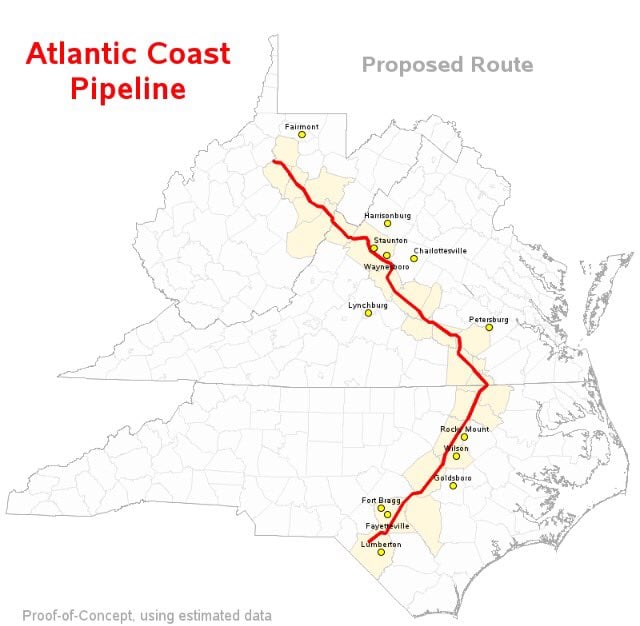 This past week, the North Carolina Dept. of Environmental Quality (DEQ) held two public hearings on Dominion’s proposed $5 billion, 594-mile natural gas pipeline that will stretch from West Virginia through Virginia and into North Carolina. One hearing was in Fayetteville, the other in Rocky Mount. Both had more people opposed to the project than for it, although the Fayetteville hearing saw a strong showing of people in favor of the project. The Fayetteville public hearing was held Tuesday, and Rocky Mount on Thursday. Here’s the coverage we could find of the two hearings…
 The Potential Gas Committee (PGC), a private non-profit organization loosely affiliated with the Colorado School of Mines, performs a comprehensive study of potential supplies of natural gas in the United States every two years. In April of 2013 MDN reported the committee’s findings of just how much gas is down there (see
  Rockwater Energy Solutions is a “leading provider of comprehensive water management solutions to the North American unconventional oil and gas industry” and the only company that provides complementary chemistry products and expertise in connection with its water solutions. Rockwater operates in the Marcellus/Utica region, among other shale plays. Select Energy Services is a billion dollar oilfield services company with three main divisions: water services, rentals, and wellsite completions. They operate in every major shale play in the country, including the Marcellus/Utica. Earlier this week the two companies announced they are merging in an all stock swap deal. It looks to be a true blending of the two companies, and not one company taking over the other. When the merger is done (later this year), John Schmitz, currently Chairman & CEO of Select, will become the full-time Executive Chairman and Holli Ladhani, currently the Chairman, President & CEO of Rockwater, will become the President & CEO of Select. The water parts of both businesses will be combined and branded with the Select name, but Rockwater branding will continue (as a division) for the chemicals business unit. Here’s the announcement of an impending marriage–made in heaven?…
 We’ve been listening to fake news about a supposed connection between Russia and the Trump campaign for so long now, we’re ready to puke. It’s a totally fabricated story without even an allegation of wrongdoing. Fake news outlets like CNN run this garbage endlessly (so we’ve been told, we NEVER watch CNN). So perhaps you can forgive us for not highlighting and bringing you this news before now. There IS a Russia scandal–a serious one. But it has nothing to do with Donald Trump. The real Russia scandal is that Putin and Russia have been funneling millions of dollars to U.S. Big Green groups, like the Sierra Club and League of Conservation Voters Education Fund, in an attempt to smear and block fracking in the U.S. Russia is funding these efforts not because they care a scintilla about the the environment (come to think of it, the Sierra Club doesn’t care about the environment either, not really). No, Russia is funding anti-fracking efforts by Big Green as a way of eliminating competition for Russian oil and gas. If they can throw some money at the nutjobs in our country, and if those nutjobs can convince unthinking masses to go along, problem solved for the Russkies. Here’s the lowdown on the REAL Russia scandal…
 Earlier this week MDN brought you the news, via a Wall Street Journal article, that EnerVest, a huge private equity firm with its fingers in many shale (and conventional) pies across the U.S., has gone bust (see