
More Background on Investors Encouraging EQT to Sell Itself

Last week MDN told you about a kerfuffle that erupted yesterday when Chapter IV Investors, a Charlotte, NC-based investment firm with investments in EQT, Range Resources and Antero Resources, announced it had sent a letter to EQT urging the company to consider merging with either Range Resources or Antero Resources (see EQT Urged by Major Investor to Merge with Either Range or Antero). As we told you, Chapter IV is essentially two investors, W. Barnes Hauptfuhrer, Managing Partner and Portfolio Manager, and Ryan J. Jack, Partner. We said at the time, “we don’t detect any kind of bullying on the part of Chapter IV, like that of a raider Carl Icahn (successful takeover of Chesapeake Energy & Cheniere Energy) or Keith “Mini-Me” Meister (unsuccessful attempt to takeover Williams). Rather, it appears to be a couple of investors who believe there is an honest and good case for a combination of EQT with another company.” We now have more evidence that our gut instinct was right–from an article Bloomberg published…
Read More “More Background on Investors Encouraging EQT to Sell Itself”
 Several townships in the Philadelphia orbit appear to be colluding with each other and with the Philadelphia-based Clean Air Council in passing nearly identical resolutions opposing the Mariner East 2 natural gas liquids pipeline. Eight townships or boroughs along or “close to” (meaning not along) the route in Delaware and Chester counties have published resolutions or proclamations badmouthing the project. The municipalities include: Edgmont, West Goshen, Thornbury, Middletown, Westtown, Rose Valley, Swarthmore and Media. Some of the self-incriminating evidence for collusion comes from an admission by one of them: “The community statements are similar to each other because of consultation between their leaders.” And this, from the odious Clean Air Council: “Alex Bomstein, a lawyer with the environmental group Clean Air Council, said that while there are other local campaign such as those in Lebanon and Huntingdon Counties, the efforts in Delaware and Chester Counties are more ‘developed’ in the Philadelphia suburbs. ‘There are more people organizing than elsewhere,’ he said, probably because of a greater population density closer to Philadelphia.” Why would the StateImpact Pennsylvania propagandist quote the CAC in the same article as the colluding towns, unless they were somehow tied together?…
 Headquartered in Houston, Texas, Exterran Corporation (with 5,400 employees) specializes in natural gas compression production equipment and processing facilities. They design, build and operate compressor stations and natural gas processing plants. In 2012 MDN reported on a contract Exterran won to build three natural gas processing plants in West Virginia (see
 Last May MDN told you about a group of brave landowners in Wayne County, PA who have had their property rights stolen by the Delaware River Basin Commission (see
  Events related to drilling in the Marcellus and Utica Shale, primarily pro-drilling.
 The “best of the rest” – stories that caught MDN’s eye that you may be interested in reading. In today’s lineup: Rice Energy one of top gas picks for 2017; OH anti group quietly disbands after funding studies that prove fracking is safe; rig count shows PA drilling back on the upswing; DOE cuts off funds for NJ off-shore wind farm; natgas storage would not benefit Maine consumers, says study; US natgas production will increase in 2017; and more!
 A couple of weeks ago four companies won bids on 17 parcels totaling 719 acres of federal land (for Utica Shale drilling) in the Ohio Wayne National Forest (see
 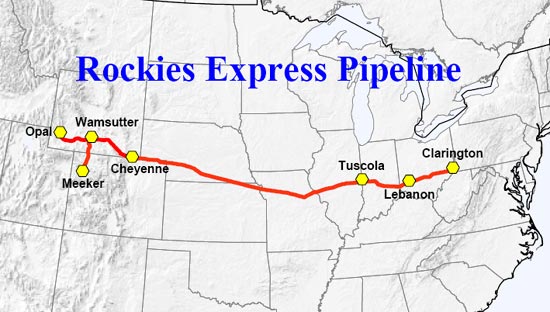 The Rockies Express Pipeline (REX), originally built from Colorado and Wyoming to Monroe County, OH to bring natural gas from west to east, last year reversed the flow for a large and important section of the pipeline. On August 1, 2015 the section of REX from Monroe County, OH to Mexico, MO reversed the flow and began to carry 1.8 billion cubic feet per day (Bcf/d) of Utica and Marcellus Shale gas to the Midwest, including to the greater Chicago area. REX has been hard at work on plans to expand capacity even more by beefing up compressor stations along portions of the pipeline. REX filed a plan with FERC to add another 800 million cubic feet per day (MMcf/d) of capacity along the same portion of the reversed pipeline–for a grand total of 2.6 billion cubic feet per day (Bcf/d). In mid-December, the first 200 MMcf/d of capacity came online (see
  As MDN reported earlier this week, on the last business day of 2016 the Federal Energy Regulatory Commission (FERC) issued a favorable draft (not final, but draft) environmental impact statement (EIS) for the $5 billion, 594-mile Dominion Atlantic Coast Pipeline project (see
  In Oct. 2015 MDN reported a story about International Paper’s Ticonderoga mill in northern New York, near the Vermont border (see
  Over the past four years MDN has monitored and reported on conventional driller Beck Energy and their ongoing difficulties with attempting to drill in Munroe Falls (Summit County), OH. You can see our list of stories stretching back to February 2013
  A couple of times we’ve highlighted the great work done by the Norton Rose Fulbright law firm, most recently just last month (see
  Spitting and spouting about so-called renewables and nasty, evil, vile fossil fuels, the head of the extremist Natural Resources Defense Council is trash-talking the incoming Trump Administration even before it takes up residence in Washington. Typical. According to Rhea Suh, a Donald Trump presidency equals the end of a liveable earth. We invite Ms. Suh to relocated to Mars, or perhaps one of the moons of Jupiter. Here’s some of the insane ramblings from the NRDC earlier this week in declaring war on the Trump Administration…
 The United States is already on the cusp of energy independence, thanks to the shale revolution. What does that mean? It means when you consider how much energy we produce and export, and how much we consume and import, at the end of the day, we are producing as much energy as we consume. But it gets complicated. We still import a lot of oil from the Middle East and elsewhere. We import (and export) oil via pipelines to Canada. We also still import natural gas. But at some point the U.S. will export more than it imports. That is, we won’t only produce as much as we consume, we’ll produce extra energy–and sell it abroad to other countries. We will become a “net exporter.” When will that happen? According our favorite government agency, the U.S. Energy Information Administration (EIA), it will happen in the next 10 years–or less. The EIA has just released its “Annual Energy Outlook 2017” (full copy below). In the report the number crunchers at EIA look at multiple scenarios and conclude that under most scenarios we are a net exporter by 2026, and in some of those scenarios, it happens even sooner. That would be the first time since 1953 that our country has exported more energy than it uses. Not surprisingly, LNG (liquefied natural gas) plays a critical role in our country becoming a net exporter. Here’s what the EIA said in releasing the 2017 annual report…