
DC NatGas Utility WGL Considers Selling Itself to Spanish Company
 Word has leaked out that WGL Holdings, the umbrella company that owns Washington (DC) Gas Light Company and WGL Midstream, is considering selling itself to utility giant (and Spanish-based) Iberdrola. The deal, if it happens, has implications for the Marcellus. Earlier this month MDN reported that WGL Midstream, which already is a 7% owner in the Mountain Valley Pipeline project, had upped its ownership stake to 10% (see WGL Midstream Buys More of Mountain Valley Pipeline). WGL’s plan is to pipe more Marcellus/Utica gas to the Washington, DC area for sale to customers living in our nation’s capital. Would/could a change in ownership change that plan? It might…
Read More “DC NatGas Utility WGL Considers Selling Itself to Spanish Company”
 In May, U.S.-based oilfield services company FMC Technologies announced they will merge with their much larger quasi-competitor, France-based Technip, in an all-stock deal that will create a new company called TechnipFMC worth $13 billion (see
  Middle Eastern counties who sell us oil, including Saudi Arabia, have never been our “friends.” To pretend otherwise is dangerously stupid. We have depended on them for their oil, plain and simple. Oil equals energy and energy equals freedom and prosperity for the U.S. In the 1970s OPEC, the Organization of the Petroleum Exporting Countries, flexed its economic muscles against our country and brought us to our knees with an oil embargo that caused shortages and prices to skyrocket. MDN editor Jim Willis recalls growing up in the 1970s when gas was rationed and you could only buy gas every few days (odd and even days) based on your license plate number. A scary time in our country. Thing is, our enemies haven’t changed–they are still there. They’re just a whole lot richer than they were back then, richer with our money in their pockets. The shale revolution changed all that. We are close to being 100% energy independent–without the need to import oil. Oh, we’ll have to keep importing for the foreseeable future. We don’t have enough refineries here to process the type of oil we produce (light sweet crude). But in a pinch, we’d figure out a way. OPEC and Saudi Arabia have badly misjudged America. They thought they could flood the market with cheap oil and bankrupt America’s shale drillers. Didn’t happen. In fact, we got better. We figured out how to drill for less money. Little known fact: Bakken drillers can now make money with oil selling as low as $29 per barrel! In other words, it’s now time to put the last nail in OPEC’s coffin and kiss them goodbye. We sincerely hope finally defeating OPEC will be a top priority in the new Trump Administration…
 The “best of the rest” – stories that caught MDN’s eye that you may be interested in reading. In today’s lineup: OH Utica rig count stays 19; fake news in energy; energy woes trigger business bankruptcies in PA; criminal pipeline protesters in ND strain courts; ND law enforcement cuts off supplies to protesters; US doesn’t need Paris to meet emissions targets; o&g mergers making a comeback; Schlumberger making “rigs of the future”; gas exports to Mexico increase; and more!
 It’s now apparent that the fix has been in from the beginning–that New York’s corrupt Gov. Andrew Cuomo, colluding with New York’s corrupt Attorney General, Eric Schneiderman, were on a mission to block the construction of the federally approved Constitution Pipeline, due to run from Susquehanna County, PA into Upstate New York (to Schoharie County). Before Cuomo decided to take the breathlessly lawsless act of blocking the pipeline by denying stream-crossing permits (being challenged in court), the Constitution asked for permission to begin clearing trees along the pipeline’s path. In January 2016, Schneiderman immediately objected (see
 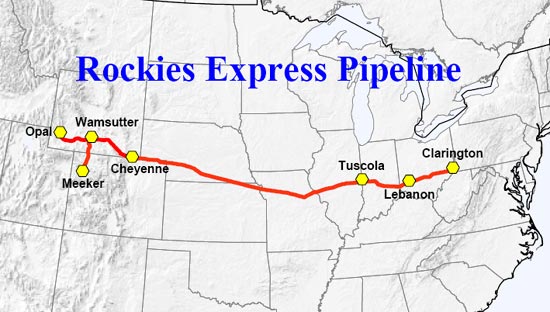 The Rockies Express Pipeline (REX), originally built from Colorado and Wyoming to Monroe County, OH to bring natural gas from west to east, last year reversed the flow for a large and important section of the pipeline. On August 1, 2015 the section of REX from Monroe County, OH to Mexico, MO reversed the flow and began to carry 1.8 billion cubic feet per day (Bcf/d) of Utica and Marcellus Shale gas to the Midwest, including to the greater Chicago area. REX has been hard at work on plans to expand capacity even more by beefing up compressor stations along portions of the pipeline. Their efforts have paid off. REX previously filed a plan with FERC to add another 800 million cubic feet per day (MMcf/d) of capacity along the same portion of the reversed pipeline. Yesterday the Federal Energy Regulatory Commission (FERC) gave REX the go-ahead to start additional compressors added at three locations along the route…
 The city of Green in Summit County, OH has put NEXUS Pipeline on notice that if surveyors show up to survey in the city and if those surveyors don’t have permission from the landowner, or a judge’s order, those surveyors will be arrested and charged with trespassing. Apparently Green hasn’t gotten the memo that pipelines are the safest form of transportation on earth–period. NEXUS, as well as other pipeline projects, face a classic Catch-22 situation. In order to get the Federal Energy Regulatory Commission to grant a certificate to build the pipeline, the pipeline company must first conduct initial surveys to plan the route. With a certificate from FERC in hand, the pipeline then has the power of eminent domain to use on recalcitrant landowners to build the pipeline across their land. The open question is whether or not the pipelines can use eminent domain to conduct the survey ahead of a full FERC certificate. That’s the Catch-22. Surveying doesn’t do a single thing to a property, other than a few guys and gals running around for a short time looking through a transit and taking measurements. It’s a shame that landowners, in some cases, won’t even allow that. So Green has put NEXUS and the world on notice that the city and its residents don’t want to participate in the riches that come from shale. Fine. Let them eat dirt…
 Sunoco Logistics Partners, the builder of the Mariner pipeline projects, has fought a long and hard legal battle to be recognized as a public utility in Pennsylvania–especially with regard to the next big project in the lineup, the Mariner East 2 pipeline. ME2, as it’s called, is a $2.5 billion, 350-mile natural gas liquids (NGL) pipeline that will run from eastern Ohio through the state of Pennsylvania to the Marcus Hook refinery near Philadelphia. From the beginning anti-pipeline fanatics have tried to derail the project by claiming it is not a public utility (with the right of eminent domain) as defined by PA’s statutes. In July 2014 two administrative law judges working for the PA Public Utility Commission (PUC) said ME2 is not a public utility (see
  One of the lasting, positive legacies of Pennsylvania Gov. Tom Corbett, predecessor to the current disaster of a governor, Tom Wolf, is signing into law Act 13, which updated PA’s laws for Marcellus Shale drilling. Among the provisions of Act 13 is something called an impact fee–far better and more fair than a so-called severance tax. As we wrote at the time, the impact fee is really 60% fee and 40% tax. Most of the revenue raised, 60% of it, stays local in the communities impacted (hence the name) by drilling. Those communities have higher expenses for first responders, water and sewer, and other government expenses, due to an increase in drilling activity. But in order to get the deal done in Harrisburg, Corbett and the Republicans had to agree to grease the palms of bureaucrats with 40% of the revenue raised from the fee, to be spread around to various agencies (see
 Ultra Petroleum, based in Houston, TX, is an independent exploration and production (E&P) company mainly focused on drilling in the Green River Basin of Wyoming. Ultra also drills for oil in the Uinta Basin/Three Rivers area in Utah. In addition, Ultra maintains a position in the Pennsylvania Marcellus shale with leases on 184,000 gross (91,000 net) acres–no small amount. They aren’t currently drilling on their Marcellus acreage, but if prices change, they likely would. At the end of April Ultra filed for Chapter 11 bankruptcy (see
  In July MDN reported that the New York Stock Exchange de-listed trading for shares in Atlas Resource Partners (see
  Seems like GE Oil & Gas is putting its fingers in every U.S. o&g pie it can. In October GE announced it would pursue Baker Hughes for a merger/buyout (see
  We spotted a great editorial in the Philadelphia Inquirer (of all places) written by the American Petroleum Institute’s (API) Marty Durbin. Marty used to be the head of the American Natural Gas Association (ANGA) before it merged with and into API. Marty’s column looks forward to Donald Trump’s presidency and to getting back to “smart energy policies” as opposed to the dumb energy policies we’ve gotten under Lord Obama. As we read the column, it dawned on us that the real point Marty is making is this: It’s time to build MORE pipelines in this country! Not less. It’s time to push the advantage and to lock in fossil fuel use for the next couple of generations. Love it! Give Marty’s excellent column a read…
 Philadelphia Energy Solutions (PES) has been on a mission to expand their operation at the Southport Marine site in Philadelphia by leasing an additional 200 acres to build a terminal for shale oil imports and exports. Believe it or not, a plan to lease the extra space has been going on for more than two years (see