
AG Sunday Hits Eureka with 16 More Crimes for Williamsport Spill
 Two months ago, we told you PA Attorney General Dave Sunday had charged Eureka Resources with seven crimes over years of leaking tanks at its Standing Stone plant in Bradford County (see Eureka Resources Charged with 7 Crimes for PA Wastewater Leaks). That was the appetizer. Sunday has now filed a second, separate criminal case against the defunct wastewater company — this one aimed squarely at the Aug. 17, 2025 spill that sent 16,000 gallons of oily frack waste out of the Williamsport Second Street plant and into the West Branch of the Susquehanna River. Sixteen counts this time. And for the first time, Eureka is charged under laws that protect water, not just laws that govern waste. Read More “AG Sunday Hits Eureka with 16 More Crimes for Williamsport Spill”
 Amazon Web Services (AWS) is now in talks to build a data center campus next to the Homer City Energy Campus in Indiana County, PA — meaning the company that already pledged $20 billion for data centers in eastern PA (see our prior coverage
  Quinnipiac University released a new poll of Pennsylvania registered voters on July 15, and one question in it should worry everyone who makes a living from Marcellus gas. Asked whether they would support or oppose building an AI data center in their community, 74% of Pennsylvania voters said “oppose,” 16% said “support,” and 10% offered no opinion. That’s a jump from Quinnipiac’s February 25 poll, when the split was 68% opposed and 20% in favor. The opposition is bipartisan — 64% of Republicans, 82% of Democrats, and 77% of independents all said no thanks. Three-quarters of voters (76%) say they’re following data center news either very closely (26%) or somewhat closely (50%). And Gov. Josh Shapiro isn’t getting credit either: just 24% approve of how he’s handling data centers in Pennsylvania, while 34% disapprove and a whopping 42% have no opinion. The survey polled 895 registered voters July 9-13, with a margin of error of +/- 4.3 percentage points.
  MARCELLUS/UTICA REGION: Prime Data Centers proposes seven-building complex at Starpointe Business Park; OTHER U.S. REGIONS: N.J. looks to “virtual power plants” as another solution to demand spike; NATIONAL: U.S. natural gas futures hold steady ahead of storage data; Wright says fuel shipping waiver extension ‘quite likely’; This law is killing US jobs AND harming national security; Why natural gas isn’t going anywhere in the US power system; The ‘conservatives’ being paid to sell you wind and solar; Climate crusaders turn to flimsy ‘extreme event attribution’ to bring down oil, gas, and coal; INTERNATIONAL: Oil extends losses on Hormuz talks; Dozens of idling Iranian tankers show USA blockade is working; Aramco sees long road ahead to restore energy supply chains after Iran war; BP to sell US RNG unit as it moves focus to oil and gas; Hormuz draft agreement reportedly awaits Khamenei approval.
  Gulfport Energy dropped its second quarter 2026 numbers on Monday (Aug. 3), followed by an analyst call Tuesday morning — the first for new President and CEO Nick Dell’Osso, who took the chair May 28 after running Chesapeake/Expand Energy for five years. The profit line went the wrong direction. But strip away the accountants’ noise, and there’s a genuinely good story here for Ohio landowners, for the service companies that turn dirt, and for anyone holding the stock.
  Williams dropped its second quarter 2026 results after the close on Monday, August 3, and held the analyst call Tuesday morning. The headline numbers are good: adjusted EBITDA of $1.921 billion (up 6%), GAAP net income of $827 million (up 51%), and a raised full-year guidance midpoint of $8.4 billion. Wall Street liked it. But the story for MDN readers isn’t in the headline. It’s buried in the volume tables on page 8 of the release, in a capital spending line nobody read out loud, and in two new Transco projects in Pennsylvania and New Jersey that got about eleven seconds of airtime on the call.
  Peregrine Energy Partners, the Dallas-based royalty buyer we’ve been tracking since 2019, is back in the Marcellus/Utica with its checkbook open. Yesterday (Aug. 4), the company announced it closed five separate mineral and royalty deals — two of them right here in the M-U — totaling roughly 3,680 net royalty acres and interests in more than 1,240 producing wells. The first Appalachian deal is a cash-flowing overriding royalty portfolio in Susquehanna County, PA, covering about 936 gross acres and 86 producing horizontal Coterra Energy (now Devon Energy) wells, with more than 50 DUCs and PUDs behind them in both the Upper and Lower Marcellus.
  The long, sad saga of Eureka Resources has a new chapter — and for once, it’s not another fine or another leak. Eureka has sold the business operations at all three of its shuttered Pennsylvania frack wastewater treatment plants. Two of the three went to Select Water Solutions, one of the biggest water-management companies in the oilfield. The third went to a Washington County trucking outfit. We didn’t hear this from Eureka. We heard it from the Middle Susquehanna Riverkeeper Association, which pried the details out of the PA Department of Environmental Protection (DEP) in advance of the one-year anniversary of the Aug. 17, 2025 spill that dumped 16,000 gallons of untreated wastewater into the West Branch of the Susquehanna River (see
  Back in January 2022, we brought you what looked like a milestone: the WV Dept. of Environmental Protection had issued a construction permit for a big Marcellus gas-fired power plant next door to the Longview coal plant in Maidsville, Monongalia County (see
  The Tennessee Valley Authority (TVA) posted its third-quarter fiscal 2026 results yesterday (Aug. 4) — a press release, an investor presentation, and a 10-Q filed with the Securities and Exchange Commission. The headline numbers are fine but boring: $10 billion in revenue over nine months, net income of $965 million, up $220 million from last year. Yawn. However, if you dig into the 10-Q, there’s real news for Marcellus/Utica producers. TVA’s giant new Cumberland gas plant has fired up for the first time. TVA borrowed $2 billion to pay for it — the largest such financing in the agency’s history. And TVA has quietly expanded its natural gas hedge book to nearly 1 trillion cubic feet. Let’s dig in.
  On July 30, French environmental services giant Veolia announced it had been picked by “a major project developer” to operate and maintain a 350-megawatt (MW) microgrid that will power an artificial intelligence data center campus in Ohio. The press release carried a New Albany, Ohio dateline. It’s a genuinely big deal — a behind-the-meter power plant that will supply 100% of a data center campus without leaning on the grid at all. Here’s the dots nobody else has connected. This is the same Veolia that Antero Resources and Antero Midstream spent six years suing over a botched frack wastewater plant in West Virginia. And Veolia announced this shiny new Ohio contract exactly six days after wiring Antero a check for $371 million. You can’t make this stuff up.
  A Harrison County landowner and longtime pro-drilling voice is now accusing EOG Resources of “theft” — and while the word grabs headlines, the underlying dispute is a lot more nuanced than one company stealing one man’s mineral rights. A recent report from Your Ohio News lays out landowner Ron Ott’s grievances against EOG, but bundles together at least four separate issues into one story. We think MDN readers deserve the untangled version.
 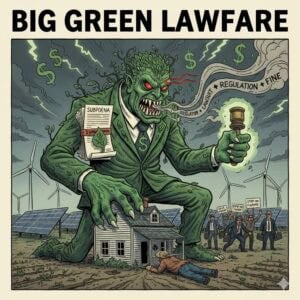 Two federal lawsuits landed in the same Washington, D.C. courthouse six days apart last month, and while both are nominally about pipelines in Mississippi and Alabama, Marcellus and Utica readers should pay close attention. Not because of where the pipe goes — but because of which pipelines the greens dragged into their complaints as Exhibit A.
  Want to know what the smartest money in the natural gas business expects to happen in the Northeast this winter? Don’t ask a politician. Look at the forward curve. As of the first of August, traders were pricing December-through-February gas at Algonquin Citygate (the Boston benchmark), Iroquois Zone 2 in New York, and three Tennessee Gas Zone 6 points in New England above $18 per MMBtu. At the other 77 pricing hubs Natural Gas Intelligence tracks across the U.S. and Canada, that same three-month strip averages under $5. Read that again. Same country. Same historically abundant supply. Roughly four times the price.