
Sunoco Makes Marcellus Ethane-by-Truck Available at Marcus Hook, PA
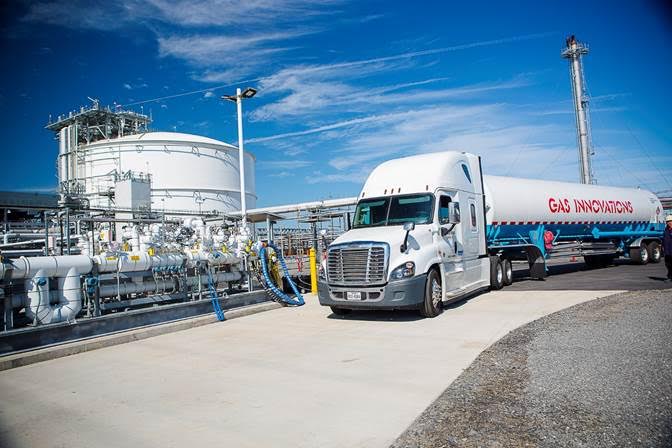
In March 2016 an Ineos tanker ship carrying 173,000 barrels of Marcellus ethane set sail from the Marcus Hook terminal near Philadelphia, bound for Norway (see Bon Voyage! First Ethane Export Ship Leaves Marcus Hook in Philly). Since that time, regular shipments of Marcellus ethane have traveled from Marcus Hook to various European destinations. Yesterday Sunoco Partners, a subsidiary of Energy Transfer Partners and the operator of the Marcus Hook refinery, announced they have opened a new ethane distribution facility inside the Marcus Hook refinery complex. It is a truck loading facility–the first such facility in the U.S. to load liquid ethane onto tanker trucks for local delivery. Wait, what? You thought ethane was only used in gigantic cracker plants, used as the raw material to make ethylene (i.e. plastics)? That is the primary use of ethane–but not the only use. Ethane can also be used as a refrigerant in cryogenic refrigeration systems. And there are other uses for small quantities of ethane, including the manufacturing of electronics. Sunoco says local trucked ethane deliveries will be used for “various ethane uses, from energy research and development to cooling and other industrial applications.” Sunoco already has its first customer–Gas Innovations–a reseller that trucks NGLs like ethane and propane throughout the U.S. (and ships it around the world). Gas Innovations is excited that their “cryogenic ethane business” is now supplied domestically via Marcus Hook. Previously, Gas Innovations had to import liquefied ethane. Marcus Hook’s truck facility opens up a whole new market for smaller users of Marcellus/Utica ethane throughout the U.S….
Read More “Sunoco Makes Marcellus Ethane-by-Truck Available at Marcus Hook, PA”
 Williams announced yesterday that its New York Bay Expansion pipeline project to flow an extra 115 million cubic feet per day (MMcf/d) of natural gas to New York City is now online and working. In July 2015, Williams filed an application with the Federal Energy Regulatory Commission (FERC) for the $130 million project, which will flow Marcellus gas to 500,000 additional New York City residents by the 2017/2018 heating season (see
  North Carolina has become the first state to complete an environmental evaluation for Dominion’s proposed $5 billion, 594-mile Atlantic Coast Pipeline (ACP)–a natural gas pipeline that will stretch from West Virginia through Virginia and into North Carolina. ACP is slated to run through eight NC counties. After completing it’s evaluation, the NC Dept. of Environmental Quality (DEQ) issued a rejection letter (copy below) for the project. The reason? The DEQ says the erosion and sediment control plan for the project is not up to scratch. Dominion can now do two things: Revise the erosion and sediment control plan and resubmit it, or contest the DEQ’s rejection of the existing plan. Although antis are rejoicing at the news, there really isn’t much here in the way of news. This is not uncommon in pipeline reviews. A government agency (federal or state) will push back on some aspect of the plan, the project builder will modify the plan, and the modified plan will pass muster and life goes on. That’s the way it works. The DEQ is (presumably) doing it’s job and not simply looking for an excuse to reject the project. We’ll give them the benefit of the doubt–this time. Although we’ve not read that Dominion has responded to the rejection, another partner in the project, Duke Energy, has responded–saying they will provide the necessary information the DEQ says is missing in the original plan…
 Environmental radicals from a group called Lancaster Against Pipelines made good on their promise to disrupt work on Williams’ Atlantic Sunrise Pipeline project–a $3 billion, 198-mile natural gas pipeline project running through 10 Pennsylvania counties to connect Marcellus Shale natural gas from northeastern PA with the Williams’ Transco pipeline in southern Lancaster County. Lancaster Against Pipelines is headed up by Mark Clatterbuck (who participated in the protests against the Dakota Access Pipeline) and his wife Malinda. The clattering Clatterbucks got 20-35 wackos from Lancaster County to load themselves into 16-18 vehicles (numbers change depending on the news source), which they then drove onto an access road used by Williams, where workers are beginning to clear land. The wackos parked themselves right in the middle of the road and stood in front of machinery, preventing Williams personnel from accessing the site. The only problem, for the wackos, is that it was raining so hard (leftovers from Hurricane Nate moving through), that Williams personnel weren’t working at the site anyway! However, it’s the principle of the thing. So the police were called. The so-called protesters were asked to move (or be arrested)–so they moved. End of story. Nobody hauled away in handcuffs, no striking images of people laying down refusing to move (too wet for that). Just a bunch of wackos with nothing better to do for a few hours, along with a few reporters…
 This story is a tangled web we’re having trouble unraveling. We’re hoping some astute MDN readers can shed some light for us. A few days ago we noticed a press release from American Energy Partners, Inc., with a subsidiary company called Gilbert Oil & Gas, claiming to have invested in some “Tier I” Marcellus and Utica Shale gas and oil wells, as well as undeveloped acreage in the region. Wait right there. Isn’t American Energy Partners (AEP) the company founded by Aubrey McClendon after he was tossed out of Chesapeake Energy? AEP announced last year, following the death of McClendon, they were closing the doors (see
  In July MDN told you that puppets of the PA-based Community Environmental Legal Defense Fund (CELDF) have once again gotten enough signatures to put a so-called Community Bill of Rights (i.e. frack ban) ballot measure on the ballot this November in Youngstown, Ohio for a 7th time (see
  When MDN editor Jim Willis attended the Shale Insight conference in Pittsburgh two weeks ago, one of the recurring themes he heard from West Virginia officials is that the state urgently needs to pass “mineral efficiency” laws. What they meant by mineral efficiency is another name for co-tenancy and joint development. We’ve written a fair bit about the topic–what we call “forced pooling lite.” In August the West Virginia Oil & Natural Gas Association (WVONGA) announced its intention to push, once again, for co-tenancy and joint development (see
  One of the reasons we periodically report, and keep a close eye on, Cheniere Energy’s Sabine Pass LNG export facility in southern Louisiana is our suspicion that at least some Marcellus/Utica gas makes its way to that facility and gets exported to other countries. We’ve never been able to prove our suspicion, but we got a lot closer to proving last February when Williams confirmed that the mighty Transco Pipeline now has a direct connection to Sabine Pass (see
  MDN editor Jim Willis has once again partnered with NGI (Natural Gas Intelligence) to bring you a great (and FREE) opportunity to learn more about everyone’s favorite twin shale plays: The Marcellus and Utica Shales. NGI produces a mountain of data and information as part of their research and development efforts, publishing it in a Shale Plays Factbook, which costs $179. However, because of MDN’s special partnership with NGI, they have agreed to combine the Marcellus/Utica sections from the Factbook into a special primer, available free for MDN readers only. Here’s what’s in the Marcellus/Utica Shale Primer, a few sample pages, and how you can
  The “best of the rest” – stories that caught MDN’s eye that you may be interested in reading. In today’s lineup: Pipeline hit in Pike County, PA, forces evacuation; US shale casts a long shadow over petchem; energy markets face basis volatility; 6 weeks left until winter natgas season kicks in; the innovation that will drive the next oil supercycle; why energy-rich Australia pays out the nose for power; onshore fracking begins in UK “within weeks”; and more!