
Venture Global’s CP LNG Loses Arbitration to BP, Owes Big Money
 Venture Global’s Calcasieu Pass (CP) LNG export facility in Louisiana began operations in March 2022 (see Calcasieu Pass LNG Loads Inaugural Cargo; Sabine Pass LNG Expands). Typically, a new LNG facility will load and ship several (maybe two or three) cargoes to “work out the kinks” and ensure everything is working as advertised. Venture Global, using loopholes in its signed contracts, maintained that they were working out the kinks long after it began shipping. After hundreds of cargoes were shipped, CP’s customers were still not receiving their contracted (at lower prices) shipments. Shell, along with several other customers, sued (see Shell, Edison, BP File for Arbitration Against Venture Global LNG). Last week, BP won its case against Venture Global. Read More “Venture Global’s CP LNG Loses Arbitration to BP, Owes Big Money”
 Don’t say we didn’t warn them, because we did. Chevron is complaining that Venture Global is behaving like Venture Global—screwing over its contracted customers so it can make billions by selling LNG to uncontracted customers while pretending its LNG export facility isn’t commercially ready. We have to ask, what the heck did Chevron *think* would happen? Fool me once, shame on you. Fool me twice…
  The highly functional and responsible Susquehanna River Basin Commission (SRBC), unlike its highly dysfunctional and irresponsible counterpart, the Delaware River Basin Commission (DRBC), continues to support the shale energy industry by approving water withdrawals and consumptive use requests for responsible and safe shale drilling. The SRBC published a notice in the October 11 Pennsylvania Bulletin that the commission voted to approve 11 water withdrawal requests related to shale gas development and two for gas-fired power plants.
  Infinity Natural Resources (INR), headquartered in Morgantown, WV, focuses 100% on the Marcellus/Utica. The company went public earlier this year with a $265 million ($20/share) initial public offering, giving INR a $1.18 billion market capitalization (see
  For the week of September 29 to October 5, the number of permits issued to drill new wells in the Marcellus/Utica increased from the previous week. There were 32 new permits issued across the three M-U states last week, up five from 27 issued two weeks ago. Last week, Pennsylvania issued 27 drilling permits across six counties—the highest weekly total the state has recorded in months, possibly even over a year. Ohio issued five permits in two counties. West Virginia was skunked last week, issuing no new permits for the second consecutive week. What’s up with WV?
 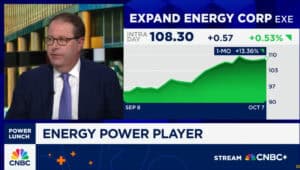 Expand Energy, formed by the merger of Chesapeake Energy and Southwestern Energy, is the largest natural gas producer in the U.S. with approximately 1.9 million leased net acres. The company operates in three distinct regions: Northeast Appalachia (Pennsylvania), Southwest Appalachia (primarily West Virginia, with additional presence in Pennsylvania and Ohio), and the Haynesville (Louisiana). Expand CEO Nick Dell’Osso appeared yesterday on CNBC’s “Power Lunch” segment to share his insights on the supply-demand dynamic for natural gas, pipelines, and more. He had some VERY interesting things to say.
  Carrie Crumpton, Vice President of Environmental Strategy, presented on behalf of CNX Resources at the recent 2025 Shale Insight Conference. Carrie provided an overview and update on CNX’s
  Disappointingly, the Trump Federal Trade Commission (FTC) voted 3-0 to maintain a “consent order” that prevents private equity firm Quantum Energy Partners from owning stock in EQT and prohibits the CEO of Quantum from serving on EQT’s Board of Directors. This is all to do with EQT’s purchase of fellow driller Tug Hill in 2023. In September 2022, EQT announced a deal to buy privately owned Tug Hill Operating’s West Virginia shale assets (90,000 acres and 800 MMcf/d of production in West Virginia) for roughly $5.2 billion (see
  In August, EOG Resources, one of the largest oil and gas drillers in the U.S. (with international operations in several other countries) and a Fortune 500 company, closed on the $5.6 billion purchase of Encino Energy, adding 675,000 net acres in the Utica and over 1,000 operating shale wells (see
 Here’s a court case that slipped under our radar. Antero Resources Corporation challenged the Federal Energy Regulatory Commission’s (FERC) approval of a two-tier fuel rate structure imposed by Tennessee Gas Pipeline Company (TGP) following an expansion project. Antero had contracted with TGP to secure firm transportation capacity by funding the construction of new compressor stations, which are energy-intensive and require substantial fuel to operate. The tariff approved by FERC stipulated that Antero would always be charged the highest marginal fuel rate, as if its gas were the last and most expensive to transport through the pipeline. In contrast, other shippers paid an average fuel rate, leading to Antero paying two to three times the fuel rate of other shippers on the same pipeline segment.
  On July 3, 2024, the Pennsylvania Department of Environmental Protection (DEP) issued an order to EQT asking the company to produce records as part of the agency’s ongoing investigation into the release of up to an estimated 940,000 gallons of wastewater at the Brova shale gas well pad in North Bethlehem Township, Washington County, and similar failures at six other EQT well pads. The issue revolves around the use of “dump lines” at well pads. EQT states that the DEP’s request for reviewing physical paperwork is onerous, and the agency lacks the authority to regulate dump lines anyway. The DEP wants to ensure that another dump line issue (spilling of wastewater) doesn’t happen.
 Our friend Bill desRosiers, Manager of Government and External Affairs at Coterra Energy, has authored an excellent article and white paper addressing the topic of how the oil and gas industry can use virtual reality (VR) to attract new blood to the industry. The oil and gas industry is facing a significant workforce challenge: nearly 400,000 U.S. energy workers are nearing retirement, while younger generations remain hesitant to enter the field. In spring 2025, Coterra partnered with Xalter to deploy a multi-state pilot VR program to prepare the next generation of energy workers. Bill draws back the curtain to discuss the company’s experience in using VR for training and to attract new talent to the company.
  In February 2016, Shell completed a $69.7 billion buyout and merger with BG, the largest such oil and gas deal since Exxon bought Mobil in 1999, driven by the company’s love of LNG (see