
Will Trump Admin Challenge PA’s Odious New Enviro Justice Regs?
 The short answer to the question posed in our headline is, “We sure hope so!” Yesterday, MDN reported that the Pennsylvania Department of Environmental Protection (DEP) has officially adopted a final version of updated Environmental Justice (EJ) regulations (see PA DEP Adopts Enviro Justice Policy as Blunt Tool Against Shale). The new regs clearly violate an executive order signed by President Trump in April. PA now runs the risk of (a) being sued, and (b) losing federal funds earmarked for the environment, due to its new EJ regulations. Read More “Will Trump Admin Challenge PA’s Odious New Enviro Justice Regs?”
 It’s kind of interesting how things sometimes work out. Mark Carney became the 24th Prime Minister of Canada on March 14, 2025, following the resignation of Justin “man-child” Trudeau in January 2025. Before entering federal politics, Carney served as the UN Special Envoy on Climate Action and Finance. He worked (hard) to try to defund fossil energy companies. But what’s this? The Canadian province of Nova Scotia, which banned fracking in 2014, has reversed course and now wants to open up the province for fracking. Not a peep from Carney against Nova Scotia’s plan to allow fracking. Apparently, Carney has found that actually governing a country is a whole lot different from prancing around at the UN bashing fossil energy.
 In April, Knighthead Capital Management, Homer City Redevelopment (HCR), and Kiewit Power Constructors Co. announced a plan to convert the former Homer City Generating Station, previously the largest coal-fired power plant in Pennsylvania (Indiana County, 50 miles east of Pittsburgh) into a more than 3,200-acre natural gas-powered data center campus, designed to meet the growing demand for artificial intelligence (AI) and high-performance computing (see
  In April, Knighthead Capital Management, Homer City Redevelopment (HCR), and Kiewit Power Constructors Co. announced a plan to convert the former Homer City Generating Station, previously the largest coal-fired power plant in Pennsylvania (Indiana County, 50 miles east of Pittsburgh) into a more than 3,200-acre natural gas-powered data center campus, designed to meet the growing demand for artificial intelligence (AI) and high-performance computing (see
  In February 2024, members of the South Carolina Public Service Commission approved a proposed project to build a 1,020-megawatt (MW) gas-fired power plant in the state’s Lowcountry, in Colleton County (see
  In 2022, then-Massachusetts Attorney General (now Governor) Maura Healey bragged she had “stopped two gas pipelines from coming into this state” and that she opposes new natgas infrastructure in the state.
  MDN was among the first to tell readers that so-called environmental groups were quickly morphing from anti-fracking to anti-data center. Over the past several months, we’ve observed in various posts how opposition to data centers (from the same people who oppose fracking and shale energy) has gone from local and regional anti groups (see
 It’s always one step forward and two steps back here in the “Empire” State of New York. Recent actions by New York Governor Kathy Hochul regarding the energy sector have been encouraging. She horse-traded with President Trump to allow two natural gas pipelines to get built in the state (see
 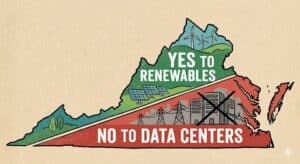 Democrats in Virginia are experiencing political ecstasy at the prospect of reversing four years of common-sense energy policies under outgoing Governor Glenn Youngkin. Gov. Youngkin removed the state from the odious Regional Greenhouse Gas Initiative (RGGI) carbon tax scheme. Incoming Gov. Abigail Spanberger has pledged to re-enroll the state in the program. Youngkin vetoed bills that would have favored unreliable renewable energy. Now, the Dems will not only have Spanberger as Governor, but hardened leftist Ghazala Hashmi as Lt. Governor, and a strong majority in both chambers of the legislature. They are already planning to reintroduce bills favoring renewables and blocking new data centers. It’s a crying shame what Virginia has done in electing these radicals to lead it.
  The Pennsylvania Environmental Quality Board (EQB) held a meeting yesterday to consider whether or not to accept a petition by radical green groups, including the Clean Air Council and Environmental Integrity Project, to “study” the issue of increasing setbacks for shale drilling so far that it would ban ALL new Marcellus/Utica drilling in the Keystone State (no exaggeration). The EQB tabled a decision on whether to accept the petition back in April (see
  Here we go again. The environmental left is attacking the shale industry by accusing it of shipping drill cuttings (the leftover rock and dirt that comes out of a borehole) to local landfills in the Buckeye State (Ohio), where it will irradiate everyone and everything close to it. According to the left, drill cuttings “could be contaminated with radioactivity and other chemicals.” And, according to the same people, lack of regulations in Ohio “allows it [radioactive drill cuttings] to slip by regulators, especially in Ohio,” and end up in the same landfills as “household trash.” Is there anything to the claim that drill cuttings are radioactive and a threat to those who live near landfills?
  Three anti-shale drilling groups—the PA Council of Trout Unlimited, the Keystone Trails Association, and the Responsible Drilling Alliance—have requested the Pennsylvania Department of Environmental Protection (DEP) hold a hearing on the Chapter 105 permit requested for a 3.9-mile shale gas access road and staging area proposed by PA General Energy in Gamble and Cascade Townships, Lycoming County. The aim of their request is not to elicit information or express concerns that can be addressed to achieve a better outcome; rather, it is to flood the hearing with bombastic charges in hopes of blocking the project altogether.