
Seismos CEO: Closed-Loop Fracking Already Used in Marcellus/Utica

Back in March, we told you about “closed-loop” fracking from Seismos and its partner ProFrac. The technology listens to a well while it’s being fracked and adjusts the job in real time, while the stage is still being pumped (see ProFrac and Seismos Bring “Closed-Loop Fracking” to U.S. Shale). At the time we asked: Is it coming to the Marcellus/Utica? Last week Seismos opened a new research center in Texas, and its PR team offered MDN some time with founder and CEO Panos Adamopoulos. We sent five questions specific to our region. The headline answer: yes, closed-loop fracturing has already been used in “the basin.” Seismos won’t say who used it or how many stages they pumped. But Panos did confirm that drillers don’t need ProFrac to use it, and he laid out the math on how much more gas a well might produce. He also says the same acoustic technology can inspect pipelines from the inside, including here in Appalachia. Read More “Seismos CEO: Closed-Loop Fracking Already Used in Marcellus/Utica”
 A Pennsylvania House committee held a hearing on Monday about spreading brine from conventional oil and gas wells on township dirt roads. Former Department of Environmental Protection (DEP) Secretary David Hess testified and proposed a fix aimed squarely at Marcellus drillers: make the shale industry recycle all brine from Pennsylvania’s conventional wells, “at no cost to conventional well owners.” Shale isn’t the problem here, but it could end up with the bill.
  Expand Energy, the largest natural gas producer in the country (born from the 2024 merger of Chesapeake Energy and Southwestern Energy), is going all-in on artificial intelligence (AI). Recently, tech consulting firm Thoughtworks announced that Expand has hired it to build AI capability across the entire company. Not just out in the field, but in the office and on the gas marketing desk, too. Expand wants a working AI tool in “production” (i.e., actually being used, not just tested) by the end of this year. That’s about 12 weeks from now! This is not Expand’s first AI rodeo. Back in January, Expand signed a deal with Baker Hughes to put AI-powered software on thousands of its Marcellus, Utica, and Haynesville wells.
  Here’s a head-scratcher for you. The Henry Hub spot (physical, not futures) price, the national benchmark for natural gas down in Louisiana, closed yesterday at $3.155 per MMBtu (million British thermal units, roughly the same as 1 Mcf, or a thousand cubic feet). Up here in the Marcellus/Utica, the very same molecule of gas sold for 88.5 cents. That’s not a typo. Our gas traded at a $2.27 discount to Henry Hub, fetching just 28 cents on the dollar. Why? The short answer is the same one we’ve given for 15 years: not enough pipelines.
 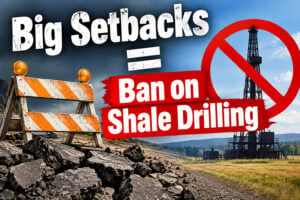 The radical green groups trying to ban new Marcellus/Utica drilling in Pennsylvania through the back door haven’t gone away. They push shale well “setbacks” out to as much as a mile. Yesterday (Oct. 7), a coalition led by the Clean Air Council and Environmental Integrity Project (EIP) marked the two-year anniversary of its rulemaking petition and pushed in Harrisburg, calling on the Shapiro administration to act. The Department of Environmental Protection (DEP) still plans to deliver its recommendation to the Environmental Quality Board (EQB) by the end of this year. The antis are making noise. We need to make more.
  A coalition of 26 state attorneys general, led by West Virginia AG JB McCuskey, is urging the Federal Energy Regulatory Commission (FERC) to adopt a proposed rule that would let interstate pipelines do bigger upgrades, faster, without FERC’s full project-by-project review. All three Republican AGs in our neck of the woods signed on: West Virginia’s McCuskey, Pennsylvania’s Dave Sunday, and Ohio’s D. Andrew Wilson. The 24-page comment letter, dated Oct. 6, is a point-by-point rebuttal to a blue-state coalition (New York, Maryland, Massachusetts, California, and friends) that wants FERC to scrap the whole idea. It’s a wonky fight over a wonky program, but it matters a great deal to drillers, pipeline companies, and royalty owners in the Marcellus/Utica.
  A developer from Bucks County wants to build a 1-gigawatt (GW) natural gas-fired power plant and up to 28 data center buildings on a former U.S. Steel landfill in Elizabeth Township, Allegheny County. If built, the plant would burn somewhere around 150 million cubic feet of Marcellus/Utica gas every day. That’s the good news. The not-so-good news? It’s the same spot where Invenergy tried, and failed, to build a gas plant a decade ago. And the anti group that fought Invenergy spent this summer fighting EQT’s Heracles well pad down the road.
  On Tuesday, a crowd of protesters packed the Pennsylvania Capitol Rotunda in Harrisburg to demand a statewide moratorium (a ban, really) on new data centers. Most of the coverage framed it as an outpouring of everyday Pennsylvanians fed up with Big Tech. MDN took a closer look at who organized the rally, who arranged the buses, and who stood at the microphone. What we found: the same groups and many of the same faces that have fought shale drilling, pipelines, and gas-fired power plants in this state for the past 15 years. New signs. Same agenda.
  Where do the people who actually drill for, and service, oil and gas wells think the price of natural gas is going? Every three months the Federal Reserve Bank of Dallas asks them, and the answer from the latest survey is: not much higher in the short run, but steadily higher over the next five years. The third-quarter 2026 Dallas Fed Energy Survey, released September 30, found executives expect the Henry Hub price to finish 2026 at $3.29 per MMBtu, rise to $3.82 in two years, and reach $4.28 in five years. Meanwhile, the price in the real world right now is hovering around $3.00. Here’s what the crystal ball says, and what it means for the Marcellus/Utica.
  The 108-mile “Women’s Water Walk” along the route of the proposed Constitution Pipeline wrapped up last Sunday in Schoharie. On Tuesday, the walkers carried jars of creek water to Gov. Kathy Hochul’s office in Albany. The walk is over, but it didn’t end quietly. It gave birth to a new, permanent anti-pipeline coalition run by Frack Action. The Governor’s office answered with a carefully worded statement that isn’t quite the “stand strong” pledge the walkers came for. And the walk’s fundraising came up about 80% short of its goal.
 The Allegheny County Board of Health has fired the first shot in what looks like a slow-motion campaign to squeeze shale drilling out of the county. At its September meeting, the board voted unanimously to have the county health department look into whether Article 21, the county’s air pollution rulebook, should be rewritten to remove permitting exemptions that oil and gas operations now enjoy. Nothing changes yet. But the idea came straight out of the board’s own “Fracking Committee,” chaired by a writer for an anti-fracking group, and the folks at Food & Water Watch are already celebrating. Here’s what happened, what it could mean for drillers and landowners in Allegheny County, and why MDN isn’t buying the “it’s just a review” line.
  The Marcellus/Utica water business just got a bit more consolidated. HydroEdge Solutions, a Canonsburg (Washington County, PA) company that moves frack water from point A to point B, has acquired a majority interest in Bridgeville (Allegheny County) based RES Water. The combined outfit will have about 350 employees, five water treatment, recycling, and storage facilities in Pennsylvania, roughly 700,000 barrels of storage, and the ability to process up to 116,000 barrels of water per day. If the HydroEdge name rings a bell, it should. Back in June, HydroEdge (operating as Myers Water Transfer) bought one of the three Williamsport-area sites formerly run by troubled Eureka Resources, a story MDN has followed closely since Eureka’s “black goop” spill into the Susquehanna River in August 2025.
  Here’s one you don’t see every day. A Democratic polling firm, one that boasts of helping elect Democrats all the way up to the White House, says a majority of New York voters want the Constitution Pipeline built. And it isn’t close on natural gas itself: roughly three out of four New Yorkers support using natural gas in the Empire State. Somebody, please forward this to Food & Water Watch, which has been telling anyone who will listen that the “overwhelming majority” of New Yorkers oppose Constitution. Before we pop the champagne, though, there’s some fine print you need to see, including the question of who paid for this poll.
 The U.S. Energy Information Administration (EIA) says U.S. natural gas production hit a new all-time high in July 2026: 137 billion cubic feet per day (Bcf/d) of “gross withdrawals.” That’s great news for the country. But when MDN dug into the state-by-state numbers behind the headline, we found the Marcellus/Utica didn’t help set the record. In fact, Appalachian output dropped in July. The record was made in Texas and New Mexico.