
Doddridge County | Harrison County | Industrywide Issues | Litigation | Statewide WV | Taxation | West Virginia
WV Supreme Court Tweaks Shale Well Property Tax Calculation
 Last Wednesday the West Virginia Supreme Court issued a consolidated opinion lumping together seven similar lawsuits filed by Antero Resources and CNX Resources against the WV state tax commissioner and the Doddridge County Commission. The lawsuits take issue with the way gas well valuations are calculated for property taxes.
Read More “WV Supreme Court Tweaks Shale Well Property Tax Calculation”
 Two important pipeline projects, PennEast and Adelphia Gateway, are at various stages of approval. PennEast is a $1 billion (or $1.2 billion, depending on the source) new greenfield pipeline project from Luzerne County, PA to Mercer County, NJ. PennEast will flow PA Marcellus gas to markets in NJ. Adelphia Gateway is an old oil pipeline, already in the ground, that runs from Northampton County, PA through Bucks, Montgomery, and Chester counties, terminating in Delaware County at Marcus Hook. Adelphia will flow Marcellus gas to the Philadelphia region. PennEast was announced in 2014, and Adelphia in 2017. Neither has yet begun construction. What’s the status for each project?
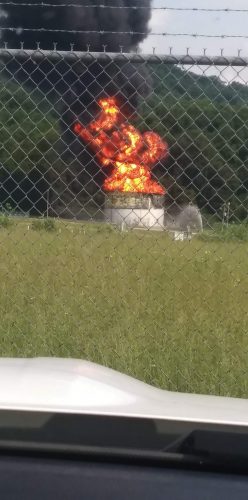 On May 25, lightning struck a 1 million gallon condensate tank near Friendly (Tyler County), WV on a Saturday afternoon (see
 President Trump is pushing members of his administration to work with state regulators in Appalachia–Ohio, West Virginia and Pennsylvania–to “build the country’s first natural gas and petrochemical hub” outside of the Gulf Coast. According to Energy Secretary Rick Perry, such a plan is in the the country’s national security interests. Members of the Trump team are also having discussions with leftists like NY Gov. Andrew Cuomo, to try and convince him to allow pipelines into and through the state. If states like NY won’t allow it, Perry holds out the hope/threat that the feds will invoke the Constitution’s interstate commerce clause to make them.
 A grandmother concerned that if Range Resources were to build a well pad three-fourths of a mile from her granddaughter’s school (in Washington County, PA) instead of building it a full mile from the school, tried to gain legal standing to challenge a permit granted to Range by Mount Pleasant Township. Grandma says her granddaughter has a sensitivity to benzene fumes. Yesterday a Commonwealth Court panel ruled she does NOT have legal standing to challenge the permit.
 Something is not going well at Elba Island in Georgia. Kinder Morgan has left a string of broken promises about the date for which the first Elba Island LNG export plant “mini-train” will begin producing and shipping LNG. We’ve chronicled the journey extensively.
 One of the worst examples of regulatory abuse under the Obama Administration was the EPA’s redefinition of what is called Waters of the United States (WOTUS). The Obamadroids redefined WOTUS to mean everything down to mud puddles–and no, we’re not exaggerating (see
  A West Virginia Circuit Court case in September 2017, Crowder and Wentz v EQT, found in favor of surface landowners ruling that EQT did not have the right to extend underground shale wells to adjacent properties where EQT also owned the mineral rights (see
  New Fortress Energy is expanding into the LNG space like gangbusters. We brought you a story about New Fortress’ billionaire co-founder just yesterday (see
 It looks like Pennsylvania Gov. Tom Wolf’s “promise them anything and everything” Santa Claus routine is working. We’re referring to Wolf’s so-called Restore PA plan that will provide (over a number of years) $4.5 BILLION worth of goodies to Pennsylvanians by slapping a Marcellus-killing severance tax on the already impact taxed shale industry. Legislation was introduced yesterday in the PA House to create Restore PA (House Bill 1585) and fund it with a severance tax, and we’ll be darned if there weren’t 99 House members who signed up to sponsor it (16 of them traitorous Republicans).
 A lawsuit brought by greedy lawyers (ab)using a group of 21 ignorant children against the United States for not doing enough about mythical man-made global warming is once again in the news. The lawsuit aims to force the end of using all fossil fuels in the United States, to address so called man-made global warming.