
WATT Fuel Cell Begins Commercial Rollout with First Install in WV

A fuel cell manufacturer located in Westmoreland County, PA — WATT Fuel Cell — manufactures Solid Oxide Fuel Cell (“SOFC”) stacks and systems that operate on common, readily available fuels such as natural gas and propane. Instead of burning and combusting natural gas (or propane), those fuel sources are subjected to an electrochemical process that produces electricity. Hope Gas, a West Virginia-based natural gas utility, announced a plan in October of last year to roll out WATT Fuel Cells to over 5,000 of its customers (see Hope Gas Gets Ready to Roll Out WATT Fuel Cells to WV Customers). It all begins with the first customer. WATT announced yesterday that it has successfully placed its first commercial installation in Clarksville, WV. Read More “WATT Fuel Cell Begins Commercial Rollout with First Install in WV”
 PJM Interconnection today announced the results of its 2027/2028 Base Residual Auction (BRA), which secured 134,479 MW of unforced capacity generation (UCAP) and demand response (DR) to meet projected electricity needs for more than 67 million people across 13 states and the District of Columbia, including Pennsylvania, Ohio, and West Virginia. The auctioned price came in at the FERC-approved cap of $333.44/MW-day (UCAP) for the entire PJM footprint, an increase of +1.3% from the 2026/2027 BRA. Even so, the BRA fits way too tightly, falling short of PJM’s reliability requirement by 6,623 MW, meaning the committed supply is less than what would be required to meet the one-event-in-10-year reliability standard of a 20% reserve margin. If that event happens in 2027/28, we’re in trouble. The lights will go out. Who’s to blame? We credit Pennsylvania Governor Josh Shapiro.
  In February 2024, members of the South Carolina Public Service Commission approved a proposed project to build a 1,020-megawatt (MW) gas-fired power plant in the state’s Lowcountry, in Colleton County (see
  Ohio already has 217 data centers with more on the way. Data centers are warehouses filled with computer equipment that generates a lot of heat. To cool down the computers, data centers use massive amounts of water. If data centers want to get rid of that water after it’s been used, they have to apply for a permit called the National Pollutant Discharge Elimination System (NPDES) through the Ohio EPA. Currently, data centers must apply for an individual NPDES permit, which is detailed and unique to their operations. The OEPA is looking to streamline the process to make it faster and easier. That’s a good thing.
  In 2022, then-Massachusetts Attorney General (now Governor) Maura Healey bragged she had “stopped two gas pipelines from coming into this state” and that she opposes new natgas infrastructure in the state.
  MDN was among the first to tell readers that so-called environmental groups were quickly morphing from anti-fracking to anti-data center. Over the past several months, we’ve observed in various posts how opposition to data centers (from the same people who oppose fracking and shale energy) has gone from local and regional anti groups (see
 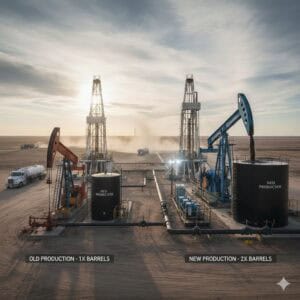 The U.S. shale industry is shifting its strategy from rapid drilling to maximizing recovery from existing wells. With the era of high-growth production ending, operators are increasingly focused on improving recovery rates, which currently average only 10% for oil. Companies like EOG Resources and Occidental Petroleum are utilizing advanced technologies, including EOR techniques like “huff ‘n’ puff” gas injection and data-driven fracking, to extract more resources from mature fields. This transition toward efficiency and capital discipline aims to extend the lifespan of inventory and boost profitability, signaling a move from “shale growth” to “shale sustainability” in a maturing market.

 In early September, MDN told you about the news that Enbridge had made a final investment decision (FID) for the Algonquin Reliable Affordable Resilient Enhancement (AGT Enhancement) project to flow an additional 75 million cubic feet per day (MMcf/d) of Marcellus/Utica molecules through the Algonquin Gas Transmission pipeline throughout New England and the northeast (see
 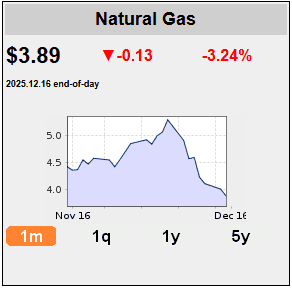 You knew it had to happen. After the meteoric rise of the NYMEX “front month” futures contract from bumping along under $3 just a couple of months ago to hitting a 52-week high of $5.289 on Friday, Dec. 5, 2025, the drop has been almost as rapid. We first crashed back into the $4 range, and as of yesterday, the price sank below $4, closing at $3.8860. The stated reason is a warm weather forecast for the rest of this month. The NOAA Climate Prediction Center (what an oxymoron that is!) shows that the vast majority of the country will experience much warmer-than-average temperatures through Dec. 30.
  In October, we told you that completion of Ohio State University’s Combined Heat and Power Plant (powered with Utica Shale gas) would be delayed until April 2026 (see
  In June, Duke Energy announced that it plans to apply to the Public Service Commission of South Carolina (PSCSC) to build a 1,400 megawatt gas-fired power plant in Anderson County (see
  U.S. Secretary of Energy Chris Wright yesterday signed an amendment order granting an additional 44 months for Woodside Energy to commence LNG exports to non-FTA countries from the Woodside Louisiana LNG Project under construction in Calcasieu Parish, LA. The project was formerly called Driftwood. Once fully constructed, the project will be capable of exporting up to 3.88 billion cubic feet per day (Bcf/d) of natural gas as LNG.
  The bidding war is heating up for those interested in buying Ascent Resources, a privately held company focused 100% on the Ohio Utica Shale. Ascent is Ohio’s largest natural gas producer and the 8th largest natural gas producer in the U.S. Kimmeridge Energy, a private investment firm focused on the energy sector (sometimes called an “activist investor” and/or corporate raider), has put an offer on the table to buy out and take over Ascent: $6 billion. This is the first hard number we’ve seen since the whole bidding war began last week.
  In early April, MDN brought you the exciting news that pipeline giant Williams, via its newly-minted subsidiary, Will-Power, is planning to build two Utica/Marcellus gas-fired power plants in the New Albany International Business Park in Licking County, Ohio, near Columbus, to power a massive new Meta (Facebook) data center complex (see