
Federal EPA Writes a PennEast Pipeline Love Letter to FERC
 Once upon a time, during the Obama reign of terror, the out-of-control Environmental Protection Agency (EPA), as headed by the odious Gina McCarthy, blasted the PennEast Pipeline project (see Obama EPA, National Park Service Try to Rain on PennEast Parade). The Obama/McCarthy EPA made an outrageous claim: That building PennEast “may” end up causing arsenic in groundwater supplies. Totally bogus. And pathetic. The Federal Energy Regulatory Commission (FERC) didn’t fall for EPA’s arsenic and old lace. They approved the project in April (see FERC Issues Favorable Final EIS for PennEast Pipeline Project). Along with the change in the presidency has come some clear-headed thinking in Washington, DC–including at the EPA. Make no mistake–the EPA is still overly populated with Obamadroids that need to be canned. However, there’s enough of a change at the EPA that the agency has just sent what we would call a love letter to FERC, about PennEast. In it, the EPA says, “FERC’s efforts to consider and actively engage EPA to discuss comments, which resulted in improved or modified documentation provided in the [Final] EIS and improved safeguards for protection of human health and the environment.” And because of that, “many of our concerns and objections [to PennEast] have been or will be addressed.” In other words, everybody has now kissed and made up. EPA is feelin’ good about PennEast. And so are we…
Read More “Federal EPA Writes a PennEast Pipeline Love Letter to FERC”
 Very good news for Spectra Energy’s Atlantic Bridge project in (of all places) New York State. In January the Federal Energy Regulatory Commission (FERC) gave its final stamp of approval for Atlantic Bridge (see
 Talen Energy was birthed in June 2015–a combination of PPL Energy Supply and certain assets of Riverstone Holdings. The company, headquartered in Allentown, PA, is one of the largest competitive energy and power generation companies in North America. Talen owns or controls 16,000 megawatts of generating capacity in wholesale power markets, primarily in the Northeast, Mid-Atlantic and Southwest regions of the U.S. Talen has gotten into converting and building natural gas-fired electric plants, stories we’ve covered over the past few years (

 Generally speaking, the western side of Ohio is seeing a lot of activity with new solar and wind installations. And the eastern side of the state is seeing a lot of activity with shale drilling and natural gas pipelines. But there is one county, Seneca County (slightly left of center, in the northern part of the state) where both renewable projects like solar and wind, and fossil fuel projects like pipelines, are both active. And that means landowners in Seneca County are being bombarded with offers from solar, wind, pipelines and electric lines. Some sage advice from the Ohio Farm Bureau Federation for landowners: hire a lawyer before you sign anything…
 In April, MDN brought you news of an effort underway in Ohio to tax Ohio ratepayers $5.4 billion and give that money to FirstEnergy to prevent some of its nuclear power plants from closing (see
 In February, MDN told you that Titan Energy, which used to be known as Atlas Energy/Resource Partners, was listing what appeared to be the rest of the acreage they still own on the Appalachian basin–some 494,229 acres–including rights for drilling in the Marcellus (see
 National Fuel Gas Company (NFG), headquartered in Western New York State, is making noises (threats) that Gov. Andrew Cuomo should be very concerned about. NFG covers the full span of the oil and gas business–from upstream (with its wholly-owned drilling subsidiary Seneca Resources), to the midstream (with wholly-owned subsidiary Empire Pipeline) to downstream (NFG’s natural gas utility service to 740,000 customers in NY and PA). It’s a big company that generates a lot of jobs and revenue for New York State. Yet NY is metaphorically crapping all over NFG–and the company is signaling its willingness to retaliate by leaving. No, not move the company HQ, or sell off its gigantic utility business. Nothing of that sort (yet, anyway). But NFG CEO Ronald Tanski said on an earnings call last Friday that NFG is “getting lousy regulatory treatment in New York State” and that “Given this type of regulatory treatment in the state, we have to take a serious look at our ability to achieve any reasonable growth in New York.” Translation: We’ll stop launching new projects that invest billions in the Empire State, and instead invest that money and the jobs it creates in PA and other states. The “lousy treatment” NFG is getting is related to NY’s corrupt Dept. of Environmental Conservation decision to deny it permits to build the Northern Access Pipeline (see
 Last week the Ohio Dept. of Natural Resources (ODNR) issued updated guidelines for “statutory unitization applications” (full copy below). That is, when a driller wants to form a unit for drilling by combining adjacent properties, the driller must first request permission from the ODNR to form a unit. In Ohio, a unit can be formed when the driller has 65% of the acreage in the unit under a lease agreement. In other words, these are the revised/new guidelines (i.e. hoops) drillers must jump through before the ODNR will agree to combine either willing, or unwilling (force pooled) landowners into a unit for drilling…
 Last week TransCanada announced they are “selling” their interest in the Iroquois Gas Transmission pipeline and a second pipeline, Portland Natural Gas Transmission System (PNGTS), to a subsidiary of TransCanada for $765 million. Every now and again big energy companies transfer some of their assets to different subsidiary companies, on paper. We say “on paper” because nothing really changes with the management of the assets–in this case two pipelines. However, money does change hands because usually there are different sets of investors for the different subsidiaries. So TransCanada “sold” themselves (different set of investors) these two pipeline systems. Iroquois is majority owned by TransCanada–in two pieces. After the drop down sale, TC PipeLines will own both pieces, representing 61.1% of the Iroquois system. Iroquois is a 416-mile interstate natural gas pipeline extending from the U.S.-Canadian border at Waddington, NY, through New York State and western Connecticut to its terminus in Commack, NY, and from Huntington to the Bronx, NY. The second pipeline part of the transfer deal is PNGTS–an interstate natural gas pipeline company providing natural gas transportation service for gas utilities, paper mills, and electric generation plants throughout New England. Here’s info about the deal, and an overview for each pipeline system…
 Last week Energy Transfer Partners (ETP), the main operating division of Energy Transfer Equity (ETE), released its first quarter 2017 financial and operating update. ETP is the company that built the Dakota Access Pipeline, which was finally completed after Obama was ejected from office–and is right now building the Rover Pipeline. Another division of ETE was, until last month, Sunoco Logistics Partners. In April Sunoco LP was merged into ETP (see
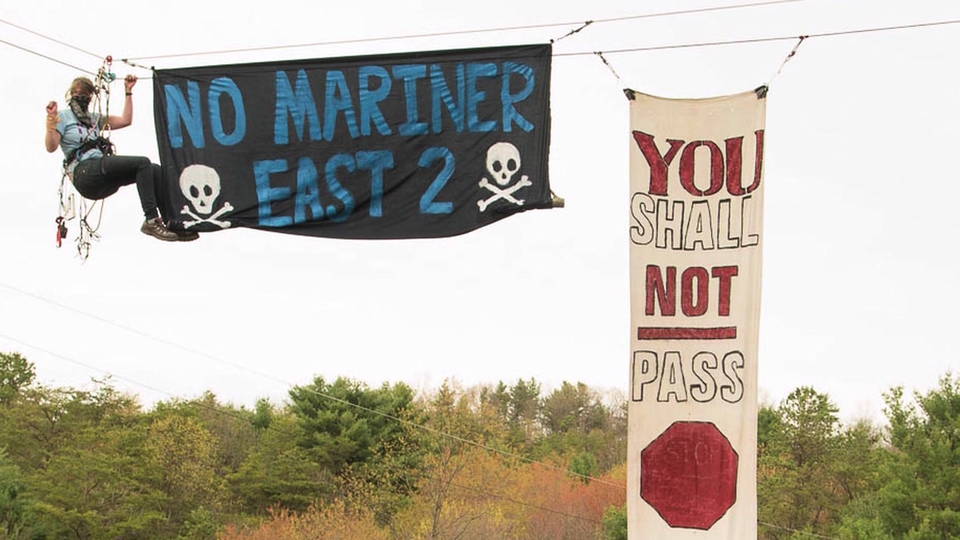 Elise Gerhart has been up a tree before. You may recall our story about Elise, daughter of a Huntingdon County, PA landowner, radicalized by Big Green groups (as evidenced by her association with well known protesters previously arrested), who took to a tree on her mom’s property in order to illegally stop crews working on tree clearing for the Mariner East 2 pipeline (see
 This one has us spitting nails. We have reported, for months, about the activities of so-called protesters against Williams’ $3 billion Atlantic Sunrise Pipeline project. In particular, there is a group in Lancaster County, PA opposing the pipeline creatively called Lancaster Against Pipelines (LAP). Some of their members previously attended and participated in protests against the Dakota Access Pipeline in Standing Rock, ND–protests that turned violent and destroyed millions of dollars in equipment (see

 Yesterday midstream and utility giant Dominion issued its first quarter 2017 update. Along with the update Dominion held an earnings call. On that call we learned new information about both the Atlantic Coast Pipeline (ACP) project, Dominion’s Cove Point LNG export project, and a plethora of other projects, including natgas-fired power plants and more pipelines in the works. Dominion CEO Tom Farrell shared the exciting news that Cove Point is now 89% complete and will be “in service” later this year. As for Atlantic Coast Pipeline, Dominion has now purchased 80% of the materials they will need to build it. Farrell said the pipeline will be online in the second half of 2019. Another six pipeline projects are underway (at a cost of $700 million)–with five of the six due to be done THIS YEAR. Dominion is a happening company. Below are extracts from the earnings call, the 1Q17 update (with financials), and the newest PowerPoint slide deck used during the earnings call…