
FERC Cuts Pipeline Challenge Rule; Result is Faster Construction
 One of the environmental left’s favorite tactics to defeat fossil fuel projects is to challenge every single infrastructure project (pipeline or otherwise) connected to fossil energy at the Federal Energy Regulatory Commission (FERC). As soon as a company files an application to build a new project, and FERC approves it, Big Green will challenge it, first at FERC, and eventually via the courts. FERC has an internal rule, called Order No. 871, that states a company cannot begin construction (even though FERC has approved the certificate) until all such legal challenges are resolved, which can take YEARS. Which is the point—delay, and eventually, some of the projects will give up and won’t build. Run out the clock. Two days ago, FERC issued a new rule eliminating Order No. 871 rule, meaning construction can now begin months and years sooner, even while appeals continue. The enviro-left just lost one of its most potent weapons. Read More “FERC Cuts Pipeline Challenge Rule; Result is Faster Construction”

 The U.S. Energy Information Administration (EIA) issued its latest monthly Short-Term Energy Outlook (STEO) yesterday. The STEO is the agency’s monthly best guess about where energy prices and production will head in the next 12 months. In this latest assessment, EIA dropped its estimates for the Henry Hub spot price for 2025, again, as it has for months. The agency expects the HH spot price to average $3.40 per million British thermal units (MMBtu) in 2025, $0.10 lower than last month’s forecast (and $0.30 below the prediction from three months ago). EIA also dropped its 2026 forecast, quite radically, lowering it by $0.40 to $3.90/MMBtu. Hence, our suspicion that sometimes the data crunchers haul out the breakroom dartboard to help with forecasts.
  PJM Interconnection, the U.S.’s largest regional transmission operator, has proposed an Expedited Interconnection Track (EIT) to let large power generation projects over 500 MW bypass the grid’s traditional interconnection queue. Open to any fuel type, the EIT requires projects to be state-sponsored, seek Capacity Interconnection Rights, and achieve operational readiness within three years. Any fuel type that can meet those criteria, including natural gas, nuclear, renewables, and even battery storage, will qualify for the program. However, the reality is that natural gas is the most likely source to be built and brought online.
 Commonwealth LNG is developing a 9.5 MTPA (million tonnes per annum) liquefied natural gas (LNG) export terminal project located near Cameron, Louisiana. In September, Commonwealth announced it had signed a deal with EQT Corporation to provide 1.0 MTPA of LNG for EQT to resell (see
 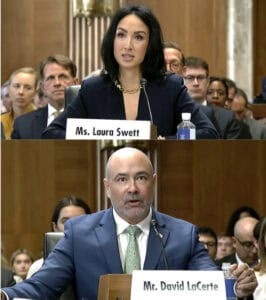 We finally have all five members in place for the Federal Energy Regulatory Commission (FERC). Yesterday, the U.S. Senate, despite the best efforts of Democrats to further delay confirmation votes for *any* Trump appointments, voted to confirm a slate of over 100 new appointments, including two new members of FERC, on a party-line vote of 51-47. In June, President Trump nominated Laura Swett of Vison & Elkins to replace Republican Mark Christie, who had been elevated to Chairman under Trump (see
  In April, MDN told you about a new greenfield expansion of Kinder Morgan’s Elba Express pipeline into South Carolina to serve growing demand for natural gas in the state (see
 Southwestern Pennsylvania faces a time-sensitive opportunity to capitalize on the AI data center boom, with small and midsized manufacturers positioned to play a key role, industry experts said at a recent conference held in Pittsburgh. The rush to build advanced facilities, which have extensive physical, energy, and technology requirements, demands speed and coordination. Panelists highlighted Pennsylvania’s abundant natural gas and diverse energy potential as critical for powering centers, while noting that regulatory frameworks, workforce capacity, and supply chain readiness are equally vital. With $92 billion in committed investment, the region could leverage this moment if policies, energy costs, and development incentives align effectively. The question is, will SWPA be able to pull it off?
  Energy companies are set to invest nearly $50?billion over the next five years in building or expanding 8,800 miles of U.S. natural gas pipelines to meet soaring domestic consumption, record LNG exports, and growing data center demand, greatly aided by regulatory changes under President Trump. Surging gas production, particularly in the Permian Basin as a byproduct of crude oil output, has outpaced pipeline and processing capacity, resulting in occasional negative Waha prices and production slowdowns. Major operators, such as Kinder Morgan and Enbridge, face record backlogs but continue to expand, especially in Texas and the Gulf Coast, with future gas growth tied to sustained oil prices.
  Last week, FERC voted to sunset 53 outdated and unnecessary regulations to advance the Commission’s core mission of ensuring reliable, safe, secure, and economically efficient energy for consumers at a reasonable cost. The actions respond to President Trump’s Executive Order “Zero-Based Regulatory Budgeting to Unleash American Energy” issued in April 2025, which directs agencies to incorporate a sunset provision into their regulations governing energy production to stimulate innovation and deliver prosperity to everyday Americans. Bear in mind, this action comes from the current three FERC commissioners, which include two Democrats and one Republican.
  The Europeans have tried to regulate the U.S. oil and gas industry for more than a year (see
  After gaining rigs for four weeks in a row, last week the Baker Hughes U.S. national rig count stayed even, neither gaining nor (more importantly) losing any rigs. The count remained at 549 active rigs. Sadly, Pennsylvania lost one rig, from 18 to 17, after maintaining its count for 10 consecutive weeks. Ohio kept 13 rigs in the Utica for a second week after gaining a rig two weeks ago. West Virginia kept its seven active rigs, the same number since May 30 (four months). The combined M-U count was 37 rigs, with 23 rigs targeting the Marcellus layer and 14 targeting the Utica.
 What is it about the modern Democrat Party that seeks the total destruction and annihilation of that which they perceive as a political threat? The party, or perhaps more accurately, the radical left elements of the party (which increasingly is all of the party), wants to destroy law and order, including our police departments. Just look at the “protests” (i.e., violent riots) in places like Portland, Oregon. Look at the violence against ICE (U.S. Immigration and Customs Enforcement) employees in places like Chicago. And look at the dangerous talk of politicians like Pennsylvania Governor Josh Shapiro, who is threatening to force the state out of the PJM Interconnection electric grid (see