
Good News for Marcellus: New Brunswick Commits Fracking Suicide
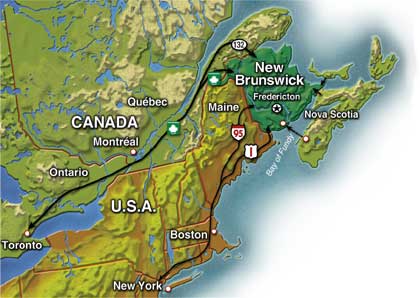
New Brunswick is a Canadian province that shares a border with the U.S. state of Maine. Since 2014 the brainiacs who run the province of New Brunswick have had a fracking moratorium in place–similar to what the State of New York had. Yep, you can see where this one is going. Last week those same brainiacs announced that the fracking moratorium in New Brunswick will go on “indefinitely.” Meaning it’s a ban, not a moratorium. The Canadian’s stupidity is a gift to the Marcellus/Utica because New Brunswick also shares a border with Nova Scotia and there are several LNG (liquefied natural gas) export facilities actively being planned. Those facilities will not get their gas from Nova Scotia or (now) from New Brunswick. The place those facilities will have to get their gas from is the Marcellus/Utica. So thanks, Canada!…
Read More “Good News for Marcellus: New Brunswick Commits Fracking Suicide”
 It’s been a while since we’ve checked in on the proposed 549 megawatt, $615 million electrical generating plant to be built near Moundsville (Marshall County), WV. At last check almost a year ago, Moundsville Power was on schedule for an opening in 2018 (see
 Since announcing the project in 2012, the Constitution Pipeline has handed out more than $2 million in community grants to fire departments, police departments and a variety of nonprofit organizations that benefit the community. Recently New York Gov. Andrew Cuomo decided to block the Constitution Pipeline to placate his radical left supporters (see
 We often debate whether or not a bit of news is actually interesting for the MDN audience. Will this bit of news help either a landowner, driller, midstreamer, supply chain company or investor if they knew about it? The following story comes down right on the line for us. We could go either way, but we elected to include it. We don’t know when, exactly, but at least two years ago SemGroup Corporation, a publicly traded (shares of stock) midstream company that moves mostly oil from the wellhead to market, started up a master limited partnership (MLP) subsidiary called Rose Rock Midstream. An MLP issues “units” instead of shares of stock. MLPs have certain tax advantages for investors. We ran a story in June 2014 about Rose Rock buying some of Chesapeake Energy’s assets, including a trucking operation that services the Utica Shale in Ohio (see
 A company we’re keeping our eye on is Siluria Technologies. We wrote about them a few weeks back (see

 A few weeks ago MDN brought you the news that the federal Environmental Protection Agency (EPA) has issued onerous new regulations on capturing every last molecule of methane all along the route from wellhead to burner tip (see
 RigData is one of the oil and gas industry’s most trusted sources for information on drilling activity in the U.S. RigData provides details on drilling rigs–where they are, who’s operating them, what kind of well they’re drilling. RigData publishes reports daily, weekly and monthly. We’ve seen their web and mobile phone app–seriously cool stuff. The company has been around for 25 years. So it was like a fracking-induced earthquake to discover that RigData has been sold–to S&P Global Platts. Financial terms of the deal were not disclosed. Here’s the earth-shaking announcement…
 “Unbelievably dense” is how we would describe the “leaders” of Munroe Falls, Ohio. Going back to 2012, Monroe Falls–a “city” with a population of 5,000–has been attempting to stop legally permitted wells from being drilled on private property within city limits. Munroe Falls ordered Beck Energy to cease and desist drilling activity claiming the driller had not secured permits from the city first (Mother May I?). The object was to never let Beck drill, to deny them the permits they would need to seek, so Beck took them to court and an Ohio appeals court struck down Munroe Falls’ “home rule” zoning ordinances as illegal (see


 Strong demand from electric power generators will push natural gas demand this summer up by an estimated 4 billion cubic feet per day (Bcf/d), according to a new report from the Natural Gas Supply Association (NGSA). However, even though there’s more demand, because supplies are so bountiful, the price of natural gas over the summer is actually expected to go down, not up. Using published data and independent analyses, NGSA evaluated the combined impact of weather, economic growth, customer demand, storage inventories and production activity on the direction of natural gas prices for the summer of 2016 compared to last summer. The NGSA says summer 2016 will see a “remarkable growth in demand.” Even so, NGSA expects “downward pressure on prices compared to last summer.” Bummer. It’s great news for consumers and power generating plants. But not so good news for drillers. Below we have a full copy of the NGSA report…
 CNBC, not known for being an objective news source (witness the Republican debate debacle earlier this year), conducted a survey among 22 strategists, traders and analysts on the topic of the price of oil. MDN sometimes covers oil stories because natural gas oil are joined at the hip. Often the same E&Ps that drill for oil also drill for gas. And when you drill a hole in the ground, you get what you get–not only oil, but “associated gas” and gas liquids. Hydrocarbons of all kinds come out of the holes drilled. So it pays to pay attention to the oil market and what’s happening with the price of oil. According to the CNBC survey, those responding said overall they expect drilling to pick back up with the price hitting $50 per barrel. But they also said it won’t really pick up in earnest until the price hits $60 per barrel. Roughly half expect the price of oil to remain in the $40-$50 range until the end of 2016, with the other half thinking it will go higher. Only 9% believe come Dec. 31 the price will be at or above $60/barrel…