
Beaver County | Belmont County | Energy Companies | Energy Services | Ethane | Industrywide Issues | Ohio | Pennsylvania | Pipelines | Processing Plants | PTT Global | Shell
Marcellus/Utica Ethane Will Flow to 6 Crackers Being Built in SW
 While two, possibly three, major ethane cracker plant projects are being considered for the Marcellus/Utica region, there are six ethane crackers currently being built in the Gulf Coast region. The kicker? Marcellus and Utica Shale ethane will feed some of, perhaps portions for all of, those six cracker plants. It’s a shame, really. We could be reaping the rewards of a massive influx of jobs and investment not only by building an ethane cracker, but with the satellite businesses that will locate around it. Instead, much of that investment and those jobs are slipping away to the Gulf via NGL pipelines…
Read More “Marcellus/Utica Ethane Will Flow to 6 Crackers Being Built in SW”
 An interesting article in the Philadelphia Inquirer provides some of the history, and an update, for the Marcus Hook refinery in the Philly area. You may recall that Sunoco Logistics Partners purchased the refinery and is in the process of turning it into an NGL export facility–to send ethane, propane and other NGLs to locations along the U.S. coastline and internationally to Europe. What you may not know (what we sure didn’t know) is that Sunoco LP hopes to one day build a propane cracker at the site–a facility that will convert propane into propylene, the raw material used to make plastics. Who knew?! This would be yet another cracker plant that would compete, in a small way, with the proposed Shell cracker plant planned for the Pittsburgh area…
 You really can’t make this stuff up. CORN–the Ohio-based Coalition to Reroute Nexus (as in the NEXUS pipeline)–is holding a CORN maze for a fund-raiser. Could anything be CORNier? Of course, CORN is not really about re-routing the NEXUS pipeline to another area–it’s about stopping it altogether. Antis have a hard time telling the truth. It seems to be a congenital flaw. We’ve previously written about CORN on a number of occasions (see our
  There are over 300,000 miles of natural gas pipelines in the ground in the United States–did you know that? Those pipeline bring cheap, abundant, clean-burning natgas to American households, businesses, and electric generating plants. Nobody gave pipelines a second thought for oh, the past 75 years or more. That is, until coordinated campaigns by groups of nutters who irrationally oppose fossil fuels, seeking to demonize pipelines–the safest form of transportation in existence. Unfortunately their lies require a response. The Interstate Natural Gas Association of America (INGAA) has stepped up to the plate, launching a nationwide campaign, complete with a TV commercial, to educate American consumers about the benefits of natural gas and natural gas pipelines…
 Sunoco Logistics Partners, which owns the Mariner series of pipelines (East, West and South), has just launched a new binding open season–time when drillers and other shippers can sign up for capacity–for an expansion of the planned Mariner East 2 project. In April 2014 MDN brought you the news that Sunoco LP had completed an open season for Mariner East 2 and had enough customers to move forward with the project (see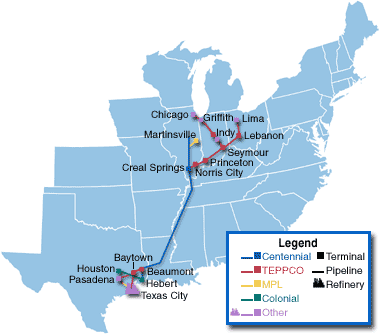

 For years MarkWest Energy has been one of the most active midstream companies in the Marcellus/Utica region. MDN has often called MarkWest the premier midstream company in the northeast–with more pipelines and processing plants than any other company, except possibly the recently merged Williams/Access Midstream. Even though MarkWest has a huge portfolio of assets in Ohio, West Virginia and Pennsylvania, and continues to have a big and ambitious list of future projects, it wasn’t enough to stave off a takeover. Marathon Petroleum announced in July they are buying out MarkWest and adding it into their own operations (see
  In an attempt to make it easier for natural gas-fired electric generating plants to buy gas only when they actually need it, Kinder Morgan’s Tennessee Gas Pipeline has just launched a new service called PowerServe(TM). The new service is specifically targeted to electric plants in New England. Traditionally, electric generating plants have shied away from signing long-term contracts for natural gas because of the peaks and valleys in power generation. During the dead of winter, they need a lot of natural gas. In the summer, they don’t need nearly as much. TGP’s new PowerServe service is meant to give them a way to grab only what they need, when they need it. Part of the PowerServe service will be tied to a pipeline not yet built–TGP’s Northeast Energy Direct pipeline that will cross parts of Massachusetts and New Hampshire…
 In a shameless act of political pandering, the president of the Massachusetts State Senate, Stan Rosenberg (Democrat), ran his own version of a Federal Energy Regulatory Commission (FERC) scoping hearing. Such hearings, while meant to elicit useful information about where a pipeline should, and should not, run, usually devolve into freak shows by anti-drilling zealots who parade and preen before the cameras and microphones–making fools of themselves. We’ve seen it many times before. So Rosenberg, apparently not satisfied that there’s not a FERC hearing every week where anti-drilling zealots in Mass. can gripe and moan and complain, set up his own faux session. He “listened” to some 60 people complain about the proposed Kinder Morgan Northeast Energy Direct pipeline. Stan says he’s going to hand deliver transcriptions of the entire sordid affair to FERC, personally…
 Both Kinder Morgan and Spectra Energy are in a tough fight to build pipelines from the Marcellus into New England. One of the competing visions for how to get more natural gas to residents, businesses and electric generating plants that so desperately need natural gas is to import it through the Everett, MA LNG import terminal. That’s where GDF Suez, the American name for the French multinational electric utility company Engie, imports natural gas. We told you about GDF Suez’s self interested last year (see
  In June MDN updated you on Kinder Morgan’s plans to repurpose part of the existing Tennessee Gas Pipeline that currently runs south to north, reversing the flow to send natural gas liquids (NGLs) southward (see
  Kinder Morgan has just released a study that they commissioned (paid for), but researched by the independent ICF International. The study, titled “New England Energy Market Outlook: Demand for Natural Gas Capacity and Impact of the Northeast Energy Direct Project” (full copy below), finds that New Englanders would have saved $3.7 billion in wholesale electricity costs during the 2013-2014 ‘Polar Vortex’ winter had the proposed Northeast Energy Direct Project (NED) been in service at the time. The study also finds the additional gas capacity that NED would provide will generate $2.1 billion to $2.8 billion in annual savings going forward for New England electric consumers, under normal weather conditions. Plus there are many other benefits (aside from cost savings) from building NED, including lower air pollution throughout New England…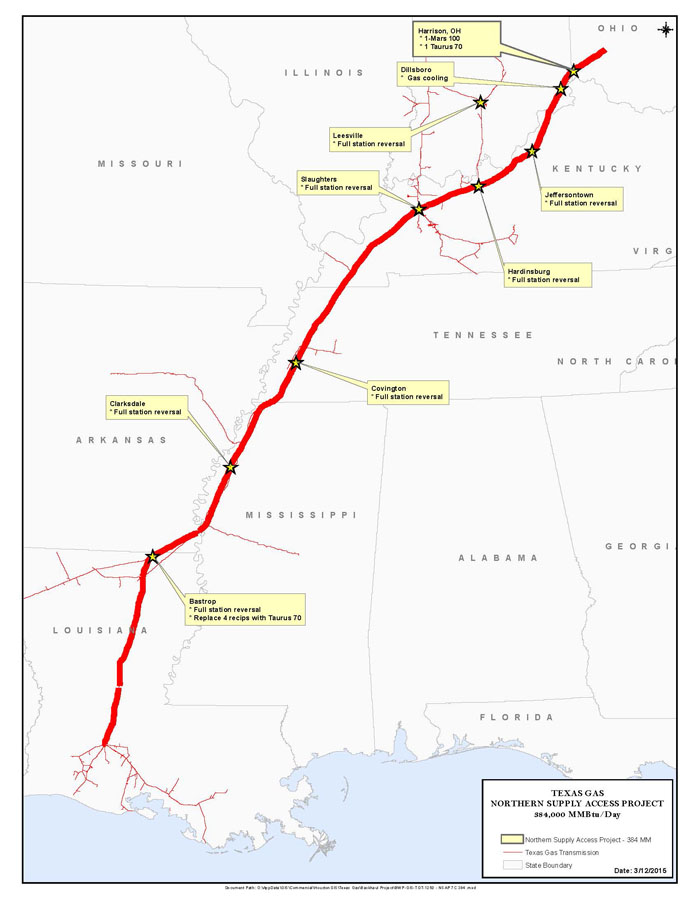
 The NEXUS Gas Transmission pipeline, a $1.5-$2.0 billion natural gas pipeline that will carry Utica and Marcellus Shale gas spanning 11 counties in Ohio, 3 counties in Michigan, and eventually connect to the Dawn Energy Hub in Canada, has had to take some Ohio landowners to court simply to gain access to their property survey for potential routes. Sometimes county judges rule against NEXUS (see
  Midstream giant Williams and drilling giant Chesapeake Energy are cuddling a little bit closer in the Ohio Utica Shale. Williams announced today they have signed an agreement with Chesapeake to run gathering pipelines in a new area of the dry gas Utica for Chesapeake in return for signing a contract that binds Chessy to using Williams until 2035. Williams was already gathering natural gas for Chessy on 140,000 acres of Utica Shale land in Ohio. This agreement extends the time on that 140,000 acres by adding another 20 years, and adds another 50,000 acres to the mix…