
Canada Rejects Discounted Rates for U.S. Shale Gas to New Brunswick

The Maritimes and Northeast Pipeline (M&NP) runs from Goldboro, Nova Scotia through Nova Scotia and New Brunswick to the Canadian – U.S. border near Baileyville, Maine. The pipeline continues through Maine and New Hampshire into Massachusetts where it connects with the existing North American pipeline grid at Dracut, Massachusetts. It used to be that offshore natural gas from Nova Scotia fed the pipeline, which ran from north to south. But those offshore fields are running low, and the Marcellus/Utica appeared. These days the M&NP runs from south to north–at least part of the system does. One of M&NP’s big customers is Irving Oil, with a refinery and cogeneration (natgas-fired) power plant in Saint John, New Brunswick. Irving is an M&NP customer. However, another pipeline company offered to build a new pipeline to feed Irving Oil’s operations with natural gas, at discount. M&NP said that’s crazy. They want to keep Irving as a customer, so they cut a deal with Irving to import natural gas from the U.S. (in all likelihood, Marcellus/Utica gas), flowing the gas from the Maine border to St. John and Irving’s operation there. The only thing standing in the way is the Canadian National Energy Board (NEB)–which is kind of like our own Federal Energy Regulatory Commission (FERC). The deal offered by M&NP requires NEB approval because it lowers the toll (fee charged) and changes directions to import/flow U.S. gas to Irving. Last week the NEB rejected M&NP’s plan, saying the plan is “premature” because the Maritimes region is facing a period of uncertainty. It is not clear (to the NEB) where natural gas will ultimately come from, and what the market actually needs. Offshore? Canadian fields? Import from U.S.? It’s not yet clear how it will all shake out. So the NEB turned down M&NP’s request. What happens now?…
Read More “Canada Rejects Discounted Rates for U.S. Shale Gas to New Brunswick”
 Big Green leftists HATED President Richard Nixon (frankly, they hate any/every Republican before and since). They hated Nixon even though he created the Environmental Protection Agency (EPA). Did you know that Nixon created the EPA? And now the EPA’s first-ever Secretary, William Ruckelshaus (a card-carrying member of the swamp dweller’s club) is criticizing current EPA Sec. Scott Pruitt for returning the EPA to its roots–to clean up superfund sites and target polluters. Pruitt has pledged to roll back EPA’s cancerous expansion under Obama, with its wild attempt to regulate anything and everything under the excuse of trying to prevent man-made global warming. Why are we not surprised that a has-been like Ruckelshaus is criticizing Pruitt? Ruckelshaus isn’t the only swamp dweller who hates Pruitt (and yes, hate is the accurate word to use). The National Resources Defense Council (NRDC), one of the worst of the worst so-called environmental groups, recently said it is gearing up to launch dozens (!) of lawsuits against the EPA and Pruitt. NRDC is part of the Washington, D.C. swamp. It seems the swamp doesn’t like getting drained and is fighting back. That’s OK. President Trump loves a good fight. It’s about time somebody took the fight to unelected, Big Government-loving nongovernmental organizations like NRDC. Rather than taking something away, Trump and Pruitt are trying to return the EPA to its original mandate. Make no mistake. At it’s core this is a fight about fossil fuels. Big Green disastrously wants to kill the use of fossil fuels–NOW. Here’ a look at how the swamp is fighting back against Trump’s efforts to drain it…
 In early January, the Pennsylvania Dept. of Environmental Protection (DEP) told Sunoco Logistics Partners to suspend all work on the $2.5 billion Mariner East 2 (ME2) NGL pipline–from one side of the state to the other (see
  Yesterday MDN brought you the news that the Federal Energy Regulatory Commission (FERC) has slapped a stop work order on underground horizontal direction drilling (HDD) for Rover Pipeline at the site crossing under the Tuscarawas River (see
  Last September, amidst a heated state budget battle in Pennsylvania (where the phrase “severance tax” was on the lips of every Democrat and RINO in Harrisburg), a group of PA House Republicans did the hard work Gov. Tom Wolf and his cronies in the legislature refused to do: They figured out how to fund a wildly overspent budget without raising a single tax (see
  In November 2015 MDN reported on a zoning court case in Westmoreland County, PA (see
  Philadelphia is the sixth most populous city in the United States, with over 1.5 million residents. And yet *maybe* 120 people turned out yesterday for a Delaware River Basin Commission (DRBC) hearing on their proposed plan to permanently ban fracking in the Delaware River Basin. A pair of hearings were held earlier this week in rural northeast PA–in Waymart–where the turnout was upward of 150 people! Judging from the wild claims by green groups like THE Delaware Riverkeeper that thousands (millions!) of people don’t want fracking in the river basin, you’d think more than maybe 120 people would turn up for a hearing in a city like Philly. Could it be not all that many people in southeast PA give a hoot about fracking in two northeastern PA counties? That thought crossed our minds as we read the accounts of those who showed up at yesterday’s meetings in Philly. Yes, antis outnumbered those in favor of fracking, but that’s to be expected in Philly. Here’s a recap of yesterday’s meetings…
 The Ohio EPA continues its yapping insistence that the Federal Energy Regulatory Commission (FERC) *permanently* shut down underground horizontal directional drilling (HDD) work being done by Rover Pipeline near the Tuscarawas River over concerns that nontoxic (totally safe) drilling mud keeps disappearing down the borehole. FERC listened, sort of. In an order dated yesterday, FERC told Rover to *temporarily* stop HDD work at Tuscarawas until Rover can outline a plan for moving forward that FERC has confidence will address concerns over the disappearing drilling mud. When mud used for drilling holes comes out on the surface any place other than the hole from which it went down, it’s called an “inadvertent return.” We call it a leak. However, if that same mud never comes back to the surface, as sometimes happens, it’s fine. Except when it’s a LOT of mud, as is the case in drilling near Tuscarawas where a cumulative 200,000 gallons of it have disappeared down hole, not (so far) coming back out. Sooner or later it seems likely that at least some of that mud will come back to the surface–somewhere. That’s the concern that no doubt prompted FERC to send Rover a letter yesterday telling them to (for now) stop HDD work at Tuscarawas…
 That didn’t take long. We knew it wouldn’t. Last Friday the Federal Energy Regulatory Commission (FERC) gave its full, final approval for the PennEast Pipeline project, a $1 billion, 120-mile primarily 36-inch natural gas pipeline that will stretch from Dallas (Luzerne County), PA to Transco’s pipeline interconnection near Pennington (Mercer County), NJ. (see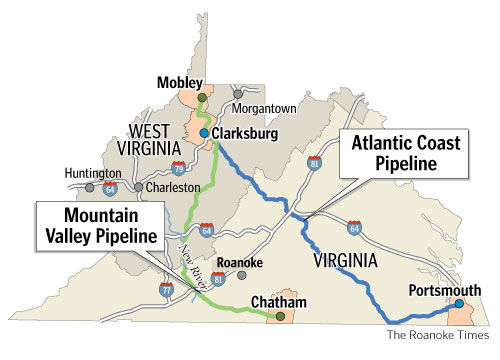
 Yesterday saw the first two of six public hearings held by the Delaware River Basin Commission (DRBC) on their plan to permanently ban fracking in the Delaware River Basin. The hearings were held in Waymart (Wayne County), PA. The DRBC frack ban would essentially ban shale drilling in two northeastern PA counties: Wayne and Pike. Landowners there have been battling the DRBC going on 10 years. At first it was a temporary ban (like New York’s). Now it has metastasized into a full blow permanent ban–if DRBC gets its way. Below we have two reports–one from mainstream media, the other from MDN friend Tom Shepstone, who hilariously was called “Crapstone” by an anti addressing one of the hearings. You know you’re being effective when they start calling you silly names! Tom said it was landowners versus special interest group groupies at both hearings. Here’s an update on what happened…
 In December 2015 MDN told you about EQT’s application to drill a single shale well in Jefferson Hills (Allegheny County), PA (see
  WOTUS is, unfortunately, far from dead. In May 2015 the Obama rogue Environmental Protection Agency (EPA) along with the Obama U.S. Army Corps of Engineers (USACE) released a finalized rule clarifying what “Waters of the United States” (WOTUS) means vis a vis what can be regulated under the federal Clean Water Act (see
  In December MDN told you that Dominion’s $5 billion Atlantic Coast Pipeline (ACP) project had asked permission from the Federal Energy Regulatory Commission (FERC) to begin clearing trees along the path of the pipeline in all three states where the pipeline will run: West Virginia, Virginia, and North Carolina (see
  It’s looking more and more like co-tenancy legislation will pass this year in West Virginia (see