
Good News for Marcellus: New Brunswick Commits Fracking Suicide
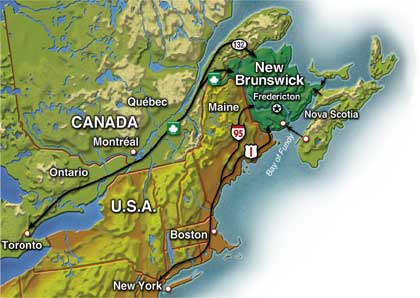
New Brunswick is a Canadian province that shares a border with the U.S. state of Maine. Since 2014 the brainiacs who run the province of New Brunswick have had a fracking moratorium in place–similar to what the State of New York had. Yep, you can see where this one is going. Last week those same brainiacs announced that the fracking moratorium in New Brunswick will go on “indefinitely.” Meaning it’s a ban, not a moratorium. The Canadian’s stupidity is a gift to the Marcellus/Utica because New Brunswick also shares a border with Nova Scotia and there are several LNG (liquefied natural gas) export facilities actively being planned. Those facilities will not get their gas from Nova Scotia or (now) from New Brunswick. The place those facilities will have to get their gas from is the Marcellus/Utica. So thanks, Canada!…
Read More “Good News for Marcellus: New Brunswick Commits Fracking Suicide”

 A few weeks ago MDN brought you the news that the federal Environmental Protection Agency (EPA) has issued onerous new regulations on capturing every last molecule of methane all along the route from wellhead to burner tip (see
  “Unbelievably dense” is how we would describe the “leaders” of Munroe Falls, Ohio. Going back to 2012, Monroe Falls–a “city” with a population of 5,000–has been attempting to stop legally permitted wells from being drilled on private property within city limits. Munroe Falls ordered Beck Energy to cease and desist drilling activity claiming the driller had not secured permits from the city first (Mother May I?). The object was to never let Beck drill, to deny them the permits they would need to seek, so Beck took them to court and an Ohio appeals court struck down Munroe Falls’ “home rule” zoning ordinances as illegal (see

 Last week the federal EPA released a draft of its final Environmental Justice Strategic Plan for 2016-2020 (full copy below). The feds are now seeking comments, until July 7, which they will toss in the garbage can. The EPA is and remains a rogue agency–out of control and drunk on its own power (with a need to be reigned in). What is so-called “environmental justice” anyway? It’s coded language for screwing “rich” companies and giving the money to poor folk. The aims of the EPA’s enviro justice plan are: (1) radically expand “rulemaking”–which means enacting laws without the legislative branch doing it, and then enforcing the cockamamie laws they make up using their own thugs; (2) come down on state and local governments like a ton of bricks, forcing them to dance to the EPA’s tune; and (3) continue to use unrealistic standards to punish companies that dare to make money and provide jobs. That about sums up the EPA’s approach, in our estimation. The EPA gets to make up its own laws and then enforce those laws–bypassing Congress altogether. It is a gross violation of the U.S. Constitution. Here’s a copy of the EPA’s “justice” plan, along with a more “objective” (than we offered) description of what the EPA is attempting with this latest power grab…
 Last week presidential candidate Donald Trump gave a speech on energy and energy policies at the Williston Basin Petroleum Conference in Bismark, North Dakota. By all accounts, Trump hit the ball out of the park. Before a crowd of some 7,000 people, Trump delighted the audience with a pretty simple message: cut back on regulations that choke America’s exploration and production of energy–and frack a lot more. Which is contrary to “crooked Hillary’s” vision of enacting new regulations to the point that fracking will be banned (see
 There are precisely two counties in all of the State of Maryland that contain Marcellus Shale deposits under them–Garrett and Allegany counties, in the far western tip of the state. Maryland is currently under an idiotic temporary ban (see
  Both Energy Transfer Equity (ETE) and Williams yesterday issued statements about their proposed/impending merger that say Form S-4 filed with the Securities and Exchange Commission (SEC) has been ruled “effective.” As we so often point out, we’re not Wall Street wizards. From what we can determine, an S-4 is a filing between companies that propose to merge. The SEC is (we think) saying that the proposed stock swap between ETE and Williams can move forward, when and if the merger closes. That is, the SEC is cool with the proposed plan to merge. ETE points out there are still roadblocks to such a merger, and Williams continues to press several lawsuits to force ETE into the merger they (ETE) wanted in the first place. Below we have yesterday’s statement about the S-4 along with ETE’s continued “but but but” statement. We also include some interesting and insightful analysis from a writer on the Seeking Alpha investors website…
 In the end, it was John Quigley’s own hubris that resulted in his demise as Secretary of the Pennsylvania Dept. of Environmental Protection. As we reported yesterday, last Friday Sec. Quigley suddenly resigned his position (see