
M-U Rig Count Stays @ 39 But PA & OH Swap 1 Rig; Nat’l Count @ 546
 The Marcellus/Utica rig count gained 1 rig eight weeks ago in the Ohio Utica, bringing the regional total to 39 rigs. The combined number of 39 remained the same last week, however, there was an important change. The Pennsylvania Marcellus picked up one rig last week, while the Ohio Utica lost a rig. PA is now operating 19 rigs, OH is operating 13 rigs, and WV maintains its 7 rigs, which it has operated since May of last year. There were 25 rigs targeting the Marcellus and 14 targeting the Utica last week. The national count gained 2 rigs last week, bringing the national total to 546 active rigs. Read More “M-U Rig Count Stays @ 39 But PA & OH Swap 1 Rig; Nat’l Count @ 546”
 The Marcellus/Utica region received a combined 10 new drilling permits last week, Jan. 19 – 25, down significantly from the 27 issued two weeks ago. Pennsylvania issued 6 new permits, Ohio issued 4, and West Virginia issued none. The drillers receiving new permits last week included: Ascent Resources, EOG Resources, Expand Energy, and Pennsylvania General Energy.
 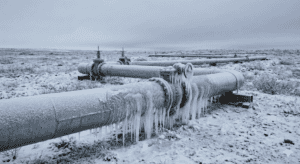 We’ve recently begun to highlight flow restrictions along pipelines that carry Marcellus/Utica molecules. When flows slow or stop (can’t reach other markets), the price typically falls because supply exceeds demand. But sometimes, the opposite happens. If pipelines are restricted due to outages and freeze-offs (as is happening right now with Winter Storm Fern), the supply of natural gas is diminished, leaving insufficient supply to meet increased demand due to the cold weather. When that happens, spot prices for natural gas soar. Wood Mackenzie reported that natural gas freeze-offs across the country reached a single-day high of 17 billion cubic feet (Bcf) on January 25th, approaching the record 18 Bcf set during Winter Storm Uri, as an intense Arctic weather system sweeps across the United States. What about the situation in the M-U?
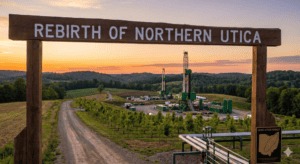 The Mahoning Valley is entering a “Utica 2.0” era as advanced drilling technologies revitalize oil production in previously dismissed regions of Ohio. While energy companies once abandoned Mahoning and Trumbull counties, record-breaking yields from new wells in Columbiana and Mahoning counties have triggered a surge in leasing and permits. Improvements in horizontal drilling and fracking fluids now allow operators like EOG Resources and Hilcorp to extract significant oil from formations once considered unprofitable. This industrial renaissance, punctuated by EOG’s $5.6 billion acquisition of Encino Acquisition Partners, signals a transformative phase of exploration poised to expand further north in the Utica.
  We recently became aware of an Ohio Supreme Court decision that affects producers (i.e., drillers) and, by extension, potentially affects royalties for landowners and rights owners. In E. Ohio Gas Co. v. Croce, the Supreme Court affirmed that the Public Utilities Commission of Ohio (PUCO) has exclusive jurisdiction over claims brought by natural gas producers against Dominion Energy. The producers alleged conversion and unjust enrichment, claiming Dominion sold their excess gas without compensation. The producers tried to litigate the matter in the courts. But the Supreme Court ruled that, in these types of cases, PUCO has primary jurisdiction—not the courts.
  JobsOhio, a private, nonprofit corporation that works on behalf of the state to drive job creation and new capital investment in Ohio by attracting business, contracts its economic research to Cleveland State University (CSU) to keep tabs on the Utica Shale industry. JobsOhio released the latest CSU updated report earlier this week (full copy below), showing that more than $114.6 billion has been invested in Ohio across natural gas, natural gas liquids, and petrochemical supply chain industries since 2011. Ohio’s shale energy sector drew approximately $3.5 billion in fresh capital between July and December 2024.
  One of the significant stories of 2024 in the Ohio Utica was about Austin Master Services (AMS), a radiological waste management solutions company in Martins Ferry, Ohio, that processes and transports fracking waste for disposal. AMS ran into trouble when it ran out of money. The Martins Ferry facility in Belmont County, where waste is temporarily stored, had vastly exceeded its permitted limit of 600 tons (storing over 10,000 tons), resulting in a permit violation. The Ohio Attorney General’s office filed a lawsuit against the company in March 2024 to compel compliance and require the company to clean up the facility. After the company didn’t perform, the Ohio Department of Natural Resources (ODNR) stepped in to handle the cleanup (see
  Ohio State Representatives Gary Click and Kellie Deeter have introduced legislation to establish a 13-member bipartisan Ohio Data Center Study Commission. This initiative responds to the rapid expansion of approximately 200 data centers across the state, which has sparked community concerns regarding agricultural land use, noise pollution, water consumption, and energy demands. The commission aims to provide a platform for public dialogue and develop a comprehensive report to guide future development. By evaluating these impacts, lawmakers hope to encourage smart, balanced growth that potentially prioritizes brownfield redevelopment over rural green spaces while ensuring long-term resource stability.
  The bidding war for Ascent Resources continues and gets more complex. Law firm Kirkland & Ellis has been drawn into a dispute between Ascent Resources investors and the private equity firm Energy & Minerals Group (EMG). Mason Capital Management is questioning Kirkland & Ellis’s role representing the Ascent board while also advising EMG in its legal fight with the Abu Dhabi Investment Council. The dispute concerns EMG’s plan to put Ascent into a “continuation vehicle,” which Mason Capital and other investors have opposed. Other companies have since jumped in to make bids to take over Ascent.
 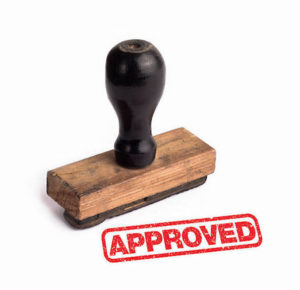 Yesterday, the Ohio Oil & Gas Land Management Commission (OGLMC) met in a public forum in Columbus and voted to open another 6,570 acres of state-owned wildlife land (in Belmont and Harrison counties) to allow bids to frack under (not on top of) those areas. The Commission also awarded a contract to Grenadier Energy to drill under another wildlife area in Carroll County, 172 acres of the Leesville Wildlife Area. The state is getting an amazing $6,000 signing bonus, equaling $1.03 million, plus big royalties!