
Accidents | Carroll County | Energy Companies | EOG Resources | Hydraulic Fracturing | Industrywide Issues | Ohio
EOG Shale Oil Pad in Carroll County, OH Explodes During Fracking
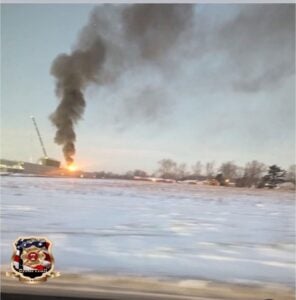
There was an explosion around 7:00 a.m. on Tuesday, December 16, 2025, at an EOG Resources shale well pad located on June Road in Malvern (Carroll County), Ohio. A well on the pad was actively being fracked at the time of the incident, according to news reports. Fortunately, there were no injuries. The fire was contained to a vapor tank on the pad. The wellheads themselves were not involved or damaged. Read More “EOG Shale Oil Pad in Carroll County, OH Explodes During Fracking”

 In October, we told you that completion of Ohio State University’s Combined Heat and Power Plant (powered with Utica Shale gas) would be delayed until April 2026 (see
  The bidding war is heating up for those interested in buying Ascent Resources, a privately held company focused 100% on the Ohio Utica Shale. Ascent is Ohio’s largest natural gas producer and the 8th largest natural gas producer in the U.S. Kimmeridge Energy, a private investment firm focused on the energy sector (sometimes called an “activist investor” and/or corporate raider), has put an offer on the table to buy out and take over Ascent: $6 billion. This is the first hard number we’ve seen since the whole bidding war began last week.
  In early April, MDN brought you the exciting news that pipeline giant Williams, via its newly-minted subsidiary, Will-Power, is planning to build two Utica/Marcellus gas-fired power plants in the New Albany International Business Park in Licking County, Ohio, near Columbus, to power a massive new Meta (Facebook) data center complex (see
  In October, National Fuel Gas Company, a large utility company headquartered in the Buffalo, NY area with both upstream and midstream subsidiaries (Seneca Resources and NFG Midstream), announced a deal with CenterPoint Energy to acquire CenterPoint’s Ohio natural gas utility business (CNP Ohio) for $2.62 billion (see
  The Marcellus/Utica rig count gained a rig last week in the Ohio Utica. The combined count hit 39 total rigs, the most it has operated in more than a year. That’s great news! It means drilling is picking up in the M-U. Pennsylvania has held at 18 active rigs for four consecutive weeks. Ohio picked up one and now operates 14 rigs. Before last week, Ohio had held the same number of rigs at 13 since September 26. West Virginia maintained its 7 rigs, which it has operated since May 30. There were 24 rigs targeting the Marcellus and 15 targeting the Utica, for a combined 39 rigs in the M-U.
  After a pathetic showing two weeks ago (just 8 permits), last week was a barnstormer—the most permits we’ve seen issued in a single week since we’ve been chronicling permits here on MDN. But, there’s a catch. Last week’s report for the combined three states shows 60 (!) permits issued, with 22 going to Pennsylvania, 24 to Ohio, and 14 to West Virginia. However, Ohio’s numbers are inflated because the Ohio Department of Natural Resources (ODNR) reported numbers last week that stretch back three weeks in time. You may recall Ohio didn’t issue permits for two weeks in a row. They actually issued permits but didn’t report them. So, this report includes 6 permits for the two missing weeks. Still, removing six from the total means 54 permits were issued last week, which remains a record high. Could the spike in the spot price for natural gas in the M-U be the reason?
  Tailwater Capital LLC, an energy and infrastructure private equity firm based in Dallas, Texas, yesterday announced it has closed on the acquisition of a majority interest in Central Midstream Partners, LLC (originally established as Central Crude). Central Midstream provides liquids transportation, storage, and terminal services to support demand-pull customers across the Gulf Coast and in the Utica region. We have to confess we had not heard about nor written about Central Midstream before this announcement.
  The second round of big news coming from Antero Resources today is the sale of the company’s Utica Shale assets. We told you in November that Antero, the largest Marcellus/Utica (M-U) driller in West Virginia, officially began to market its Ohio Utica assets for sale (see
  Here we go again. The environmental left is attacking the shale industry by accusing it of shipping drill cuttings (the leftover rock and dirt that comes out of a borehole) to local landfills in the Buckeye State (Ohio), where it will irradiate everyone and everything close to it. According to the left, drill cuttings “could be contaminated with radioactivity and other chemicals.” And, according to the same people, lack of regulations in Ohio “allows it [radioactive drill cuttings] to slip by regulators, especially in Ohio,” and end up in the same landfills as “household trash.” Is there anything to the claim that drill cuttings are radioactive and a threat to those who live near landfills?
  Last week, the Baker Hughes U.S. national rig count got wacked good, losing 10 rigs from the previous week. The national count went from 554 to 544 (as of Wednesday, when BH reported the numbers). Bummer. It had gained rigs for each of the prior three weeks. Rigs in the Marcellus/Utica remained the same last week after gaining one rig the week before. Pennsylvania has held at 18 for two weeks in a row. Ohio was the same at 13 rigs, which it has operated since September 26. West Virginia maintained its 7 rigs, which it has operated since May 30. There were 24 rigs targeting the Marcellus and 14 targeting the Utica, for a combined 38 rigs in the M-U.
  In July, MDN told you that Talen Energy, a leading energy producer in the U.S., which owns and operates approximately 10.7 gigawatts (GW) of power infrastructure, had announced the acquisition of two gas-fired power plants: one located near Wilkes-Barre in northeastern Pennsylvania, and the other in Guernsey County, in eastern Ohio (see
  One of the significant stories of 2024 in the Ohio Utica was about Austin Master Services (AMS), a radiological waste management solutions company in Martins Ferry, Ohio, that processes and transports fracking waste for disposal. AMS ran into trouble when it ran out of money. The Martins Ferry facility in Belmont County, where waste is temporarily stored, had vastly exceeded its permitted limit of 600 tons (storing over 10,000 tons), resulting in a permit violation. The Ohio Attorney General’s office filed a lawsuit against the company in March 2024 to compel compliance and require cleanup of the facility. The Ohio Department of Natural Resources (ODNR) stepped in to handle the cleanup. As of May 2025, cleaning and testing were completed (see