
Baker Hughes | Energy Services | Industrywide Issues | Ohio | Pennsylvania | Research | West Virginia
M-U Rig Count Stays @ 39 for 6th Week; Nat’l Count Drops 1 @ 543
 The Marcellus/Utica rig count gained 1 rig six weeks ago in the Ohio Utica, bringing the total to 39 rigs. For the past six reports in a row, the M-U has maintained that count—the most rigs it has operated in more than a year. Pennsylvania has held at 18 active rigs for nine consecutive weeks. Ohio has operated 14 rigs for six straight weeks (its highest in over a year). And West Virginia maintained 7 rigs, which it has operated since May 30, 2025. There were 24 rigs targeting the Marcellus and 15 targeting the Utica. The national count lost 1 rig last week, bringing the total down to 543 active rigs. Read More “M-U Rig Count Stays @ 39 for 6th Week; Nat’l Count Drops 1 @ 543”

 A return to normalcy last week for permits issued to drill new shale wells in the Marcellus/Utica. Two weeks ago, we reported that just one new permit was issued (see
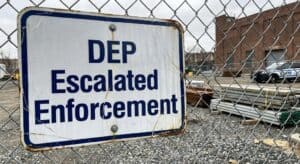 On August 17, Eureka Resources’ Williamsport Second Street facility (one of the three wastewater treatment plants previously operated by Eureka) leaked some of its stored untreated frack wastewater, which ended up in the nearby Susquehanna River via a storm drain (see
  In 2015, a group of landowners in northeastern Pennsylvania who had leased their land for fracking filed a lawsuit against Chesapeake Energy, Anadarko, Statoil (now Equinor), Mitsui E&P, and Access Midstream (later bought by Williams), alleging the companies had improperly deducted post-production costs (e.g., gas gathering and transportation expenses) from royalties owed to the landowners in breach of their respective leases. The lawsuit also alleged collusion and conspiracy to defraud the landowners (antitrust violations). The lawsuit was on hold for many years while other lawsuits played out. In 2024, a federal court in Scranton unpaused the lawsuit, and the judge ruled, tossing out the landowners’ royalty claims (see
  We spotted a short article alleging EQT has “abandoned” a shale well in Washington County, PA, and thought it would be a good opportunity to (once again) discuss the misnomer of “abandoned” oil and gas wells in Pennsylvania. Let’s begin with the news as reported…
  AI data centers are all the rage. The news (local and national) is full of such stories, playing up opposition to data centers. We’ve written plenty about AI data centers on MDN, given the close connection to gas-fired power that’s needed to operate them. We’ve also told you about a developing trend of “behind the meter” gas-fired power plants, built at the same location as a data center. That’s when the data center is built next to a power plant or vice versa. The electricity goes directly to the plant and never flows through the local power grid. Another part of this story is that sometimes the gas-fired power plant that’s on-site powering the data center receives its gas from a well drilled at the same site! The gas flows directly into the gas plant (bypassing gathering pipelines), and the plant produces electricity for the data center. And therein lies a potential, very thorny issue.
  Last summer, Texas Eastern Transmission Pipeline Company (aka TETCO, owned by Enbridge) filed to build the Appalachia to Market III Project, abbreviated A2M III (see
  Last October, a seven-member, all-Democrat group of Pennsylvania House of Representatives members announced a six-bill legislative package aimed at regulating the “responsible development” of artificial intelligence (AI) data centers in the state (see
  Despite claims by anti-fossil fuelers that the Tenaska Westmoreland Generating Station in southwestern PA would spread disease and death if built, it’s been up and running since 2018, producing power and generating revenue for both its builders and the community. Oh, and everyone is in good health. However, the plant has been operating under a state permit since it opened. It needs a federal Title V permit for long-term operation. The state Department of Environmental Protection (DEP) is the agency that issues such a permit and is proposing to do so, which (of course) has antis’ knickers in a twist (see
  Constellation Energy Corporation has finalized its acquisition of Calpine Corporation from Energy Capital Partners, becoming the largest electricity producer in the United States, with a generating capacity of 55 gigawatts. This merger integrates Constellation’s zero-emission nuclear fleet with Calpine’s natural gas and geothermal assets. Prior to the merger, Calpine owned 79 energy facilities across the country, generating some 27 gigawatts (GW) of electricity, with a significant number located in the eastern U.S. Many of Calpine’s facilities use natural gas to produce electricity.
  In November, Pennsylvania finally passed a budget—four months late. As part of the deal struck between Democrats and Republicans, the Regional Greenhouse Gas Initiative (RGGI) carbon tax scheme was permanently ash-canned (see
  The short answer to the question posed in our headline is, “We sure hope so!” Yesterday, MDN reported that the Pennsylvania Department of Environmental Protection (DEP) has officially adopted a final version of updated Environmental Justice (EJ) regulations (see