
Antero Resources | Energy Companies | Industrywide Issues | Litigation | Statewide WV | West Virginia
WV Supreme Court Rejects Nuisance Lawsuit Against Antero
 In Feb. 2016, lawsuits filed by some ~200 West Virginia residents against Antero Resources were combined into a class action (see More People Pile on Antero, Seek to Join Mass “Nuisance” Lawsuit). The lawsuits are called “nuisance” lawsuits because, according to the plantiffs, Antero is a nuisance to them (truck traffic, noise, lights at night, etc.). The collective class action nuisance lawsuit was appealed all the way to the WV Supreme Court. On Monday, the Supremes rejected the nuisance claims, granting Antero a big victory.
Read More “WV Supreme Court Rejects Nuisance Lawsuit Against Antero”

 Last Wednesday the West Virginia Supreme Court issued a consolidated opinion lumping together seven similar lawsuits filed by Antero Resources and CNX Resources against the WV state tax commissioner and the Doddridge County Commission. The lawsuits take issue with the way gas well valuations are calculated for property taxes.
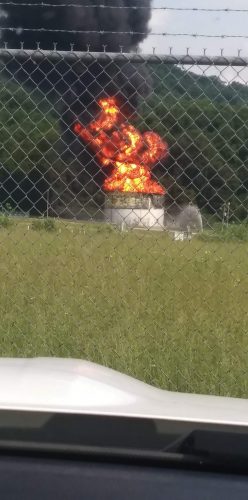 On May 25, lightning struck a 1 million gallon condensate tank near Friendly (Tyler County), WV on a Saturday afternoon (see
 President Trump is pushing members of his administration to work with state regulators in Appalachia–Ohio, West Virginia and Pennsylvania–to “build the country’s first natural gas and petrochemical hub” outside of the Gulf Coast. According to Energy Secretary Rick Perry, such a plan is in the the country’s national security interests. Members of the Trump team are also having discussions with leftists like NY Gov. Andrew Cuomo, to try and convince him to allow pipelines into and through the state. If states like NY won’t allow it, Perry holds out the hope/threat that the feds will invoke the Constitution’s interstate commerce clause to make them.
 A West Virginia Circuit Court case in September 2017, Crowder and Wentz v EQT, found in favor of surface landowners ruling that EQT did not have the right to extend underground shale wells to adjacent properties where EQT also owned the mineral rights (see
 In March MDN brought readers a pair of posts about a new bill in the Pennsylvania House of Representatives, HB 247, which would allow fully leased parcels that are part of one drilling “unit” to be combined with parcels in a different unit–“cross-unit drilling” if you will (see
 Antero Resources sued EnerQuest Oil & Gas in a Texas court last year claiming EnerQuest had solicited and received trade secrets for a pair of landmen who live and work in Texas. A lower court dismissed the lawsuit based on a technicality (because the solicitation from EnerQuest came via email), claiming Texas does not have jurisdiction over the case. Antero disagrees and has just asked the Texas Supreme Court to review the case.
 In April, West Virginia Gov. Jim Justice, who is pro-coal (because much of his personal fortune comes from coal), took a swipe at shale drillers claiming shale is responsible for the poor condition of roadways in the Mountain State (see


 A new study just published in the peer reviewed journal Geophysical Research Letters by an international team of researchers finds that natural gas “has half the carbon footprint of underground coal mining.” The researchers looked at (did measurements of, actual real science) methane in the atmosphere by flying transects over the southwestern portion of Pennsylvania and adjacent portions of West Virginia and Ohio. Marcellus/Utica central. One of the researchers from Penn State said this about the findings: “Obviously, renewable energy would be better, but there is no debate, switching to natural gas is worth it in the short run.”
 During a President Trump trade trip to China in November 2017, Chinese officials signed an informal (non-binding) agreement to invest a whopping $83.7 billion in shale and petrochemical projects located in West Virginia (see
 A pipeline feeding the MarkWest Hopedale Fractionation Facility in Jewett, Ohio was knocked offline last Sunday, and that outage caused a cascading effect throughout the region that forced three gas processing plants in West Virginia to temporarily scale back (or stop) operations, which further caused a ~2.1 billion cubic feet per day (Bcf/d) decrease in gas flows on two interstate gas transmission pipelines. The good news is that the problem is now resolved.
