
WVONGA Hits Back Hard Against Leftist Charleston Gazette-Mail

Last December MDN pointed out the biased “reporting” now coming from the Charleston (WV) Gazette-Mail (see Antis Get a Reporter at the Charleston Gazette-Mail). Reporter Ken Ward, Jr. now has most (all?) of his salary paid by anti-fossil fuel organizations, and his “reporting” on the shale industry reflects the bias of his paymasters. Following a couple of recent grossly biased “articles” penned by Ward and fellow “reporter” Kate Mishkin, the West Virginia Oil & Natural Gas Association is hitting back–hard.
Read More “WVONGA Hits Back Hard Against Leftist Charleston Gazette-Mail”

 One of West Virginia’s two U.S. Senators, Joe Manchin, is not happy that the memorandum of understanding (MOU) signed by China and his home state is hush hush. Manchin has not seen a copy of that agreement and he wants to see it, NOW. At a Senate hearing last week, Manchin made noise about the $83.7 billion deal signed by WV and China, part of a Trump Administration effort, back in 2017 (see
  Dominion Energy began work on the 600-mile Atlantic Coast Pipeline (ACP) project in West Virginia in May 2018 (see
  Two weeks ago at the Northeast Petrochemical Conference in Pittsburgh, a panel of speakers from West Virginia, including former Commerce Secretary Keith Burdette, addressed the topic of Advanced Manufacturing and Petrochemicals related to the shale industry. At the end of the prepared talks, the session was opened to questions from the audience. MDN asked the first question, which was this: “The $83.7 billion question is, what’s going on with the proposed investment in shale and petchem promised by China?”
 A “first of its kind” coal-to-liquids plant has been planned for Mason County, WV. The $1.2 billion project will create “ultra-low-sulfur diesel fuel, gasoline and other liquids.” The main two ingredients in the process are coal and (you guessed it), natural gas. Which is why we’re interested in this project.
 Appalachia Development Group is leading an effort to build a ~$10 billion (or $2.5B, or $3.4B, depending on your source) NGL storage hub in Appalachia–most likely in West Virginia (see
  In Feb. 2016, lawsuits filed by some ~200 West Virginia residents against Antero Resources were combined into a class action (see
 Last Wednesday the West Virginia Supreme Court issued a consolidated opinion lumping together seven similar lawsuits filed by Antero Resources and CNX Resources against the WV state tax commissioner and the Doddridge County Commission. The lawsuits take issue with the way gas well valuations are calculated for property taxes.
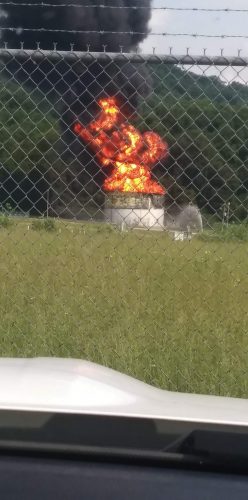 On May 25, lightning struck a 1 million gallon condensate tank near Friendly (Tyler County), WV on a Saturday afternoon (see
  President Trump is pushing members of his administration to work with state regulators in Appalachia–Ohio, West Virginia and Pennsylvania–to “build the country’s first natural gas and petrochemical hub” outside of the Gulf Coast. According to Energy Secretary Rick Perry, such a plan is in the the country’s national security interests. Members of the Trump team are also having discussions with leftists like NY Gov. Andrew Cuomo, to try and convince him to allow pipelines into and through the state. If states like NY won’t allow it, Perry holds out the hope/threat that the feds will invoke the Constitution’s interstate commerce clause to make them.
 A West Virginia Circuit Court case in September 2017, Crowder and Wentz v EQT, found in favor of surface landowners ruling that EQT did not have the right to extend underground shale wells to adjacent properties where EQT also owned the mineral rights (see
  In March MDN brought readers a pair of posts about a new bill in the Pennsylvania House of Representatives, HB 247, which would allow fully leased parcels that are part of one drilling “unit” to be combined with parcels in a different unit–“cross-unit drilling” if you will (see
  Antero Resources sued EnerQuest Oil & Gas in a Texas court last year claiming EnerQuest had solicited and received trade secrets for a pair of landmen who live and work in Texas. A lower court dismissed the lawsuit based on a technicality (because the solicitation from EnerQuest came via email), claiming Texas does not have jurisdiction over the case. Antero disagrees and has just asked the Texas Supreme Court to review the case.
 In April, West Virginia Gov. Jim Justice, who is pro-coal (because much of his personal fortune comes from coal), took a swipe at shale drillers claiming shale is responsible for the poor condition of roadways in the Mountain State (see