The “best of the rest” – stories that caught MDN’s eye that you may be interested in reading. In today’s lineup: Activists backed with lib $$ protest against Trump & natgas; petition with out-of-state signatures may affect OH Wayne National Forest lease sale; Williams closing OKC office, moving people to Tulsa; OPEC cutback may trigger drilling boom in US shale; North American natgas prices will rise due to LNG, petchem demand; the frac spread; and more! Read More “Marcellus & Utica Shale Story Links: Fri, Dec 2, 2016”
As MDN predicted, yesterday the Federal Energy Regulatory Commission (FERC) approved the NEXUS Pipeline project (see FERC Expected to Approve NEXUS Today; Surveyors have Armed Guards). More precisely, FERC issued a positive Final Environmental Impact Statement (FEIS). These projects are complex and the final Certificate is yet to be granted that allows Spectra Energy to begin digging–but that Certificate is now just a formality. The big nut to crack was the FEIS. With that now granted (executive summary of FEIS below), the final Certificate is on track to be issued in the first quarter of 2017. That is, NEXUS is on track, on time, and WILL get built despite the objections of anti-fossil fuelers. The NEXUS Pipeline is a $2 billion, 255-mile interstate pipeline that will run from Ohio through Michigan and eventually to the Dawn Hub in Ontario, Canada. It is a critically needed pipeline to move Utica and Marcellus Shale gas from an over-saturated market in the northeast to markets in the Midwest and Canada. But FERC’s approval is not only great news for Marcellus and Utica Shale drillers, it’s also great news for Ohioans as there are numerous taps along the proposed route that will deliver plenty of cheap Utica gas to Ohio residents and businesses. And lest you believe the anti lie that FERC is nothing more than a rubber stamp for the pipeline industry, there are some 38 mitigation projects NEXUS will have to make when building the pipeline–projects that will come at great expense. FERC does it job and does it well, balancing the need for more energy with the impacts that infrastructure will have on landowners and the environment. Here’s the great news, along with some of the reaction… Read More “FERC Approves NEXUS Pipeline, Project on Track for 2017”
FERC (the Federal Energy Regulatory Commission) is not happy with Energy Transfer and their Rover Pipeline. There are two major pipeline projects planned for Ohio: NEXUS and Rover. NEXUS got some FERC love today (see today’s lead story). Rover, on the other hand, is getting the cold shoulder from FERC, from a self-inflicted wound. Let us explain. As a reminder, Rover (an Energy Transfer project) is a $3.7 billion, 711-mile Marcellus/Utica natural gas pipeline that will run from PA, WV and eastern OH through OH into Michigan and eventually into Canada. The short version of what happened is that in May 2015 Rover purchased a house in Carroll County, OH, located near where the pipeline, and a compressor station for that pipeline, is due to run. Rover bought the house to use for offices for several Rover affiliate companies. After buying it, they determined it was “ill-suited for its intended purpose” and decided to demolish the house. Problem was/is, that house was under consideration to be added to the National Register of Historic Places. The house was not yet on the list of Historic Places, but was on a list of properties under consideration. Rover should have reported their decision to demolish the house to FERC but didn’t, which has Rover in hot water with FERC and the Advisory Council on Historic Preservation. Will Rover’s action kill the project? No. Will it slow down Rover and end up costing the company boatloads of money? Most likely, although Rover disputes that interpretation of events… Read More “Rover Pipeline in Hot Water Over Demolishing Historic House in OH”
Statoil, based in Norway, is a big player in the West Virginia Marcellus Shale. Statoil paid property taxes to Brooke, Marshall, Ohio and Wetzel counties (all in WV) in 2015 and later found, during an audit/review, that they had overpaid those counties. They overpaid Brooke by $1.8 million, Ohio by $2.9 million, Wetzel by $1.6 million and Marshall by $342,000. The WV Tax Department argues that Statoil “acted negligently” and exercised “poor judgment” in not finding the mistake sooner. All four counties voted to deny Statoil’s request, so Statoil took them to court, asking the West Virginia Supreme Court of Appeals to hear the case. However, the Appeals court has just ruled that the cases are not “complex” and don’t require “special treatment,” so back to county court the cases will go… Read More “Statoil’s Tax Overpayment Cases Bounced Back to WV County Courts”
For several years MDN has tracked and reported on a lawsuit brought against the Muskingum Watershed Conservancy District (MWCD) by an anti-drilling couple in Guernsey County, OH–Leatra Harper and her husband Steven Janstro (backed by the odious Food & Water Watch). At last check in April 2014, the couple had won the right to continue on with the lawsuit (see Anti-Drillers Win Minor Victory Against Muskingum Watershed Dist). Their aim was to prove the MWCD had violated the original deed to the property by allowing drilling–that by allowing shale drilling on MWCD-owned land, it frustrates the original purpose of the land as stated in the deed, which is to use the land for “recreation, conservation, or reservoir-development purposes.” The case made it all the way to the Sixth Circuit Court of Appeals. Last week the Sixth Circuit dismissed the case. The anti-drillers have lost… Read More “Anti-Drillers Lose 2-Yr Case Against Muskingum Watershed District”
FirstEnergy is one of the nation’s largest investor-owned electric systems, serving customers in Ohio, Pennsylvania, New Jersey, West Virginia, Maryland and New York. FirstEnergy loves the shale industry. We told you in December 2014 that FirstEnergy was planning to invest $100 million in new electric transmission projects to service the growing Marcellus and Utica Shale industry in WV (see FirstEnergy Investing $100M in Electric Projects for WV Marcellus). FirstEnergy’s construction crews have begun erecting steel poles for a new 18-mile high voltage power line that will run through Harrison and Doddridge counties in WV in April (see FirstEnergy Installs $92M Electric Line in WV for Shale Industry). Great news! FirstEnergy flipped the switch on the new line and the electric is now flowing… Read More “FirstEnergy Flips the Switch on New Marcellus Power Line”
Kinder Morgan’s Broad Run Expansion Project will expand transportation capacity of natural gas on the existing Tennessee Gas Pipeline system. The project includes the construction of two new compressor stations in Kanawha County, WV, one new compressor station in Davidson County, TN, and one new compressor station in Madison County, KY. Tennessee Gas also expects to increase compression capacity by modifying two of its existing compressor stations in Powell and Boyd counties in KY by replacing existing capacity with new, higher-rated horsepower compression units. The project will provide an extra 200,000 dekatherms per day (Dth/d) of transportation capacity along the same capacity path as the Broad Run Flexibility project, which was placed in service on Nov. 1, 2015. All of the additional gas will come from Antero Resources and their Marcellus/Utica program. The Federal Energy Regulatory Commission (FERC) issued a Certificate to build the project in September. However, several anti-drillers filed an appeal, asking for a stay claiming a removal of 40 acres of forest for a compressor station would irreparably harm Mom Earth. FERC has just ruled against the stay and told the antis Mom Earth will be just fine. Fire up the backhoes!… Read More “FERC Denies Anti Request to Stop KM’s Broad Run Expansion Project”
Pipelines have been, and continue to be, a big deal throughout the Marcellus and Utica region. Landowners who are approached about placing a pipeline through their property should (1) never sign the standard contract presented, and (2) never sign anything without first running it by a lawyer. Beyond that, what else should landowners think about/do when negotiating a pipeline easement? Clif Little from the Ohio State University Extension gives us some helpful tips… Read More “OSU’s Helpful Tips for Negotiating a Pipeline Contract”
The “best of the rest” – stories that caught MDN’s eye that you may be interested in reading. In today’s lineup: Sierra Club lies (again) about PennEast Pipeline; Vermont missing out on low natgas prices; Mass. residents gear up to oppose compressor station; OPEC agrees to cut output & prices jump; valuing our energy infrastructure; Sept natgas output lower despite higher prices; US will be 3rd largest natgas exporter by 2020; and more! Read More “Marcellus & Utica Shale Story Links: Thu, Dec 1, 2016”
Word on the street is that the Federal Energy Regulatory Commission (FERC) will announce a decision today to approve the NEXUS Pipeline–a $2 billion, 255-mile interstate pipeline that will run from Ohio through Michigan and eventually to the Dawn Hub in Ontario, Canada. It is a critically needed pipeline to move Utica and Marcellus Shale gas from an over-saturated market in the northeast to markets in the Midwest and Canada. If the decision doesn’t come today, it will come very soon. As MDN reported yesterday, the small city of Green, OH (population 26,000) has put NEXUS on notice that if its surveyors show up and landowners refuse access, those surveyors will be arrested if they “trespass” on the landowner’s property (see Green, OH Threatens NEXUS Surveyors with Arrest for Trespassing). Other news agencies are reporting that surveyors are about to show up with armed guards. Into this mess may come an approval for the project. If NEXUS gets approved, it will have the right to use federal eminent domain laws to build the pipeline, regardless of landowner desires. Does eminent domain also include surveying? One would think so since surveying is part of the construction process. Green’s bluster may amount to nothing if the project receives a final approval today. Below are several stories about surveying for NEXUS, as well as a look at the FERC commissioners who will make the final decision on NEXUS… Read More “FERC Expected to Approve NEXUS Today; Surveyors have Armed Guards”
The world’s third largest oilfield services company, Baker Hughes, has struggled to stay afloat given the radical reduction in revenue they get for the services they offer. BH’s recent third quarter update showed the company lost $430 million, which is down from losing $912 million in 3Q15, a positive sign we suppose (see Baker Hughes 3Q16: Bleeding Slows, but Hefty Loss of $430M). Halliburton tried to buy BH last year, but earlier this year the Obama DOJ killed the proposed merger (see Obama DOJ Kills Halliburton/Baker Hughes Merger, Deal “Terminated”). Last month GE Oil & Gas launched its own takeover/merger with BH (see Breaking: Who Needs Halliburton? Baker Hughes Merging with GE O&G). In the midst of all that, BH is not sitting on its hands. Yesterday the company announced it will spin off its North American shale fracking business into a new company, BJ Services. The deal involves investments and assets contributed from both Goldman Sachs and CSL Capital Management. Here’s the lowdown on BH’s new “pressure pumping” (i.e. fracking) deal, and the real reason BH is doing it… Read More “Baker Hughes, CSL & GS Form New US Fracking Co: BJ Services”
In November 2014, MDN told you about an innovative plan by PECO–formerly known as the Philadelphia Electric Company, is the largest combined electric/natural gas utility company in PA serving some 500,000+ natural gas customers in southeastern PA–to allow customers to sign up for its natural gas service and spread the cost over 20 years (see PA Utility’s Innovate Plan to Deliver Marcellus Gas to Customers). It costs a lot of money to install new gas mains through an area–$500,000 – $1,000,000 per mile–and PECO needs a lot of customers along a route to sign up to make it profitable. So they innovated a plan to make it possible. But the plan needed approval from the Pennsylvania Public Utility Commission (PUC). PECO got approval in October 2015 (see PA Utility’s Plan to Deliver Marcellus Gas Approved by PUC). Now, some two years after they first floated the plan, PECO is breaking ground to build pipelines that will service 160 new customers in the suburbs of Philly… Read More “PECO Breaks Ground on New Gas Lines for 160 Homes in Philly Suburb”
Stone Energy, an independent oil and natural gas exploration and production company (E&P) headquartered in Lafayette, Louisiana drills mainly in the Gulf of Mexico but also has a presence in the Marcellus/Utica Shale with 90,000 acres of leases. Last year Stone quit drilling in the northeast and actually shut-in part of their production due to low prices (see Stone Energy 3Q15: Shut Down 110 Mmcfe/d of Marcellus Production). In June Stone cut a new midstream gathering agreement with Williams to return some of their shut-in Marcellus wells to full production (see Stone Energy Opens Marcellus Spigots Again; New Midstream Deal). However, things changed for Stone in a big way in October when the company announced (a) it is selling its Marcellus/Utica assets to Tug Hill for $350 million, and (b) the company is preparing to file for bankruptcy (see Stone Energy Enters Bankruptcy, Sells Marc/Utica Assets for $350M). Stone’s bankruptcy plans are facing a challenge from it’s biggest shareholder. It seems investor Thomas Satterfield, who now owns 9.9% of the company’s stock, doesn’t want to see that stock turned into toilet paper by handing the keys over to debtholders, as is the typical route E&Ps have taken with bankruptcy filings over the past year or so… Read More “Stone Energy’s Largest Shareholder Opposes Current Bankruptcy Plan”
It’s been 10 long years, but finally in October the Bureau of Land Management (BLM) posted a lease sale auction for 33 parcels in Ohio’s Wayne National Forest (see BLM Launches Auction to Lease Wayne National Forest for Fracking). Although there are some 18,000 acres under consideration for leasing by the BLM in WNF, this first batch amounts to about 1,600 acres–most of it in Monroe County, OH. Monroe is a prime location for Utica Shale drilling. WNF is the only national forest in Ohio and portions of it are found in Athens, Gallia, Hocking, Jackson, Monroe, Morgan, Noble, Lawrence, Perry, Scioto, Vinton, and Washington counties. WNF is a “patchwork” of public land scattered among private land. Some 60% of the mineral rights below WNF are privately owned. Those mineral rights owners have been denied the use of their property rights for a decade–an absolute crime. But Constitutional property rights mean nothing to miseducated liberals who love to protest in faddish “causes”–like banning drilling in WNF. A group of these miseducated miscreants recently presented a petition with 92,000 signatures on it (so they claim) to officials of the BLM in Washington, DC–asking the BLM to stop the lease sale and slam the door on drilling in WNF. Are all 92,000 signatures from Ohio residents who might, theoretically, be impacted by shale drilling in WNF? You can bet your bottom dollar most of the signatures are from people who live outside Ohio… Read More “Enviro Nazis File Petition Against Drilling in Wayne Natl Forest”
Earlier this week MDN reported that Pennsylvania Gov. Tom Wolf helped kill a plan by Philadelphia Energy Solutions to expand its shale oil refinery in Philly by denying a lease on 200 acres at the Southport Marine site (see PA Gov Wolf Kills Plan for PES Refinery Expansion in Philadelphia). As we noted, the PES plan to expand its refinery facilities was one of the key elements of a plan to turn Philly into an “energy hub” in the northeast–perhaps one day rivaling Houston, TX. However, even though the PES plan is now dead, the dream of turning Philly into an energy hub is far from dead. At least it’s not according to Rob Wonderling, president and CEO of the Chamber of Commerce for Greater Philadelphia. Wonderling recently published an editorial touting the economic benefits of Marcellus Shale and how Marcellus gas is already creating new jobs and opportunities in the Philly area. He calls on those who want to see Philly’s manufacturing and jobs picture improve by leveraging Marcellus gas to join him in “picking some stones” to help Philly achieve its dream… Read More “Philly Energy Hub Plan – Not Dead Yet”
Rob Powelson is a member of the Pennsylvania Public Utilities Commission (PUC). At one point, under then-Gov. Tom Corbett, Powelson was the PUC Chairman (see PA’s PUC Pro-Drilling Chairman Powelson Leads Mid-Atlantic Group). After Democrat Tom Wolf was elected as governor, he replaced Powelson with Gladys Brown as Chairwoman (see Anti-Drillers Cheer PA Gov Wolf’s New Appointment to Head PUC). However, Powelson remains on the PUC as a member. He’s one of the good guys–someone who supports shale energy. At a recent natural gas conference in Washington, DC, Powelson had some sharp words of criticism for New York Gov. Andrew Cuomo on the topic of pipelines (see PA Regulator Criticizes NY Gov. Cuomo for Pipeline Obstructionism). Powelson said, in so many words, that Cuomo’s screwing around with pipeline delays (like the Constitution) threatens the reliability of the electrical grid in the entire northeast and New England. He even poked fun at Cuomo, saying it takes Andy two hours to watch 60 Minutes–a cut on Cuomo for his “overly cautious” approach to pipeline approvals. Good news. Rob’s stature and reputation have just increased, yet again. He has been elected as the next president of the National Association of Regulatory Utility Commissioners (NARUC). He will serve a one-year term. It is not a full-time gig–he remains a commissioner with the PA PUC. Our point: It’s great having a Marcellus booster as the head of this prestigious national organization… Read More “PA PUC Commissioner Rob Powelson Elected as President of NARUC”

 The “best of the rest” – stories that caught MDN’s eye that you may be interested in reading. In today’s lineup: Activists backed with lib $$ protest against Trump & natgas; petition with out-of-state signatures may affect OH Wayne National Forest lease sale; Williams closing OKC office, moving people to Tulsa; OPEC cutback may trigger drilling boom in US shale; North American natgas prices will rise due to LNG, petchem demand; the frac spread; and more!
 As MDN predicted, yesterday the Federal Energy Regulatory Commission (FERC) approved the NEXUS Pipeline project (see
  FERC (the Federal Energy Regulatory Commission) is not happy with Energy Transfer and their Rover Pipeline. There are two major pipeline projects planned for Ohio: NEXUS and Rover. NEXUS got some FERC love today (see today’s lead story). Rover, on the other hand, is getting the cold shoulder from FERC, from a self-inflicted wound. Let us explain. As a reminder, Rover (an Energy Transfer project) is a $3.7 billion, 711-mile Marcellus/Utica natural gas pipeline that will run from PA, WV and eastern OH through OH into Michigan and eventually into Canada. The short version of what happened is that in May 2015 Rover purchased a house in Carroll County, OH, located near where the pipeline, and a compressor station for that pipeline, is due to run. Rover bought the house to use for offices for several Rover affiliate companies. After buying it, they determined it was “ill-suited for its intended purpose” and decided to demolish the house. Problem was/is, that house was under consideration to be added to the National Register of Historic Places. The house was not yet on the list of Historic Places, but was on a list of properties under consideration. Rover should have reported their decision to demolish the house to FERC but didn’t, which has Rover in hot water with FERC and the Advisory Council on Historic Preservation. Will Rover’s action kill the project? No. Will it slow down Rover and end up costing the company boatloads of money? Most likely, although Rover disputes that interpretation of events…
 Statoil, based in Norway, is a big player in the West Virginia Marcellus Shale. Statoil paid property taxes to Brooke, Marshall, Ohio and Wetzel counties (all in WV) in 2015 and later found, during an audit/review, that they had overpaid those counties. They overpaid Brooke by $1.8 million, Ohio by $2.9 million, Wetzel by $1.6 million and Marshall by $342,000. The WV Tax Department argues that Statoil “acted negligently” and exercised “poor judgment” in not finding the mistake sooner. All four counties voted to deny Statoil’s request, so Statoil took them to court, asking the West Virginia Supreme Court of Appeals to hear the case. However, the Appeals court has just ruled that the cases are not “complex” and don’t require “special treatment,” so back to county court the cases will go…
 For several years MDN has tracked and reported on a lawsuit brought against the Muskingum Watershed Conservancy District (MWCD) by an anti-drilling couple in Guernsey County, OH–Leatra Harper and her husband Steven Janstro (backed by the odious Food & Water Watch). At last check in April 2014, the couple had won the right to continue on with the lawsuit (see
  FirstEnergy is one of the nation’s largest investor-owned electric systems, serving customers in Ohio, Pennsylvania, New Jersey, West Virginia, Maryland and New York. FirstEnergy loves the shale industry. We told you in December 2014 that FirstEnergy was planning to invest $100 million in new electric transmission projects to service the growing Marcellus and Utica Shale industry in WV (see
  Kinder Morgan’s Broad Run Expansion Project will expand transportation capacity of natural gas on the existing Tennessee Gas Pipeline system. The project includes the construction of two new compressor stations in Kanawha County, WV, one new compressor station in Davidson County, TN, and one new compressor station in Madison County, KY. Tennessee Gas also expects to increase compression capacity by modifying two of its existing compressor stations in Powell and Boyd counties in KY by replacing existing capacity with new, higher-rated horsepower compression units. The project will provide an extra 200,000 dekatherms per day (Dth/d) of transportation capacity along the same capacity path as the Broad Run Flexibility project, which was placed in service on Nov. 1, 2015. All of the additional gas will come from Antero Resources and their Marcellus/Utica program. The Federal Energy Regulatory Commission (FERC) issued a Certificate to build the project in September. However, several anti-drillers filed an appeal, asking for a stay claiming a removal of 40 acres of forest for a compressor station would irreparably harm Mom Earth. FERC has just ruled against the stay and told the antis Mom Earth will be just fine. Fire up the backhoes!…
 Pipelines have been, and continue to be, a big deal throughout the Marcellus and Utica region. Landowners who are approached about placing a pipeline through their property should (1) never sign the standard contract presented, and (2) never sign anything without first running it by a lawyer. Beyond that, what else should landowners think about/do when negotiating a pipeline easement? Clif Little from the Ohio State University Extension gives us some helpful tips…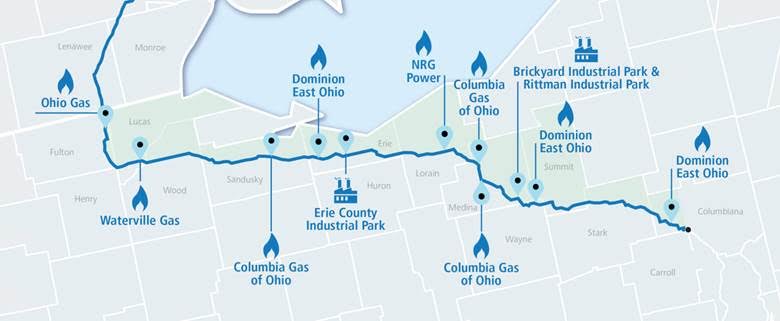
 The world’s third largest oilfield services company, Baker Hughes, has struggled to stay afloat given the radical reduction in revenue they get for the services they offer. BH’s recent third quarter update showed the company lost $430 million, which is down from losing $912 million in 3Q15, a positive sign we suppose (see
  In November 2014, MDN told you about an innovative plan by PECO–formerly known as the Philadelphia Electric Company, is the largest combined electric/natural gas utility company in PA serving some 500,000+ natural gas customers in southeastern PA–to allow customers to sign up for its natural gas service and spread the cost over 20 years (see
  Stone Energy, an independent oil and natural gas exploration and production company (E&P) headquartered in Lafayette, Louisiana drills mainly in the Gulf of Mexico but also has a presence in the Marcellus/Utica Shale with 90,000 acres of leases. Last year Stone quit drilling in the northeast and actually shut-in part of their production due to low prices (see
 Earlier this week MDN reported that Pennsylvania Gov. Tom Wolf helped kill a plan by Philadelphia Energy Solutions to expand its shale oil refinery in Philly by denying a lease on 200 acres at the Southport Marine site (see