
NYU, Cambridge U Reject Calls to Divest from Fossil Fuel Stocks
 MDN has previously told you about the temper tantrum by radical environmentalists and the idiot kids they foment to try and get universities to divest from owning stock in fossil fuel companies. The very liberal Cornell University didn’t fall for it (see Cornell University Rejects Fossil Fuel Divestment Scam). But up the road, Syracuse University did fall for it, albeit they didn’t own all that much in the way of fossil fuel company stocks (see Syracuse U Divests from Fossil Fuels, NYU Says “Irresponsible”). Rich kids with no purpose in life other than to navel gaze and worry about the latest Taylor Swift video have found a new purpose: try to get the old farts in the board rooms at their school to divest from fossil fuel stocks. Not because it actually makes sense or would improve anything–but just to see if they can do it. Fortunately, 99% of colleges and universities have decided against divestment. The latest “we’re not divesting, you dopers” includes New York University and Cambridge University…
Read More “NYU, Cambridge U Reject Calls to Divest from Fossil Fuel Stocks”
 What happens to the regulatory environment for the energy industry, in particular oil and gas, should Donald Trump win the presidency? What if (perish the thought) Hillary Clinton wins? What can we expect under each administration? That was the theme for comments by Tom Sansonetti, partner with the Holland and Hart law firm, at the recent Independent Petroleum Association of America (IPAA) 86th Midyear Meeting, held in Colorado Springs two weeks ago. The IPAA knows a number of people could not make the meeting and wants to disseminate Sansonetti’s comments, so they sent along a copy of his “what if?” analysis. We found it interesting and think you will too…
 Is this the future of engines for large gas-hauling ships? Mitsui Engineering & Shipbuilding Co. announced two weeks ago they have completed the world’s very first ethane-operated two-stroke diesel engine. The engine is one of three the company is building to power three LEG (liquefied ethylene gas) tanker ships for Hartmann Schiffahrt of Germany and Ocean Yield of Norway. The ships are being built in China. Why ethane as fuel? For one thing, it’s cheaper than heavy fuel oil (HFO), the traditional fuel source for ship engines. Plus it burns a whole lot cleaner–something increasingly important with new emissions regulations coming along. But the obvious reason is that a tanker full of ethane can always tap into that ethane as fuel for the ship, should the need arise. The Marcellus/Utica produces ethane in abundance and ethane exports now regularly take place via ship from the Marcus Hook refinery near Philadelphia. Might we one day see an ethane-powered ship hauling ethane leaving Marcus Hook for Norway? Maybe, since some of the Marcus Hook exports to date have gone to Norway (see
 The electric power and natural gas sectors are increasingly joined at the hip, as we observed in January (see
 The “best of the rest” – stories that caught MDN’s eye that you may be interested in reading. In today’s lineup: How long will Marcellus/Utica well backlog last?; MLPs started announcing projects again in June; how the Marcellus changed life in PA; $195M shortfall in WV severance tax for FY 2016; shale rigs hit bottom in 1H16; oilfield tech to keep an eye on; natgas prices had a tough week; Williams phase-out of MLP won’t be cheap; and more!
 This pipeline project has been, until now, completely off our radar screen. As pipeline projects go, it’s pretty small. But building even a single square inch of new pipeline, or expanding a compressor station, is anathema to anti-fossil fuel nutters. So we expect this project will be in the headlines starting this week, with a pair open house meetings in the Philadelphia area (and one in Delaware) where the project will get built. The project is being built by Eastern Shore Natural Gas and is called the 2017 System Expansion project. In March 2015, Eastern Shore ran a non-binding open season to see if customers want more natural gas in the Delmarva Peninsula area (includes most of Delaware and portions of Maryland and Virginia). It looks like Eastern Shore’s customers expressed enough interest that they plan to move forward with an expansion project that will bring new sources of natgas from an interconnection Eastern Shore has with the mighty TETCo (Texas Eastern Company) pipeline near Philadelphia. Below we have details on the expansion project, and details for the open house meetings scheduled for this week in PA and DE…
 It’s not all doom and gloom in the Marcellus/Utica. Seems like for the best part of a year we’ve only heard about layoffs and companies filing for bankruptcy, due to the major slowdown in drilling in our neck of the woods. But that’s not an accurate picture. Take an old steel plant in the Wheeling, WV area that had been closed for 30 years. A new business now occupies the old Wheeling-Pittsburgh Steel Corp. plant in Benwood, WV. JLE Industries has set up shop in the old plant with (so far) 25 full-time workers to inspect and repair metal tubes used in shale drilling. Chris Harris, the owner/operator, believes the company will continue to grow…
 We’re starting to crack a smile of hope that drilling has once again picked up. Our first bit of evidence that the tide is turning came last week when we reported that Patterson-UTI Energy’s rig count had gone up by two in June (see
 In May MDN told you that EQT, a major Marcellus (and Utica) driller based in Pittsburgh, had cut a deal to purchase all of Norwegian Statoil’s Marcellus assets in West Virginia (see
 Are we finally, blessedly “done” with the ongoing soap opera that was the proposed takeover/merger of midstream giant Williams by fellow midstream giant Energy Transfer Equity? Can Williams now go back to its “considerable pile of knitting” (that pile meaning some 16 expansion projects)? Well, in a word, yes! Except….except if another suitor comes along who wants to buy Williams, which is a very real possibility. A couple of analysts mull over the possibilities now that the ETE plan to buy Williams is dead…
 Outplacement firm Challenger, Gray & Christmas is out with their Mid-Year Job Cut Report (full copy below). Overall, across all sectors, it seems that job cuts are slowing down–a good sign to be sure. But what about job cuts in the energy industry? The news there is mixed. While the pace of job cuts in the energy industry is slowing as the year progresses (a good sign), if you look at the raw numbers for the first six months of 2016 versus 2015, the news is not so good. For the first six months of 2015 the energy industry cut 60,500 jobs. For the same period in 2016, the number of jobs cut was 77,211, a 28% increase this year over last. Oy vey! Will the cuts never stop?…
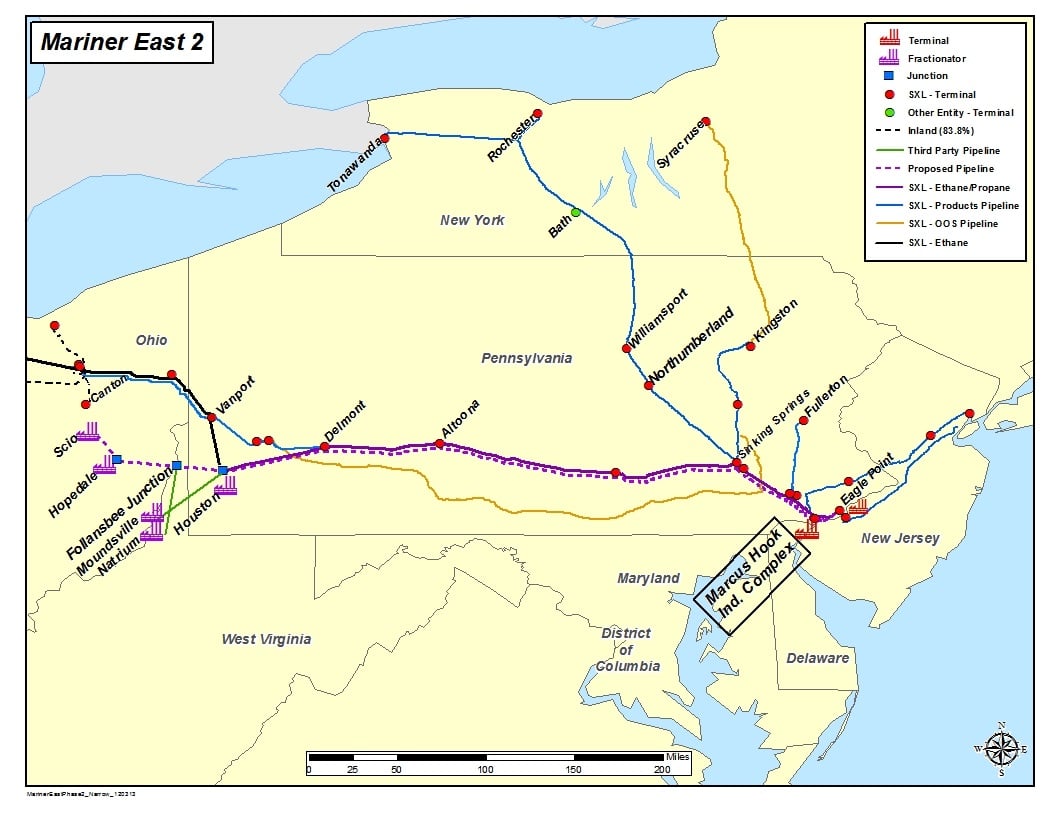
 Sunoco Logistics Partners, builder of the Mariner East pipeline projects and operator of the Marcus Hook refinery near Philadelphia (among many other projects) is floating more debt in order to pay off older debt. Last week Sunoco LP announced a new round of debt, or what we call IOUs, to the tune of $550 million. The sale will conclude tomorrow…
 We have sad news to report. Late last week Corky DeMarco, the well-loved executive director of the West Virginia Oil & Natural Gas Association (WVONGA) died of an apparent heart attack. Corky was just 68 years old. Corky took up the leadership of WVONGA in November 2002 and guided (and grew) the organization through the turbulent shale years. Needless to say, he will be greatly missed…
 Events related to drilling in the Marcellus and Utica Shale, primarily pro-drilling.