
Looking for an O&G Job? Check Out This Resource
 Hey, it’s tough out there in the oil and gas patch. Something like 200,000+ workers in the industry have been laid off in the past year and a half. Now, somebody wants to do something about it. Oilandgaspeople.com, an online job site for the oil and gas industry, recently announced they are making their service 100% free for recruiters. Now companies with jobs in the industry can advertise those jobs, for free, on website that gets an astounding 1 million+ visitors a month. Let’s help the industry out! Post your jobs and get them filled with a qualified candidate…
Read More “Looking for an O&G Job? Check Out This Resource”
 The “best of the rest” – stories that caught MDN’s eye that you may be interested in reading. In today’s lineup: PA energy advisor moves from gov to PUC; PA lawmakers attempt to stop new o&g drilling regs; energy infrastructure in New England badly needs an update; new underground storage rules coming from the feds; is fracking as dirty as coal?; what the failed Halliburton/BH deal means for the oil service industry; skeptics mock White House “support” for natgas; and more!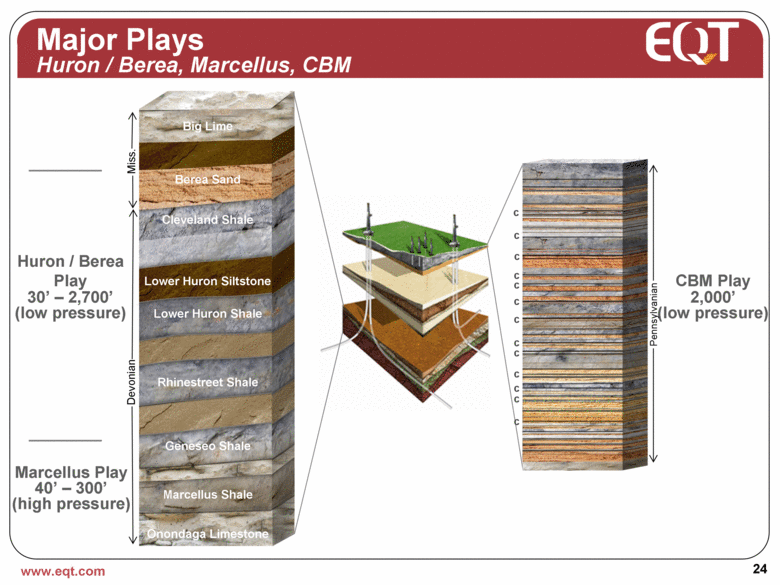
 There was an explosion and fire in Spectra Energy’s Texas Eastern Transmission’s (TETCO) “Delmont Line 27” pipeline last Friday (see
  The muckety-mucks from Shell held their quarterly earnings phone call with analysts yesterday–and there is what we consider big news to report coming from that call. In response to a question from an analyst, Shell’s Chief Financial Officer, Simon Henry, commented there are four major “chemicals” projects currently under consideration by Shell. He also said a decision on the PA cracker plant project planned in Beaver County will likely be the first decision to be made because of “the timing of certain commitments that are already in place.” He added these glowing words about the PA cracker: “It’s an excellent project…[that] provides quite some portfolio resilience relative to the rest of the opportunities.” He later said “It’s a very strong and robust project.” If the price of oil were higher than the current $40, pulling the trigger on the PA cracker would be “a very easy decision.” When you read his comments, it’s hard to miss the enthusiasm at the highest echelons inside Shell…
 It’s only been one year since Thailand-based PTT Global Chemical announced they are interested in building a $5 billion ethane cracker plant complex in Belmont County, OH (see
  As we do every month, MDN tracks how many rigs oilfield services company Patterson-UTI Energy reports operating–as a proxy for when/if the drop in rig counts for the Marcellus/Utica will turn around. Patterson operates a number of rigs in the northeast, as well as other areas of the continental United States (and Canada). Month by month Paterson’s rig count has declined over the past year plus. April was no different. Patterson reports operating an average of 56 rigs in April, versus 64 in March–a big 12.5% drop and a new low. Once again we ask, how low can it go? Below is our running Patterson-UTI rig count chart that shows the sad story…
 In March MDN reported that Canadian midstream giant TransCanada wants a bigger piece of the Marcellus/Utica midstream (i.e. pipeline) pie and has decided to buy Columbia Pipeline Group for $10 billion (see
  Rice Energy, one of the newest and brightest drillers in the Marcellus/Utica, released their first quarter 2016 update yesterday. The company reports production averaged 675 million cubic feet equivalent per day (Mmcfe/d) during 1Q16, a 53% increase over 1Q15 (and up 8% from 4Q15). On the financial side the company lost $21 million during 1Q16, versus making $152,000 in 1Q15. Pretty mild compared to most. During 1Q16 Rice drilled 11 new Marcellus wells and 8 new Utica wells. Good to see someone is still drilling! Here’s the update, along with a great PowerPoint slide deck…
 Eclipse Resources released their first quarter 2016 update yesterday. Although Eclipse, a Marcellus/Utica pure play driller headquartered in State College, PA (but drilling mostly in Ohio), has curtailed or shut-in some of it’s production given low prices for gas, they still posted an impressive 26% increase in production in 1Q16 over 1Q15. While we’ve heard of Prince and his “Purple Rain,” we hadn’t heard of Eclipse’s “Purple Hayes”–which is a Utica well with an underground lateral reaching out 18,500 feet–3.5 miles! During 1Q16 Eclipse drilled their Purple Hayes well in under 18 days. Amazing! Even more amazing–the well was completed with 124 frac stages. It is believed to be the longest onshore later well ever drilled. Kudos to Eclipse! On the downside, the company lost $41 million in 1Q16…
 Something noteworthy has happened in western Pennsylvania and (so far) local media has chosen not to cover it. So MDN is happy to break the following story about South Fayette Township in Allegheny County (near Pittsburgh). South Fayette is one of seven PA towns that sued the state after the Act 13 law was enacted in 2012 (see
 Yesterday MDN brought you the news that EQT has cut a deal to buy all of Norwegian Statoil’s operated Marcellus assets in West Virginia for $407 million (see
 EXCO Resources, once a sizable player in the Marcellus–with 145,000 net acres in the Marcellus and having drilled and operating 124 horizontal Marcellus wells–has pretty much abandoned the Marcellus at this point (see