
Big Utilities Seek to Re-Enter Powergen in MD, Reduce Competition
 Maryland State Senator Kevin Harris (D-Prince George’s) recently introduced legislation that would allow Big Utilities, such as Exelon, to build and operate power-generation infrastructure using ratepayer funds. The Alliance for Competitive Power (ACP) recently released a study that finds allowing Big Utilities to re-enter the powergen market in Maryland would shift financial risks and cost overruns to ratepayers, whereas competitive markets protect consumers by ensuring shareholders, not the public, bear investment risks. ACP argues that allowing Big Utilities to re-enter power generation would reduce competition and raise prices for ratepayers. Read More “Big Utilities Seek to Re-Enter Powergen in MD, Reduce Competition”
 Virginia Senate Bill 253, introduced by State Senator Louise Lucas (D-Portsmouth), aims to shift energy infrastructure costs from residents to data centers, potentially saving households a whopping $65 annually. The legislation requires data centers—which account for 20% of Dominion Energy’s sales—to fund their own electrical substations and cover specific “capacity costs.” If the bill becomes law and the proposals in it receive approval from the State Corporation Commission (SCC), the typical monthly energy bill for data centers would rise by about 16%, while the typical bill for residential and other customers would decrease by 3% to 3.5%. Looks like Virginia, with more data centers than any other state in the union, is now closed for data center business. Too bad.
  Despite record-breaking domestic production, U.S. manufacturers increasingly face gas shortages and price spikes during extreme weather. While the shale boom promised cheap energy, insufficient pipeline infrastructure prioritizes residential heating, power plants, and long-term export contracts over industrial users. This disparity forced companies like Evonik and International Paper to halt production or pay exorbitant spot prices during recent winter storms. Consequently, manufacturing trade groups are urging federal regulators to reform pipeline contracting and prioritize domestic supply over exports.
  OTHER U.S. REGIONS: February 2026 NY Climate Act issues; NATIONAL: U.S. natural gas futures edge up ahead of inventory data; The EPA’s plan to relax CO2 regs is not a nefarious plot; EIA forecasts lower oil prices in 2026 and 2027 due to persistent stock builds; House Ways & Means Committee spotlights foreign funding in U.S. litigation; USA labor market report underpins energy demand; INTERNATIONAL: Oil gains as Middle East tensions rise; U.S. shale majors take fracking global; Dumbing energy down – interruptible power as social policy; Dear President Trump, take their oil.
  The U.S. Energy Information Administration (EIA) issued its latest monthly Short-Term Energy Outlook (STEO) yesterday. The STEO is the agency’s monthly best estimate of where energy prices and production will head over the next 12 months. There was a major revision to the agency’s prediction about the spot price (at the Henry Hub) for natural gas in 2026. Just last month, EIA predicted the HH spot price would average $3.46 per million British thermal units (see
  Duke Energy, headquartered in Charlotte, N.C., is one of the largest U.S. energy holding companies, serving 8.7 million electric customers and 1.8 million gas customers across six states as of early 2026. While the company dabbles in unreliable renewables like solar and wind, its bread-and-butter, go-to source for new electric power generation is natural gas, which it gets from the Marcellus/Utica. We’ve reported on many of Duke’s announced new gas-fired power plant projects (
 In December, MDN told you that three anti-shale drilling groups—the PA Council of Trout Unlimited, the Keystone Trails Association, and the Responsible Drilling Alliance—requested the Pennsylvania Department of Environmental Protection (DEP) hold a hearing on the Chapter 105 permit requested for a 3.9-mile shale gas access road and staging area proposed by PA General Energy (PGE) in the Loyalsock State Forest (see
  Antis somehow got to the board of commissioners in Montour County, PA. Yesterday, the commissioners voted unanimously to reject Talen Energy’s request to rezone empty agricultural land near Talen’s Montour Power Plant (converted from coal to run on Marcellus gas in 2023) for a proposed data center. This decision followed community concerns stoked by lying groups like Food & Water Watch regarding “potential environmental impacts” on the nearby Montour Preserve.
  A Cleanview report reveals that nearly 75% of planned on-site power for U.S. data centers is natural gas-fired as operators bypass traditional grid connections. Driven by surging AI demands and grid delays of up to seven years, this trend involves 46 projects totaling 56 gigawatts. While developers publicly highlight renewables, immediate capacity remains dominated by gas due to its reliability. Development is concentrated in gas-rich regions like Texas and Pennsylvania. To overcome equipment shortages, some firms use creative solutions, such as repurposed jet engines. This shift underscores natural gas’s vital role in supporting the rapid expansion of American AI infrastructure.
  McKinsey & Company’s 2025 LNG Buyers Survey (full copy below) reveals a strategic shift toward flexibility and risk mitigation as global markets stabilize with upcoming supply from North America and the Middle East. Faced with geopolitical uncertainty, buyers are prioritizing supply diversification and flexible contract terms, specifically regarding destination and volume. While demand is expected to rise in Asia due to price-sensitive coal-to-gas switching, European demand will likely decline as renewables expand. To manage volatility, 70% of buyers are pursuing a mix of short- and long-term contracts (instead of just long-term). Overall, the survey emphasizes that adaptive procurement strategies are essential for navigating today’s evolving energy landscape.
  In an op-ed appearing on the Fox News website, Dan Doyle, the president of Reliance Well Services and Arena Resources, draws on decades of firsthand experience to defend hydraulic fracturing against activist criticism. He argues that fracking is a safe, highly regulated process that is essential to American energy independence and economic prosperity. By debunking common myths regarding groundwater contamination and seismic activity, Doyle emphasizes that technological advancements have significantly minimized environmental risks. Furthermore, horizontal fracking has lowered energy costs for families and reduced reliance on foreign energy sources. Ultimately, Doyle contends that the industry’s benefits to national security and the economy far outweigh the concerns raised by what he characterizes as misinformed rhetoric.
  Yesterday, Expand Energy announced it is moving its corporate headquarters from Oklahoma City, OK, to Houston, TX. That was the headline and lead in the announcement. And oh, by the way, the company’s very successful CEO, the guy who guided the merger of Chesapeake Energy with Southwestern Energy and has made the resulting Expand Energy *the largest* natural gas producer in the country, Nick Dell’Osso, has “stepped down” effective immediately. Talk about burying the lede! The press release and just about every news story you will read imply that Nick didn’t want to move to Houston, so he’s cashing in. Not so. What the press release doesn’t tell you is that the board terminated (fired) Dell’Osso last Friday. The question is, why?
 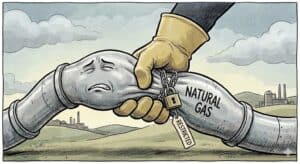 We’ve recently begun actively tracking flow restrictions on pipelines that carry Marcellus/Utica molecules. Current pipeline flow data for February 2026 show that the Marcellus/Utica (M-U) region is experiencing significant, albeit weather-driven, volatility. While the basin remains a production powerhouse, a combination of recent Arctic weather and localized maintenance has triggered several flow restrictions, including a restriction along the Tennessee Gas Pipeline.
  In January, a coalition of so-called environmental groups lodged an ethics complaint against Ohio Senator Brian Chavez, alleging that he failed to disclose ownership in five natural gas LLCs while leading the Senate Energy Committee (see
  We stumbled across a mention of a lawsuit (Kriley v. XTO Energy) that we previously were not aware of—a lawsuit that had its beginning back in 2019 and involves seven landowners in Butler County, PA. The landowners claim that XTO Energy (a subsidiary of ExxonMobil) systematically underpaid natural gas royalties. Over the past six years, the lawsuit has evolved and was certified as a class action in late 2025, meaning it has expanded from affecting seven landowners to potentially hundreds. XTO, in its latest court filing, is attempting to limit the class action.