
Georgia Power Receives 2nd of 3 Gas Turbines at Chattahoochee Plant
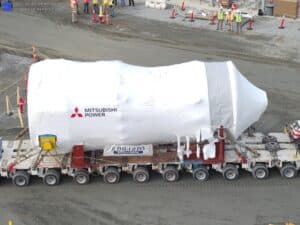
We’re always looking for an excuse to use an Alan Jackson song like Chattahoochee (watch the video here). In August, we told you that Georgia Power has just received the first of three giant gas-fired turbines delivered to its Plant Yates, located on approximately 2,400 acres on the east bank of the Chattahoochee River in Coweta County, Georgia, southwest of Atlanta (see Georgia Power Receives 1st of 3 Gas Turbines at Chattahoochee Plant). Yesterday, Georgia Power issued a press release to announce it had recently taken delivery of the second (of three) turbines and that the company is on track to have all three up and running in late 2027. Read More “Georgia Power Receives 2nd of 3 Gas Turbines at Chattahoochee Plant”

 OTHER U.S. REGIONS: Dominion Energy Charitable Foundation awards grants to 388 nonprofits; Blue states, high rates; New York utility says queue for large power users has tripled; NATIONAL: U.S. natural gas futures extend losing streak; U.S. oil slides to four year low; Tokyo Gas to invest in U.S. downstream assets; Nearly 1,400 natural gas stations to power clean transport growth in 2026; INTERNATIONAL: Baker Hughes, Hunt announce joint framework for redevelopment of mature O&G fields; USA emerges as world’s hydrocarbon superpower.
  Ascent Resources, formerly American Energy Partners, is a privately held company focused 100% on the Ohio Utica Shale. Ascent, headquartered in Oklahoma City, OK, is Ohio’s largest natural gas producer and the 8th largest natural gas producer in the U.S. The largest shareholder in the privately owned company is the private equity firm Energy & Minerals Group (EMG), with an “over 30% stake.” EMG wants to sell that stake in one of its portfolio companies to another EMG company. Another (smaller) investor, the Abu Dhabi Investment Council, sued to block the transfer, alleging a “conflicted sale” that will short-change existing investors (see
  The Marcellus/Utica rig count gained a rig last week in the Ohio Utica. The combined count hit 39 total rigs, the most it has operated in more than a year. That’s great news! It means drilling is picking up in the M-U. Pennsylvania has held at 18 active rigs for four consecutive weeks. Ohio picked up one and now operates 14 rigs. Before last week, Ohio had held the same number of rigs at 13 since September 26. West Virginia maintained its 7 rigs, which it has operated since May 30. There were 24 rigs targeting the Marcellus and 15 targeting the Utica, for a combined 39 rigs in the M-U.
  Eastern Gas Transmission and Storage (EGTS), a wholly owned subsidiary of Berkshire Hathaway Energy Company (Warren Buffett’s company), filed a new project with the Federal Energy Regulatory Commission (FERC) in July (see
  Earlier this year, Houston-based EOG Resources acquired Encino Acquisition Partners for $5.6 billion, establishing the Utica Shale as a “third foundational play” alongside its Permian and Eagle Ford assets (see
  Earlier this year, the Federal Energy Regulatory Commission (FERC) and PJM Interconnection, the country’s largest electric grid operator (covering PA, WV, and OH, among other states), began to grapple with the issue of co-locating power plants with data centers (see
  Last week, the U.S. House of Representatives passed two bills that will make it easier to build natural gas pipelines in the northeast and elsewhere. The House passed H.R. 3898, the Promoting Efficient Review for Modern Infrastructure Today (PERMIT) Act, making it more difficult for states to reject pipeline and related projects based on the Clean Water Act. No more cases of New York and other states blocking federally-approved pipelines from getting built for years on end. The House also passed H.R. 3668, the Improving Interagency Coordination for Pipeline Reviews Act, which designates the Federal Energy Regulatory Commission (FERC) as the lead agency in the interstate pipeline approval process. No more interference from the EPA, BLM, and other federal agencies attempting to stifle pipeline projects.
  The European Union is simplifying compliance with its methane emissions law for oil and gas imports, a decision expected to aid U.S. exporters following pressure from the Trump administration. Recognizing that the commingled nature of U.S. liquefied natural gas (LNG) makes tracing difficult, the European Commission proposed two streamlined reporting options: utilizing third-party verification certificates or a digital “trace and claim” system. While the core regulation remains intact with stricter standards scheduled for 2027, these adjustments aim to prevent supply disruptions by offering more flexible monitoring solutions for the fragmented U.S. energy industry. To which we say, tell Europe to bugger off.
  After a pathetic showing two weeks ago (just 8 permits), last week was a barnstormer—the most permits we’ve seen issued in a single week since we’ve been chronicling permits here on MDN. But, there’s a catch. Last week’s report for the combined three states shows 60 (!) permits issued, with 22 going to Pennsylvania, 24 to Ohio, and 14 to West Virginia. However, Ohio’s numbers are inflated because the Ohio Department of Natural Resources (ODNR) reported numbers last week that stretch back three weeks in time. You may recall Ohio didn’t issue permits for two weeks in a row. They actually issued permits but didn’t report them. So, this report includes 6 permits for the two missing weeks. Still, removing six from the total means 54 permits were issued last week, which remains a record high. Could the spike in the spot price for natural gas in the M-U be the reason?
  The highly functional and responsible Susquehanna River Basin Commission (SRBC), unlike its highly dysfunctional and irresponsible counterpart, the Delaware River Basin Commission (DRBC), continues to support the shale energy industry by approving water withdrawals and consumptive use for responsible and safe shale drilling. The SRBC also tells shale drillers when to stop withdrawing if low water flow (i.e., drought) conditions exist. Or when a body of water is frozen or blocked by ice. That’s what the SRBC did yesterday. The agency, via its Hydrologic Conditions Monitor, warned shale drillers that, at 58 listed locations (all in Pennsylvania), they must stop water withdrawals until streamflow reaches a specific “trigger flow” target (different for each location) or until the ice thaws.
  Tailwater Capital LLC, an energy and infrastructure private equity firm based in Dallas, Texas, yesterday announced it has closed on the acquisition of a majority interest in Central Midstream Partners, LLC (originally established as Central Crude). Central Midstream provides liquids transportation, storage, and terminal services to support demand-pull customers across the Gulf Coast and in the Utica region. We have to confess we had not heard about nor written about Central Midstream before this announcement.
  Epsilon Energy, a relatively small company, used to concentrate most of its effort on developing Marcellus Shale wells. However, over the past few years, the company has expanded into other plays and now owns assets in the Anadarko (Oklahoma), the Permian (Texas), the Powder River Basin (Wyoming), and the Western Canadian Sedimentary Basin (in Alberta, Canada). Epsilon typically does not do its own drilling. It joint venture partners with (gives money to) other companies, like Expand Energy in the Marcellus, and the other company does the drilling. Epsilon announced yesterday that it has sold its subsidiary that owned the Oklahoma assets for $2.5 million to an undisclosed private buyer.
  A month ago, MDN reported that Energy Transfer was holding off on a final investment decision (FID) for its Lake Charles LNG export project until 80% of the project had been sold to equity partners (see