
Beaver County | Bradford County | Butler County | CNX Resources | Devon Energy | Energy Companies | EQT Corp | Expand Energy | Formentera Operating | Greene County (PA) | Lycoming County | PennEnergy Resources | Pennsylvania | Range Resources Corp | Repsol | Seneca Resources | Sullivan County | Susquehanna County | Tioga County (PA) | Washington County | Wyoming County (PA) | XTO
Reading the Permit Tea Leaves: Who’s Building Where in PA Shale
 Every Saturday, the Pennsylvania Bulletin publishes pages of DEP permit notices that almost nobody reads. We read them so you don’t have to. Taken one at a time, most look routine: an erosion permit here, an air permit there. Lined up side by side, they tell you which drillers are building, and where. Last weekend’s edition (Oct. 24) shows Expand Energy busy across the Northern Tier, Repsol and Seneca/NFG working in Tioga County, Devon still building in Susquehanna County, and XTO getting a new pad ready in Butler County. Read More “Reading the Permit Tea Leaves: Who’s Building Where in PA Shale”
 The highly functional and responsible Susquehanna River Basin Commission (SRBC), unlike its dysfunctional and irresponsible counterpart, the Delaware River Basin Commission (DRBC), continues to support the shale energy industry by approving water withdrawals and consumptive use requests for responsible, safe shale drilling. The SRBC published a notice in the October 24th Pennsylvania Bulletin that the SRBC approved and/or renewed 33 general water use permits in September for individual shale gas well drilling pads in Bradford, Lycoming, McKean, Sullivan, Susquehanna, Tioga, and Wyoming counties.
 Last Thursday, Google announced it will pay a San Francisco company called Voltus to round up as much as 1,070 megawatts (MW) of electricity “capacity” on the PJM Interconnection grid, the 13-state (plus D.C.) grid that includes Pennsylvania, Ohio, and West Virginia. Google, Voltus, and nearly every news outlet covering the story call it a “virtual power plant.” Pardon us, but there is no such thing. No turbine spins. No Marcellus gas burns. What Google is actually doing is paying homes and businesses to use less electricity when the grid gets tight, so that Google’s power-hungry data centers can use more. Let’s call it what it is and quit with the euphemisms.
 OTHER U.S. REGIONS: As electric bills soar, Healey has shifted on energy policy. Now what?; Why brownfield projects have an edge in the ongoing Gulf Coast gas storage buildout; NATIONAL: U.S. natural gas futures settle above day’s lows; Much of the AI-will-kill-us-all scare is driven by a charity movement gone crazy; Permitting reform is the ultimate test of American mineral security; EPA’s carbon repeal saves billions, protects energy supplies; Alleged Russian funding prompts executive exodus at U.S. LNG firm; Expert explains why transformers pose a growing risk to the power grid; INTERNATIONAL: Oil dips from 6 month high as officials meet in Tehran; Cold blasts to pose early test for European and Asia gas markets; Canada’s natural gas producers thrive off B.C. election, but oversupply threatens their riches; IEA’s Birol does not expect energy markets to return to pre-war levels in 2027.
 Twenty-two years ago today, Range Resources’ Renz #1 well in Washington County, PA, unlocked the Marcellus Shale and kicked off the shale revolution here in the Northeast. This morning, on that very anniversary, Range agreed to sell itself to EQT Corporation in an all-stock deal that creates the largest natural gas producer in the country, period. MDN has been writing about the Marcellus/Utica since Jan. 2009, and we can’t think of a bigger piece of news to hit the region. The company that started it all is being folded into the company that turned it into an industrial powerhouse. Below we give you the deal numbers, then the best stuff from this morning’s 8 a.m. conference call with analysts—including what this means (for now) for landowners and the midstream.
 Eight weeks. Same number. The Marcellus/Utica held at 33 rigs yet again for the week ended October 23, and this time the national count joined the party, holding at 603 for a third straight week. Underneath that flat national total, oil rigs added one and gas rigs lost one. Frac spreads slipped by five, a second straight weekly drop. On the price board, the gap between oil and gas went from wide to ridiculous: WTI climbed to settle at $103.27 a barrel, while natural gas tumbled 15% for the week to roughly $2.64 per MMBtu. And new this week: MDN’s Marcellus/Utica Rigs by County, a county-by-county map in table form showing exactly where all 33 of our rigs are drilling, which will now be a regular part of this weekly update. (Spoiler: Susquehanna County is at zero.) Plus: Antero takes over the top spot on the Enverus permit list, and National Fuel Gas shows up on the rig list.
 State Sen. Gene Yaw (R-23), who has chaired the Senate Environmental Resources & Energy Committee since 2013, wants Pennsylvania’s data centers to pay their own version of the shale impact fee. On Thursday (Oct. 23), Yaw sent a co-sponsorship memo to all Senate members announcing plans for an annual, statewide “data center impact fee” modeled on Act 13 of 2012, the law that created the impact fee drillers have paid every year since. Yaw says the fee would be based on each facility’s size and electricity demand, and would be paid every year a data center operates. That’s different from today’s system, where towns rely on one-time deals negotiated with developers. The money would go to host communities and statewide programs, just like the shale fee. What’s not in the memo? Any dollar figures. Here’s the memo, followed by what it means (and what it doesn’t say).
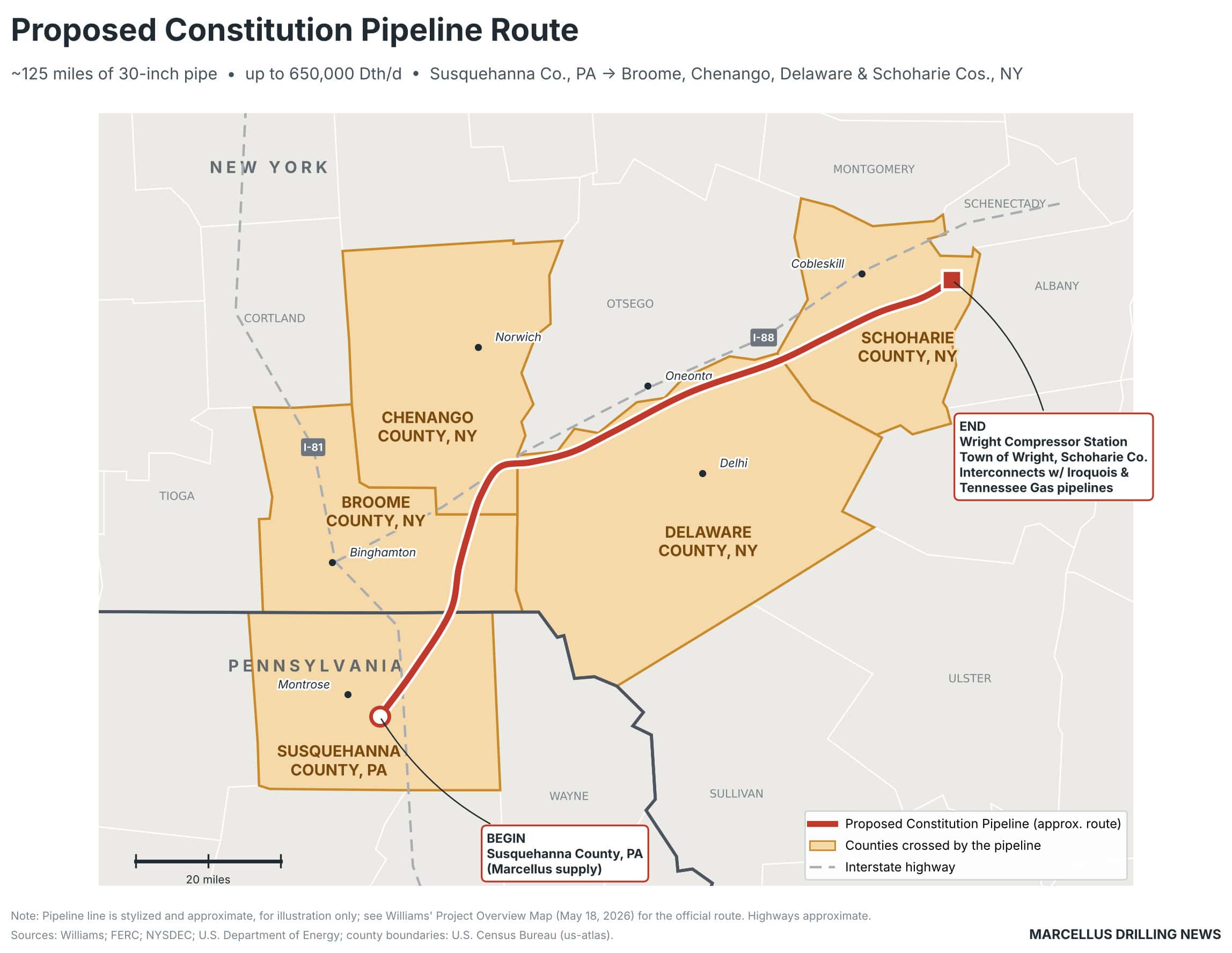
 Early last week, we told you Europe blinked on its crazy methane import rules, with the European Commission (the EU’s executive branch) proposing a one-year delay (see
 Back in April, MDN told you about Enbridge’s ~$300 million job to move the natural gas lines that hang off the Bourne and Sagamore bridges and run them under the Cape Cod Canal instead (see
 Did the ground rumble in Westmoreland County on Sunday, October 4, because of fracking? The Pennsylvania Department of Environmental Protection (DEP) asked that question, checked EQT’s nearby Porter well pad, and found nothing abnormal. EQT’s pressure logs for that day were clean, no violations were cited, and DEP asked for more paperwork. That’s good news for EQT, even if the headline you may have seen elsewhere makes it sound much more ominous.

 The Marcellus/Utica region received 12 new shale well permits last week, October 12-18, up 3 from 9 the week before. Pennsylvania issued 9 of the new permits. Ohio issued 2. And West Virginia issued a single new permit. The drillers who received new-well permits last week were: Antero Resources, Ascent Resources, Expand Energy, Range Resources, and Seneca Resources. Before we go further, a quick housekeeping note: Starting this week, MDN counts only permits for brand-new wells in the headline number. State agencies also issue renewals (more time to drill a well that was already permitted), modifications (changes to a well that was already permitted, like a new wellbore path), and in Ohio, “deepen” permits. Those wells were already counted the first time around, so counting them again would double-count. We now list them separately, in their own section below.
 Allegheny County, home to Pittsburgh, just became the first county in the nation to force private employers to pay for 12 weeks of parental leave — at up to 100% of wages, with the employer footing the entire bill. County Executive Sara Innamorato signed the regulation yesterday, two days after County Council approved it 11-4. Here’s what caught our eye (thanks to a heads-up from PIOGA): the mandate doesn’t care where your headquarters is. If you’re a driller or service company with 15 or more employees anywhere, and one of your employees works 80 hours in Allegheny County in a year, that worker is covered.