Jul-Dec 2019 Private Investment in Ohio Utica Shale: $3 Billion
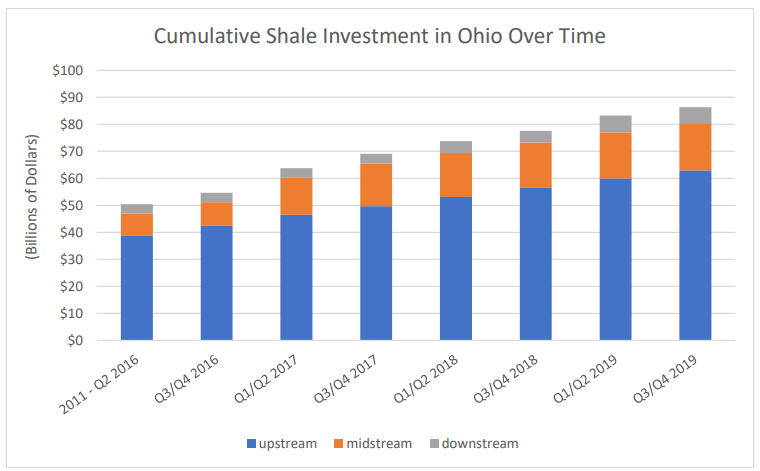
Each year Cleveland State University publishes a report for JobsOhio looking at how much money has been invested by the private sector in the Utica Shale (and related) industry. The CSU’s eighth report (full copy below) was recently released and shows some eye-popping numbers. Total shale investment from July through December 2019 in Ohio was approximately $3.06 billion, including upstream, midstream, and downstream. Cumulative shale oil and gas investment in Ohio through the end of 2019 is estimated to be $86.4 billion! It’s hard to wrap your head around that kind of money and its impact on the Ohio economy.
Read More “Jul-Dec 2019 Private Investment in Ohio Utica Shale: $3 Billion”
 Two years ago the Maryland Board of Public Works (BPW), which has three members (two leftwing Democrats and RINO Gov. Larry Hogan), rejected an 8-inch, 3.5-mile pipeline (tiny!) that would travel under the Potomac River, even though 12 other pipelines have previously been built under the Potomac in the same general vicinity (see
  Yesterday Hart Energy held its annual (always excellent) DUG (Developing Unconventional Gas) East event. Normally the event is held at the Convention Center in Pittsburgh. This year it was an all-virtual event. Among the speakers were CNX CEO Nick Deluliis, PennEnergy Resources CEO Rich Weber, and Ascent Resources CEO Jeff Fisher. While it’s not all blue skies and sunshine ahead, all three CEOs painted a picture of 2021 that’s better than 2020.
 Each year East Daley Capital publishes its Midstream Guidance Outlook which looks at themes and trends affecting the midstream (pipeline) sector in the coming year. The latest version of Daley’s report has just been released and draws some interesting conclusions about the midstream in 2021. Namely, associated gas growth in the Permian and elsewhere will go down and result in rising gas demand from the Marcellus/Utica and Haynesville gas plays. The big winners will be M-U pipeline companies, including Williams, Antero Midstream, and Equitrans (EQT Midstream).
 MARCELLUS/UTICA REGION: Planning Commission approves natural gas development project; NATIONAL: Biden’s plan to create millions of energy jobs might work, but…; China can literally pull the plug on US high tech manufacturing and defense applications; Wheeler warns of rules by a ‘future administration’; The oil industry narrowly avoided an election disaster…now it’s showing signs of life; Teaching climate crisis in classrooms critical for children, top educators say.
 Ascent Resources has listed for sale two “packages” of its assets in the core of the Utica Shale in Ohio. One package contains a non-operated interest in 68 wells and 1,362 net leasehold acres. The second package includes a royalty interest in 10 wells and 106 net revenue interest acres. Details on where the assets are located (which counties) and other details are in the listing below.
 Last week Pennsylvania issued 12 new shale well drilling permits with a mix of permits issued in both the southwest (wet gas) and northeast (dry gas) regions of the state. Ohio issued 7 new permits, all of them except one in the same county (Jefferson). West Virginia was a goose egg–no new permits issued last week.
 On Monday MDN brought you the exciting news that Enbridge’s Weymouth compressor station project, the final piece of the $452 million Atlantic Bridge expansion project, has received permission from the federal Pipeline and Hazardous Materials Safety Administration (PHMSA) to begin operations “in early December” (see
 In January 2019, Aquidneck Island (part of Rhode Island) ran out of natural gas and left thousands without heat on the island for days during a frigid cold snap. Concerned that it would happen again, in November 2019 the Rhode Island Energy Facility Siting Board waived a licensing requirement to allow a “temporary” LNG storage facility in Portsmouth (see
  “He who controls the language controls the masses.” (Saul Alinsky) What’s the best way to mass-brainwash and influence the public against something? Change the language about the issue. Saul Alinsky in his “Rules for Radicals” knew this. Hillary Clinton, Barack Obama, and other prominent leftists are disciples of the socialist Alinsky. Researchers at the once-great Yale University are Alinskyites too. Yale researchers recently conducted a poll of people’s attitudes toward the words “methane” and “natural gas” and found folks are much more favorable to the latter, viewing methane far more negatively. Conclusion: Force society to call it “methane” so the left can once-and-for-all destroy the “clean” reputation of natural gas and (hopefully) end all use of it.
 If there’s a bad cold snap in New England this winter forcing residents to use more natural gas (leaving less natgas for power plants), blackouts may occur. That’s the prediction from the North American Electric Reliability Corporation (NERC) in their just published 2020-2021 Winter Reliability Assessment (full copy below). If blackouts do occur, the residents of New England can thank Gov. Cuomo and their own politicians, like Massachusetts Attorney General Maura Healey, for blocking natural gas pipeline projects to the region.
 Diversified Gas & Oil (DGO) is a fascinating company (