
Manufacturers Ask DOE Sec. Wright to Suspend Spot LNG Exports
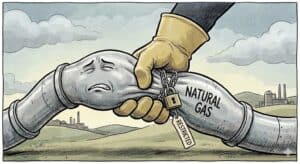
 Industrial Energy Consumers of America (IECA), a trade group representing some of the largest energy consumers in the U.S. (i.e., manufacturers), on Wednesday sent a letter to Energy Secretary Chris Wright urging the immediate suspension of spot LNG exports to reduce natural gas and electricity prices and ensure reliability. This raises many questions, such as how much of our LNG exports are spot/cash and how much are under long-term contracts. Would suspending spot LNG exports be beneficial for consumers? Is this anti-free market? Read More “Manufacturers Ask DOE Sec. Wright to Suspend Spot LNG Exports”
 In December, representatives from Chesapeake Utilities and BHE GT&S, a subsidiary of Berkshire Hathaway Energy, presented a proposal to the Port Canaveral Authority to construct a new liquid natural gas (LNG) liquefaction facility in Brevard County, FL (see
  MARCELLUS/UTICA REGION: Meeting set to air concerns about proposed Homer City power plant and data center; OTHER U.S. REGIONS: Petroleum electricity generation surpassed natural gas in New England during winter storm; New England’s clean energy connect provided little power during the storm; New England would save billions by replacing mandated renewables with nukes and natgas; Poll finds New England women feel misled about climate policies; Galveston LNG Bunker Port teams up with TOTE to build Jones Act bunker fleet; N.J. Gov. Mikie Sherrill issues state of emergency on energy costs; It’s a new heyday for gas thanks to data centers; NATIONAL: USA crude oil stocks drop week on week; Real environmental crisis is not climate change; House Judiciary Committee escalates climate litigation probe; Prediction of liquid accumulation in a shale gas pipeline; INTERNATIONAL: Brent settles above $70 as Iran tensions rise; Guardian questions plastic science, sparking activist feud; France’s Rhone gas pipeline expects full restart later this year.
  Here’s an unusual turn of events. During the recent cold snap and winter storm, the Cove Point LNG export facility (in Maryland) and Elba Island (in Georgia) stopped exporting LNG and instead *imported* LNG—from Trinidad and Tobago. They aren’t the only ones. The Everett LNG import facility off the coast of Boston and Canaport in New Brunswick, Canada, also imported Trinidad LNG cargoes. What the heck is going on here? We’ll explain.
  Reverting back to true form by obsequiously bowing to environmental extremists, New York Governor Kathy Hochul ordered her lapdogs at the state Department of Environmental Conservation (DEC) to log an objection with the Federal Energy Regulatory Commission (FERC) to a request by Williams to resurrect the Constitution Pipeline project. Even though Hochul bartered a deal with President Trump to allow this pipeline (see
  Baker Hughes has signed a multi-year agreement with Expand Energy, North America’s largest natural gas producer, to deploy its Leucipa™ AI-powered production solution across thousands of U.S. wells. This collaboration focuses on optimizing operations in the Marcellus, Utica, and Haynesville shales using data-driven insights and “Lucy,” a generative AI production assistant. Leucipa will make Expand’s operations more efficient and reliable by streamlining field decision-making and forecasting. AI comes to the shale fields of the Marcellus/Utica!
  A pretty unique situation is happening with the price of natural gas, both the NYMEX futures price and the spot (cash) price. Yesterday was the last day for the NYMEX February contract as the “front month.” The price, already high, rose further, adding 50.6 cents from the previous day to close at $7.46 per million British thermal units (MMBtu). It is the highest settlement value since Wednesday, Sept. 21, 2022. However, yesterday the physical spot (cash) price for natural gas crashed back down to earth. The benchmark Henry Hub lost about 75% of its value yesterday. Today, the March NYMEX contract becomes the “front month.” As of this morning, the March contract is trading around $3.80/MMBtu. The reason the NYMEX soared again yesterday was a short squeeze.
 Oilfield services giant Baker Hughes (BKR), a company with its fingers in many different energy pies (not just OFS) and operations in over 120 countries worldwide, issued its fourth-quarter 2025 update last week. We scoured the update, the conference call, and the latest slide deck. The company did not explicitly mention the Marcellus or Utica shale regions. However, several items from the update directly impact the outlook for the M-U region.
  Winter Storm Fern triggered a sharp decline in U.S. LNG feedgas demand, which plummeted to 11.5 Bcf/d on Sunday from a previous weekly average of 17.2 Bcf/d. The storm caused production freeze-offs and price spikes, forcing Elba Island to shut down, and Cove Point inflows fell below 0.2 Bcf/d. Sabine Pass and Freeport (along the Gulf Coast) were down 50% and 30%, respectively.
  Last weekend, EQT CEO Toby Rice showcased the shale gas industry’s resilience during a major winter storm, taking to social media to highlight field efforts to maintain natural gas production at a well pad in Washington County. Despite record price spikes and the looming threat of “freeze-offs,” major producers like EQT, Range Resources, and CNX currently report stable operations. With natural gas fueling 40% of the PJM grid, maintaining pipeline pressure is critical to preventing regional power outages. Industry leaders emphasize that proactive winterization and dedicated crews are essential to ensuring energy security and keeping furnaces running during extreme cold.
  In 2025, the Pennsylvania Department of Environmental Protection (DEP) achieved “historic success” by eliminating a longstanding permit backlog of over 2,400 applications. The DEP acted on more than 40,000 permits and conducted 116,364 inspections to ensure environmental safety. Key initiatives included the launch of the Streamlining Permits for Economic Expansion and Development (SPEED) program. The DEP is celebrating its success by creating a brand new bureaucracy: the Bureau of Permitting Coordination. Kind of a bureau of coordinating bureaus. (You know, the word bureaucracy comes from bureau, meaning a government department, and cracy, meaning rule. Literally, to be ruled by government bureaucrats who are not elected.)
  In an op-ed appearing in the Jamestown Post-Journal, New York State Senator George Borrello argues that New York’s energy crisis, marked by potential blackouts and high costs, stems from the politically motivated closure of facilities like the Dunkirk NRG plant. Initially promised a natural gas conversion, the plant was shuttered, forcing the state to import power and damaging the local economy. Borrello contends that while nuclear energy is a viable long-term goal, the state must immediately embrace natural gas to restore energy independence. He urges Governor Hochul to bypass radical interests and reopen the Dunkirk plant to provide reliable, affordable power and vital tax relief for Chautauqua County.
  To manage a historic surge in electricity demand caused by an arctic chill, PJM Interconnection has issued maximum generation alerts across 13 states. The regional grid operator anticipates record-breaking winter peaks, prompting calls for deferred maintenance and the potential deployment of backup power from data centers. While utilities in Western Pennsylvania, such as FirstEnergy and Duquesne Light, report stable operations, PJM is preparing industrial customers for demand response programs to reduce usage. In response, U.S. Steel has already increased internal power generation to reduce grid strain. These proactive steps aim to ensure regional reliability amid persistent extreme temperatures throughout the week.
  We simply could not believe this when we read it. We had to re-read it several times to be sure our eyes weren’t lying. Massachusetts Governor Maura Healey is responsible for blocking new natural gas pipelines from entering her state, as she previously bragged but then denied (see